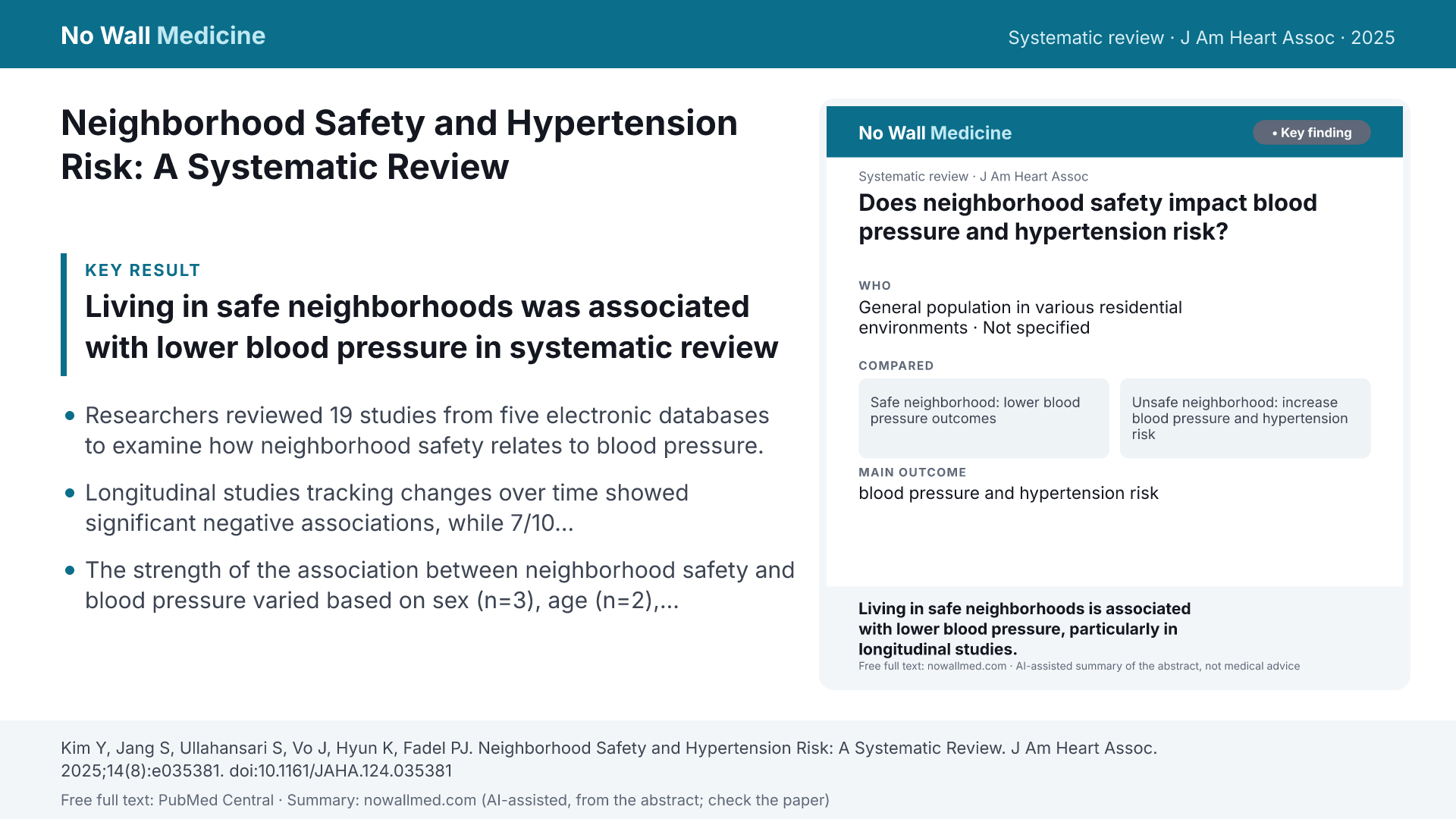
Living in safe neighborhoods was associated with lower blood pressure in systematic review
Neighborhood Safety and Hypertension Risk: A Systematic Review
Systematic reviewBenefit found
Does neighborhood safety impact blood pressure and hypertension risk?
Who
General population in various residential environments · Not specified
Compared
Safe neighborhood: lower blood pressure outcomes
Unsafe neighborhood: increase blood pressure and hypertension risk
Main outcome
blood pressure and hypertension risk
Bottom line: Living in safe neighborhoods is associated with lower blood pressure, particularly in longitudinal studies.
J Am Heart Assoc · 2025-04-03Download image
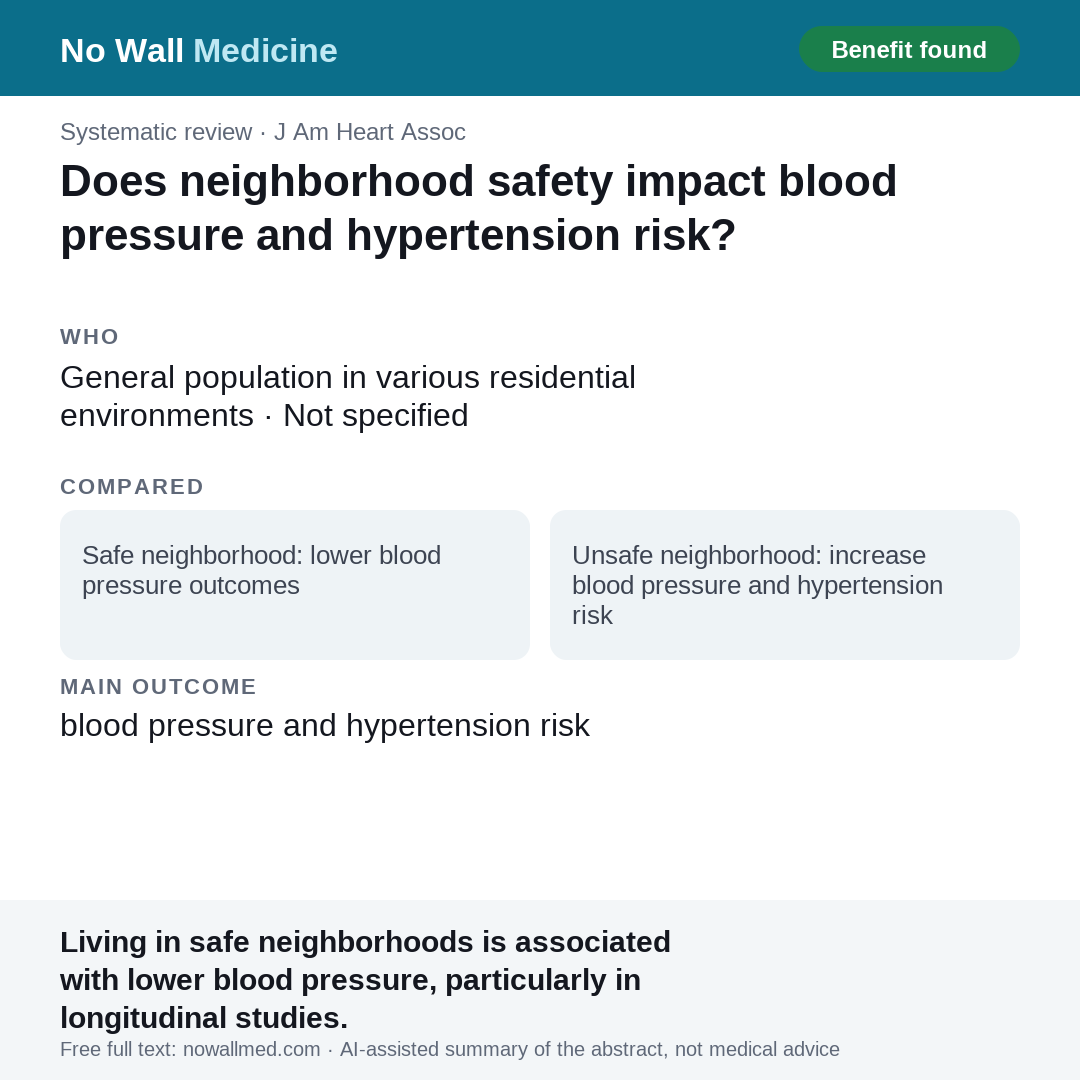
Clinical question: Does neighborhood safety impact blood pressure and hypertension risk?
Why it matters: It was unclear how neighborhood safety impacts blood pressure and what specific mechanisms or demographic factors influence this relationship.
Key points
- Researchers reviewed 19 studies from five electronic databases to examine how neighborhood safety relates to blood pressure.
- Longitudinal studies tracking changes over time showed significant negative associations, while 7/10 cross-sectional studies showed no statistically significant results.
- The strength of the association between neighborhood safety and blood pressure varied based on sex (n=3), age (n=2), and neighborhood characteristics (n=4).
Headline and key points written with AI from the paper’s abstract, with every number checked against it. Read the paper before relying on them.
Was this summary helpful?
Subject terms
Cite this article
Kim Y, Jang S, Ullahansari S, Vo J, Hyun K, Fadel PJ. Neighborhood Safety and Hypertension Risk: A Systematic Review. J Am Heart Assoc. 2025. doi:10.1161/JAHA.124.035381
Spotted a mistake? Suggest a correction