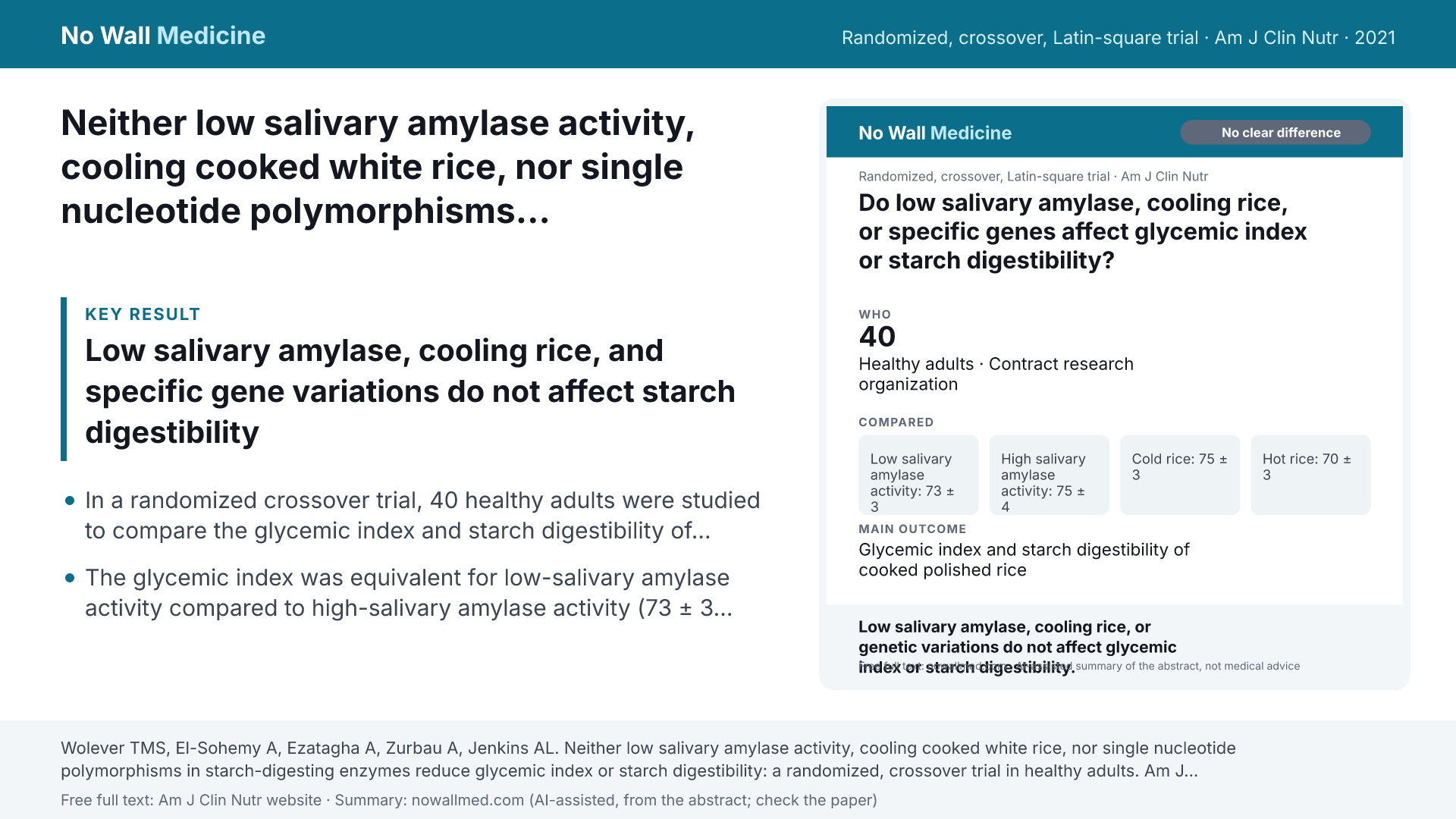
Low salivary amylase, cooling rice, and specific gene variations do not affect starch digestibility
Neither low salivary amylase activity, cooling cooked white rice, nor single nucleotide polymorphisms in starch-digesting enzymes reduce glycemic index or starch digestibility: a randomized, crossover trial in healthy adults
Randomized, crossover, Latin-square trialNo clear difference
Do low salivary amylase, cooling rice, or specific genes affect glycemic index or starch digestibility?
Who
40
Healthy adults · Contract research organization
Compared
Low salivary amylase activity: 73 ± 3
High salivary amylase activity: 75 ± 4
Cold rice: 75 ± 3
Hot rice: 70 ± 3
Main outcome
Glycemic index and starch digestibility of cooked polished rice
Bottom line: Low salivary amylase, cooling rice, or genetic variations do not affect glycemic index or starch digestibility.
Am J Clin Nutr · 2021-07-23Download image
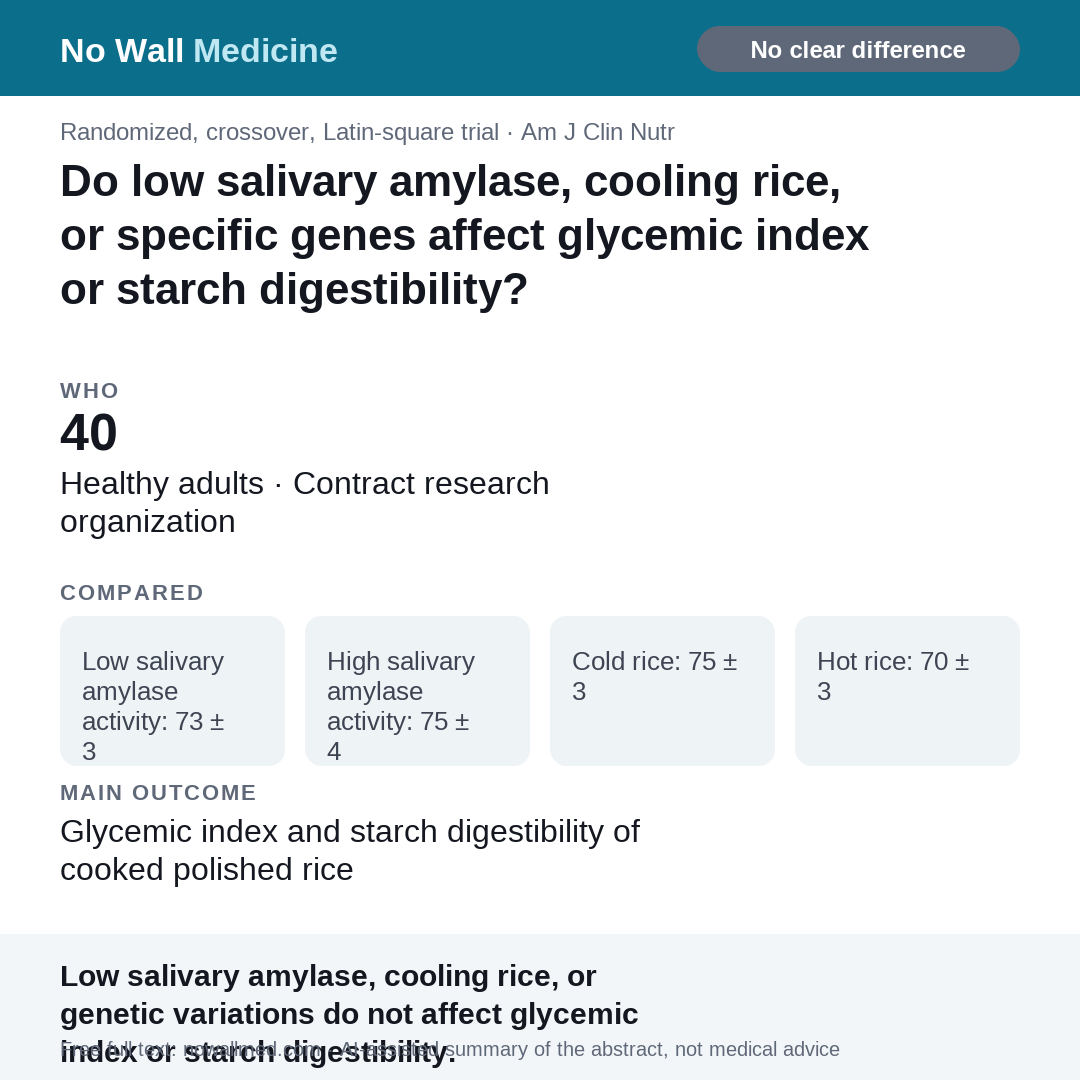
Clinical question: Do low salivary amylase, cooling rice, or specific genes affect glycemic index or starch digestibility?
Why it matters: It was suggested that low salivary amylase activity and cooling or stir-frying cooked starch decreases its digestibility and glycemic index.
Key points
- In a randomized crossover trial, 40 healthy adults were studied to compare the glycemic index and starch digestibility of hot versus cold rice and low versus high salivary amylase activity.
- The glycemic index was equivalent for low-salivary amylase activity compared to high-salivary amylase activity (73 ± 3 vs. 75 ± 4) and for cold rice compared to hot rice (75 ± 3 vs. 70 ± 3).
- Starch digestibility was equivalent for low-salivary amylase activity compared to high-salivary amylase activity (95% ± 1% vs. 92% ± 1%) and for hot rice compared to cold rice (94% ± 1% vs. 93% ± 1%).
Headline and key points written with AI from the paper’s abstract, with every number checked against it. Read the paper before relying on them.
Was this summary helpful?
Subject terms
Headline, design, result, key points, caveat and citation as plain text.
Cite this article
Wolever TMS, El-Sohemy A, Ezatagha A, Zurbau A, Jenkins AL. Neither low salivary amylase activity, cooling cooked white rice, nor single nucleotide polymorphisms in starch-digesting enzymes reduce glycemic index or starch digestibility: a randomized, crossover trial in healthy adults. Am J Clin Nutr. 2021. doi:10.1093/ajcn/nqab228
Spotted a mistake? Suggest a correction