Neoadjuvant-Adjuvant vs Neoadjuvant-Only PD-1 and PD-L1 Inhibitors for Patients With Resectable NSCLC: An Indirect Meta-Analysis
Indirect meta-analysisNo clear difference
Does adding adjuvant immunotherapy to neoadjuvant immunotherapy improve outcomes in resectable non-small cell lung cancer?
Who
2385
Patients with resectable non-small cell lung cancer
Compared
Neoadjuvant-adjuvant immunotherapy
Neoadjuvant-only immunotherapy
Main outcome
event-free survival
Result: hazard ratio 0.90 (95% CI, 0.63-1.30)
Bottom line: Adding adjuvant immunotherapy to neoadjuvant immunotherapy may not improve survival and may increase treatment-related adverse events.
Limitation: Future validation is warranted through head-to-head randomized clinical trials.
JAMA Netw Open · 2024-03-04Download image
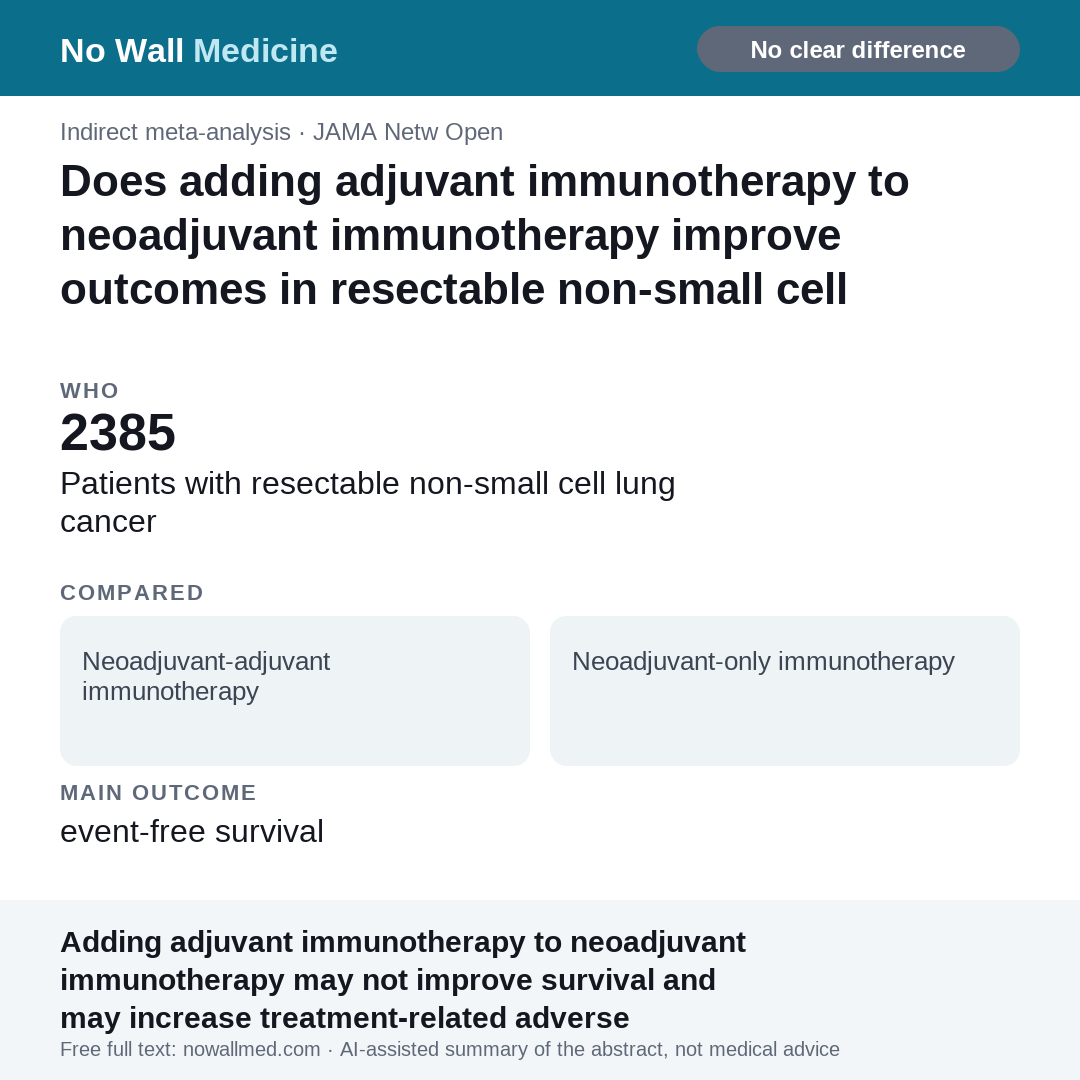
Clinical question: Does adding adjuvant immunotherapy to neoadjuvant immunotherapy improve outcomes in resectable non-small cell lung cancer?
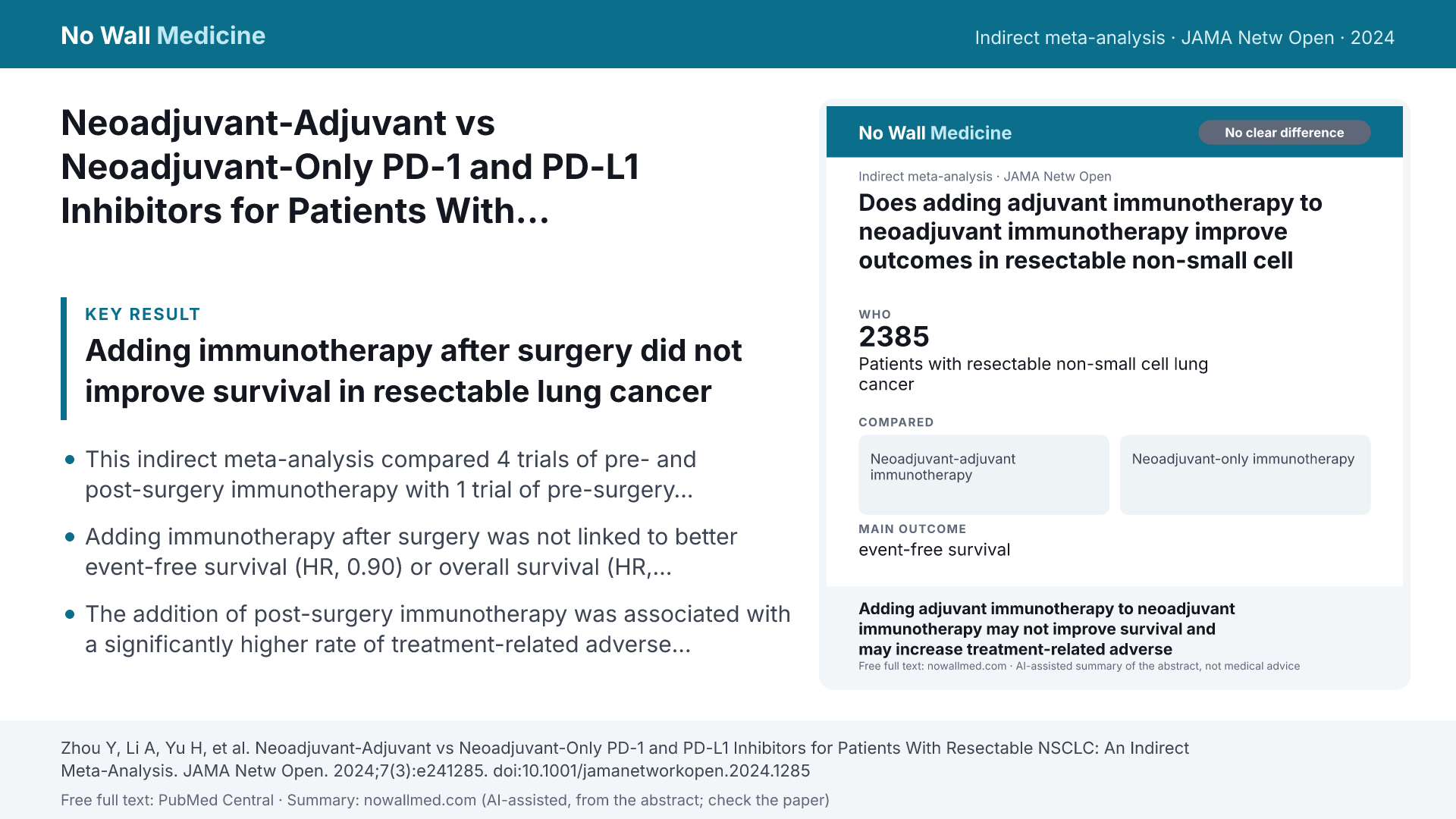
Abstract
Importance
Neoadjuvant therapy combining programmed cell death 1 (PD-1) and programmed death ligand 1 (PD-L1) inhibitors with platinum-based chemotherapy has demonstrated significant improvement in pathologic response and survival rates among patients with resectable non-small cell lung cancer (NSCLC). However, it remains controversial whether PD-1 blockade therapy given before and after surgery (neoadjuvant-adjuvant treatment) is associated with better outcomes than when given only before surgery (neoadjuvant-only treatment). Objective
To compare the efficacy and safety associated with neoadjuvant-adjuvant anti-PD-1 and anti-PD-L1 therapy with neoadjuvant-only anti-PD-1 and anti-PD-L1 therapy for patients with resectable NSCLC. Data sources
A systematic search was conducted across databases including PubMed, Embase, and the Cochrane Library, as well as major oncology conferences, through July 31, 2023. Study selection
Randomized clinical trials comparing neoadjuvant-adjuvant or neoadjuvant-only PD-1 and PD-L1 inhibitor therapy vs chemotherapy alone for patients with resectable NSCLC were selected. Data extraction and synthesis
Following the Preferred Reporting Items for Systematic Reviews and Meta-analyses (PRISMA) reporting guideline, 2 authors independently extracted data. Hazard ratios (HRs) and 95% CIs for event-free survival (EFS) and overall survival (OS) were extracted and then pooled through the generic inverse-variance methods. Relative risks (RRs) for treatment-related adverse events (TRAEs) were derived via the Mantel-Haenszel method. Using chemotherapy as a common comparator, indirect comparisons between neoadjuvant-adjuvant immunotherapy and neoadjuvant-only immunotherapy were conducted using frequentist methods. A random or fixed model was used based on intertrial heterogeneity identified through the Cochran Q test. Main outcomes and measures
The primary outcome was EFS, with secondary outcomes including OS and TRAEs. Results
The study encompassed 4 trials of neoadjuvant-adjuvant immunotherapy and 1 trial of neoadjuvant-only immunotherapy, involving 2385 patients. Direct meta-analysis revealed significant improvements in EFS for both neoadjuvant-adjuvant and neoadjuvant-only immunotherapy compared with chemotherapy alone. In indirect meta-analysis, the addition of adjuvant immunotherapy to neoadjuvant immunotherapy was not associated with improved EFS (HR, 0.90; 95% CI, 0.63-1.30; P = .59) or OS (HR, 1.18; 95% CI, 0.73-1.90; P = .51) compared with neoadjuvant-only immunotherapy. Moreover, the incidence of any grade of TRAEs significantly increased with the addition of adjuvant immunotherapy (RR, 1.08; 95% CI, 1.00-1.17; P = .04). Conclusions and relevance
This meta-analysis suggests that adding PD-1 or PD-L1 inhibitors in the adjuvant phase to neoadjuvant treatment with PD-1 or PD-L1 inhibitors and chemotherapy may not improve survival outcomes for patients with resectable NSCLC and may be associated with increased adverse events. Future validation of these findings is warranted through head-to-head randomized clinical trials.
Subject terms
Cite this article
Zhou Y, Li A, Yu H, Wang Y, Zhang X, Qiu H. Neoadjuvant-Adjuvant vs Neoadjuvant-Only PD-1 and PD-L1 Inhibitors for Patients With Resectable NSCLC: An Indirect Meta-Analysis. JAMA Netw Open. 2024. doi:10.1001/jamanetworkopen.2024.1285
Spotted a mistake? Suggest a correction
Top studies every Monday
The week’s key trials and guidelines in your specialties, plus any topics you follow. By email, free.
Get the weekly digest