Neoadjuvant treatment improves survival for borderline-resectable pancreatic cancer compared to upfront surgery
Neoadjuvant treatment versus upfront surgery in borderline resectable and resectable pancreatic ductal adenocarcinoma: meta-analysis
Meta-analysis of nine randomized trialsMixed results
Does neoadjuvant treatment improve outcomes versus upfront surgery in pancreatic cancer?
Who
1194
Patients with borderline-resectable or resectable pancreatic ductal adenocarcinoma
Compared
Neoadjuvant treatment
Upfront surgery
Main outcome
Overall survival
Result: hazard ratio 0.73 (95% c.i. 0.55 to 0.98)
Bottom line: Neoadjuvant treatment improves survival for borderline-resectable pancreatic cancer but not for resectable pancreatic cancer.
BJS Open · 2025-03-24Download image
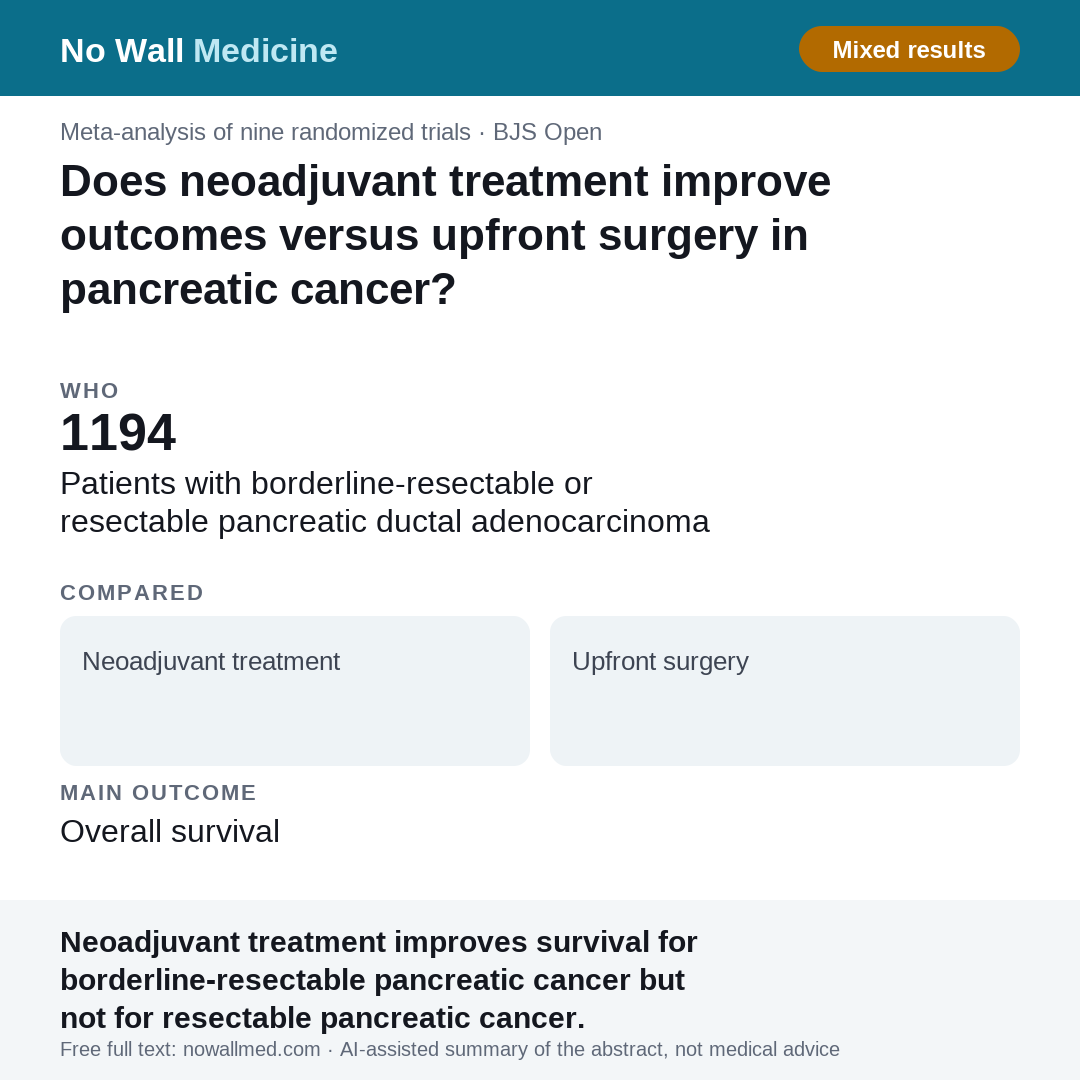
Clinical question: Does neoadjuvant treatment improve outcomes versus upfront surgery in pancreatic cancer?
Why it matters: It is unknown if neoadjuvant therapy provides better survival outcomes than immediate surgery for patients with resectable or borderline-resectable pancreatic cancer.
Key points
- Researchers analyzed nine randomized trials involving 1194 patients with resectable or borderline-resectable pancreatic cancer.
- Neoadjuvant treatment, which is therapy given before surgery, was associated with improved overall survival (HR 0.73, 95% c.i. 0.55 to 0.98) and progression-free survival (HR 0.80, 95% c.i. 0.65 to 0.99).
- Significant adverse events occurred more frequently in the neoadjuvant group (56.1% versus 27.0%) and the overall resection rate was lower (72.6% versus 80.6%).
Headline and key points written with AI from the paper’s abstract, with every number checked against it. Read the paper before relying on them.
Topics
Cite this article
Dickerson LD, Gittens J, Brunning C, Jackson R, Schmid MC, Mielgo A. Neoadjuvant treatment versus upfront surgery in borderline resectable and resectable pancreatic ductal adenocarcinoma: meta-analysis. BJS Open. 2025. doi:10.1093/bjsopen/zrae172
Spotted a mistake? Suggest a correction
Top studies every Monday
The week’s key trials and guidelines in your specialties, by email. Free.
Get the weekly digest