Antibiotic-resistant bacteria colonization rates are high in infants in low- and middle-income countries
Neonatal Colonization With Antibiotic-Resistant Pathogens in Low- and Middle-Income Countries: A Systematic Review and Meta-Analysis
Systematic review and meta-analysisMixed results
What is the prevalence of antibiotic-resistant pathogen colonization in neonates in low- and middle-income countries?
Who
17152
Neonates and infants up to 3 months of age · Low- and middle-income countries
Compared
30.2%Third-generation cephalosporin-resistant Enterobacterales
2.6%Carbapenem-resistant Enterobacterales
2.7%Methicillin-resistant Staphylococcus aureus
Main outcome
Prevalence of antibiotic-resistant pathogen colonization
Bottom line: Substantial prevalence of antibiotic-resistant pathogen colonization was found in neonates in low- and middle-income countries.
Limitation: High heterogeneity between studies limited extrapolation of results.
JAMA Netw Open · 2024-11-04Download image
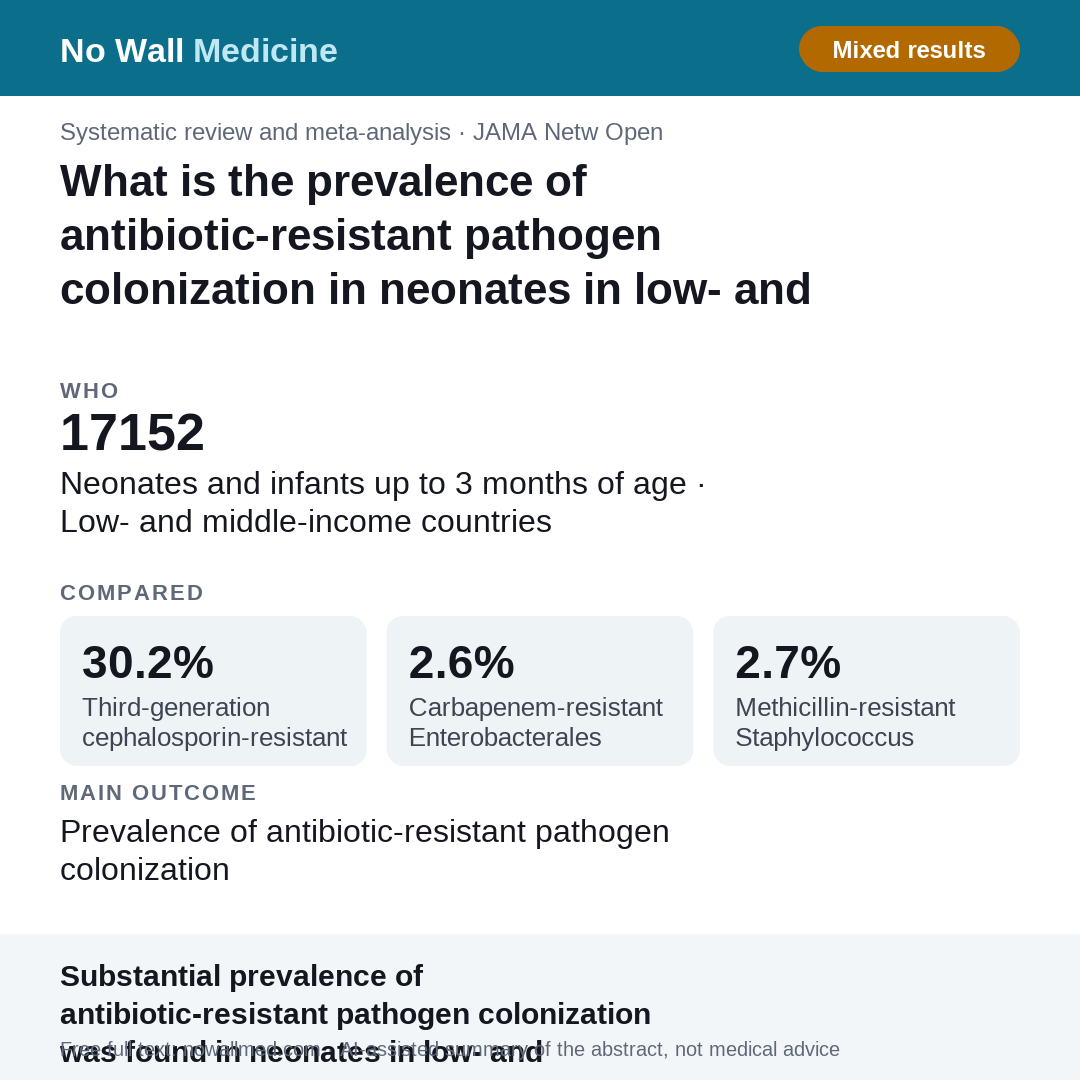
Clinical question: What is the prevalence of antibiotic-resistant pathogen colonization in neonates in low- and middle-income countries?
Why it matters: The prevalence and factors associated with antibiotic-resistant bacterial colonization in infants in low- and middle-income countries were unknown.
Key points
- Researchers analyzed 67 studies involving 17,152 infants up to 3 months old in low- and middle-income countries.
- The pooled prevalence of colonization with third-generation cephalosporin-resistant Enterobacterales was 30.2%, while carbapenem-resistant Enterobacterales was 2.6% and methicillin-resistant Staphylococcus aureus was 2.7%.
- Increased risk of third-generation cephalosporin-resistant Enterobacterales colonization was associated with hospital birth, neonatal antibiotic use, and prolonged rupture of membranes.
Limitation the authors note: High heterogeneity between studies limited extrapolation of results.
Headline and key points written with AI from the paper’s abstract, with every number checked against it. Read the paper before relying on them.
Topics
Cite this article
Beaumont AL, Kermorvant-Duchemin E, Breurec S, Huynh BT. Neonatal Colonization With Antibiotic-Resistant Pathogens in Low- and Middle-Income Countries: A Systematic Review and Meta-Analysis. JAMA Netw Open. 2024. doi:10.1001/jamanetworkopen.2024.41596
Spotted a mistake? Suggest a correction
Top studies every Monday
The week’s key trials and guidelines in your specialties, by email. Free.
Get the weekly digest