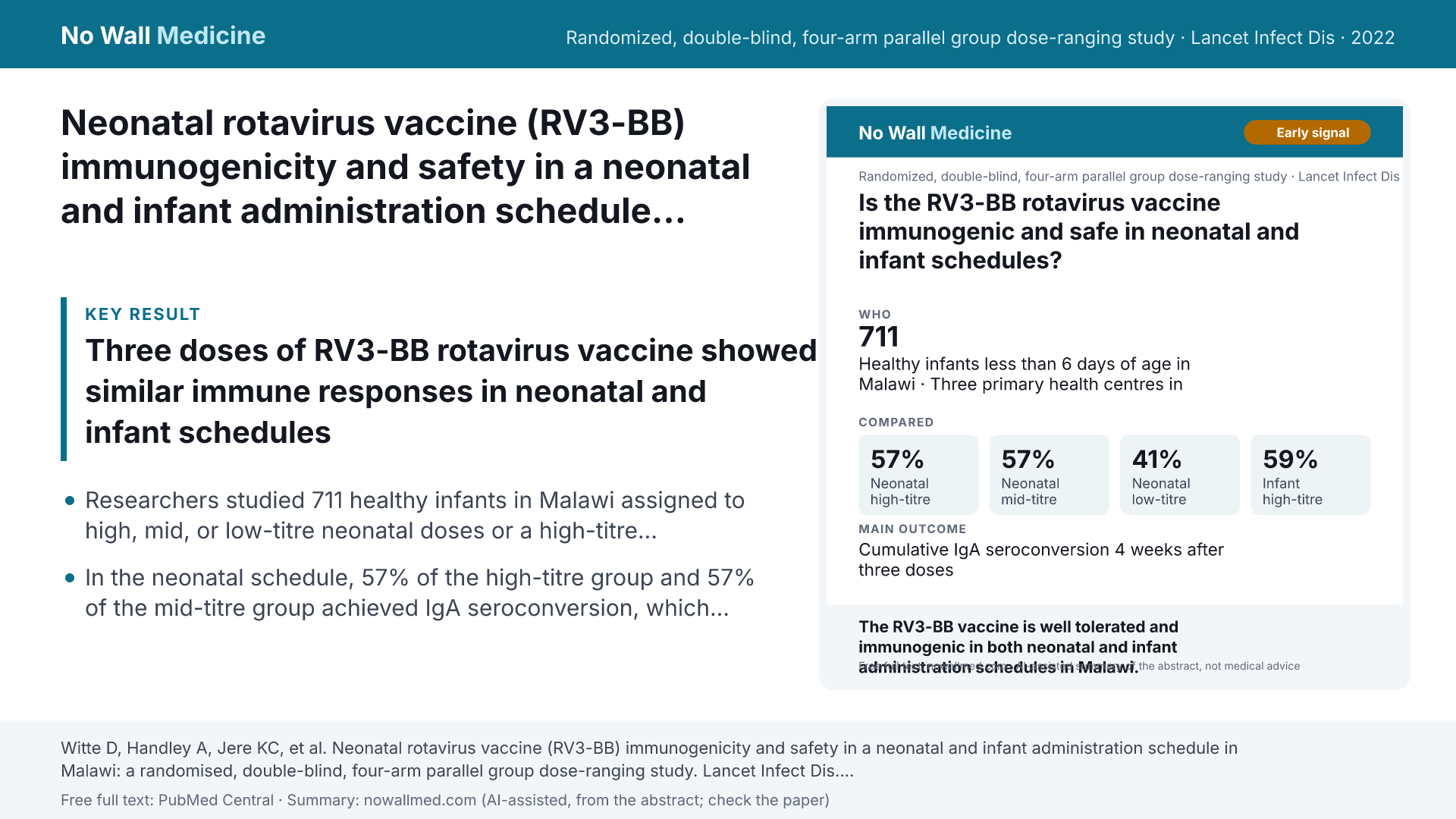
Three doses of RV3-BB rotavirus vaccine showed similar immune responses in neonatal and infant schedules
Neonatal rotavirus vaccine (RV3-BB) immunogenicity and safety in a neonatal and infant administration schedule in Malawi: a randomised, double-blind, four-arm parallel group dose-ranging study
Randomized, double-blind, four-arm parallel group dose-ranging studyEarly signal
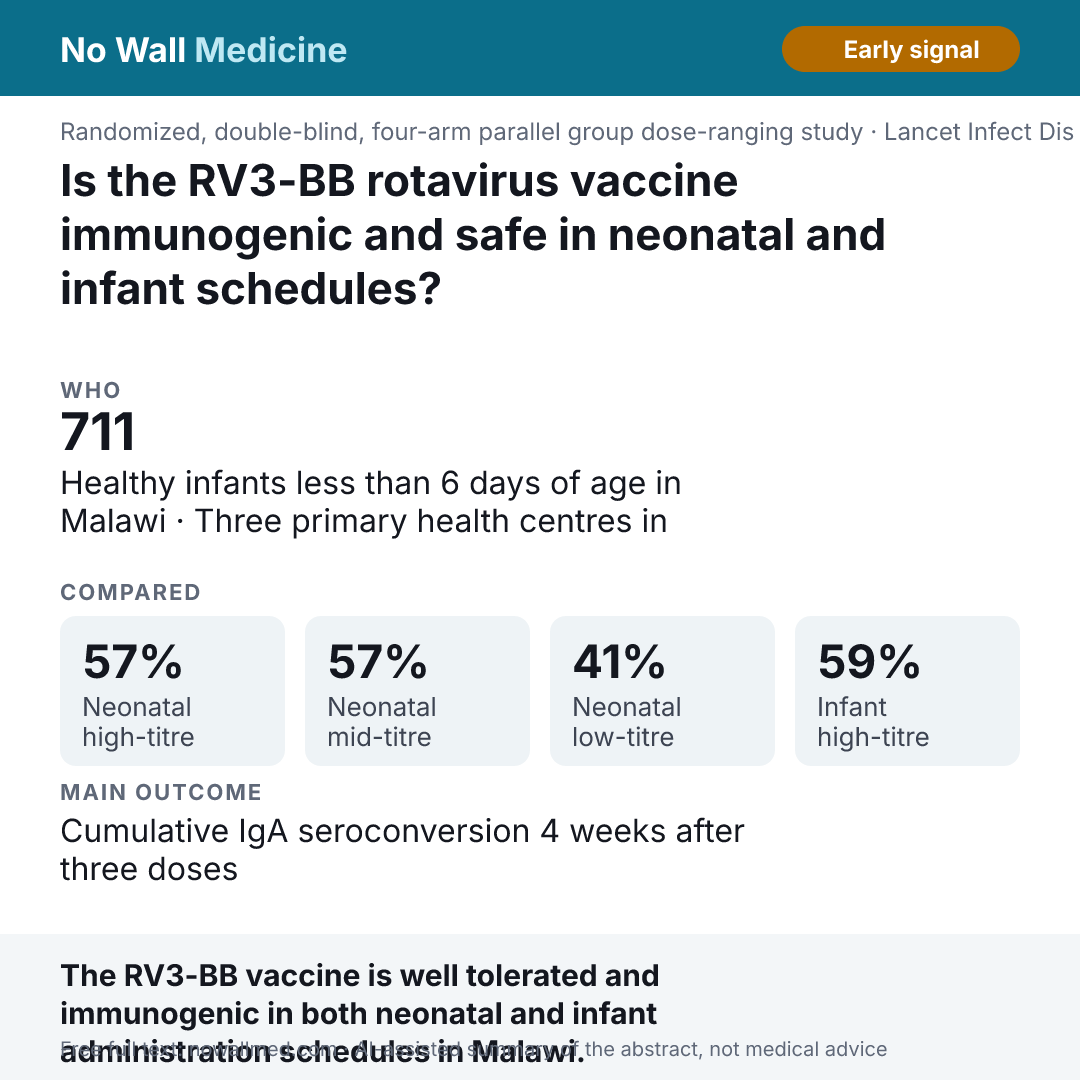
Is the RV3-BB rotavirus vaccine immunogenic and safe in neonatal and infant schedules?
Who
711
Healthy infants less than 6 days of age in Malawi · Three primary health centres in Blantyre, Malawi
Compared
57%Neonatal high-titre (79/139)
57%Neonatal mid-titre (80/141)
41%Neonatal low-titre (57/138)
59%Infant high-titre (82/139)
Main outcome
Cumulative IgA seroconversion 4 weeks after three doses
Result: difference in response rate 0·001 (95%CI -0·115 to 0·117)
Bottom line: The RV3-BB vaccine is well tolerated and immunogenic in both neonatal and infant administration schedules in Malawi.
Funded by: Bill & Melinda Gates Foundation
Lancet Infect Dis · 2022-01-20 · Save PNG
Clinical question: Is the RV3-BB rotavirus vaccine immunogenic and safe in neonatal and infant schedules?
Why it matters: The effectiveness of the RV3-BB rotavirus vaccine in African infants had not yet been evaluated.
Key points
- Researchers studied 711 healthy infants in Malawi assigned to high, mid, or low-titre neonatal doses or a high-titre infant schedule.
- In the neonatal schedule, 57% of the high-titre group and 57% of the mid-titre group achieved IgA seroconversion, which is the development of specific antibodies, 4 weeks after three doses.
- The mid-titre dose was non-inferior to the high-titre dose, and adverse events occurred in 39% of the high-titre, 40% of the mid-titre, and 41% of the low-titre groups.
Headline and key points written with AI from the paper’s abstract, with every number checked against it. Read the paper before relying on them.
Was this summary helpful?
Abstract
Background
Rotavirus vaccines reduce rotavirus-related deaths and hospitalisations but are less effective in high child mortality countries. The human RV3-BB neonatal G3P[6] rotavirus vaccine administered in a neonatal schedule was efficacious in reducing severe rotavirus gastroenteritis in Indonesia but had not yet been evaluated in African infants. Methods
We did a phase 2, randomised, double-blind, parallel group dose-ranging study of three doses of oral RV3-BB rotavirus vaccine in infants in three primary health centres in Blantyre, Malawi. Healthy infants less than 6 days of age with a birthweight 2·5 to 4·0 kg were randomly assigned (1:1:1:1) into one of four treatment groups: neonatal vaccine group, which included high-titre (1·0 × 107 focus-forming unit [FFU] per mL), mid-titre (3·0 × 106 FFU per mL), or low-titre (1·0 × 106 FFU per mL); and infant vaccine group, which included high-titre (1·0 × 107 FFU per mL) using a computer generated code (block size of four), stratified by birth (singleton vs multiple). Neonates received their three doses at 0-5 days to 10 weeks and infants at 6-14 weeks. Investigators, participant families, and laboratory staff were masked to group allocation. Anti-rotavirus IgA seroconversion and vaccine take (IgA seroconversion and stool shedding) were evaluated. Safety was assessed in all participants who received at least one dose of vaccine or placebo. The primary outcome was the cumulative IgA seroconversion 4 weeks after three doses of RV3-BB in the neonatal schedule in the high-titre, mid-titre, and low-titre groups in the per protocol population, with its 95% CI. With the high-titre group as the active control group, we did a non-inferiority analysis of the proportion of participants with IgA seroconversion in the mid-titre and low-titre groups, using a non-inferiority margin of less than 20%. This trial is registered at ClinicalTrials.gov (NCT03483116). Findings
Between Sept 17, 2018, and Jan 27, 2020, 711 participants recruited were randomly assigned into four treatment groups (neonatal schedule high titre n=178, mid titre n=179, low titre n=175, or infant schedule high titre n=179). In the neonatal schedule, cumulative IgA seroconversion 4 weeks after three doses of RV3-BB was observed in 79 (57%) of 139 participants in the high-titre group, 80 (57%) of 141 participants in the mid-titre group, and 57 (41%) of 138 participants in the low-titre group and at 18 weeks in 100 (72%) of 139 participants in the high-titre group, 96 (67%) of 143 participants in the mid-titre group, and 86 (62%) of 138 of participants in the low-titre. No difference in cumulative IgA seroconversion 4 weeks after three doses of RV3-BB was observed between high-titre and mid-titre groups in the neonatal schedule (difference in response rate 0·001 [95%CI -0·115 to 0·117]), fulfilling the criteria for non-inferiority. In the infant schedule group 82 (59%) of 139 participants had a cumulative IgA seroconversion 4 weeks after three doses of RV3-BB at 18 weeks. Cumulative vaccine take was detected in 483 (85%) of 565 participants at 18 weeks. Three doses of RV3-BB were well tolerated with no difference in adverse events among treatment groups: 67 (39%) of 170 participants had at least one adverse event in the high titre group, 68 (40%) of 172 participants had at least one adverse event in the mid titre group, and 69 (41%) of 169 participants had at least one adverse event in the low titre group. Interpretation
RV3-BB was well tolerated and immunogenic when co-administered with Expanded Programme on Immunisation vaccines in a neonatal or infant schedule. A lower titre (mid-titre) vaccine generated similar IgA seroconversion to the high-titre vaccine presenting an opportunity to enhance manufacturing capacity and reduce costs. Neonatal administration of the RV3-BB vaccine has the potential to improve protection against rotavirus disease in children in a high-child mortality country in Africa. Funding
Bill & Melinda Gates Foundation, Australian Tropical Medicine Commercialisation Grant.
Abstract reproduced under the article’s CC BY licence.
Subject terms
Headline, design, result, key points, caveat and citation as plain text.
Cite this article
Witte D, Handley A, Jere KC, et al. Neonatal rotavirus vaccine (RV3-BB) immunogenicity and safety in a neonatal and infant administration schedule in Malawi: a randomised, double-blind, four-arm parallel group dose-ranging study. Lancet Infect Dis. 2022;22(5):668-678. doi:10.1016/S1473-3099(21)00473-4
Spotted a mistake? Suggest a correction