Local blood flow patterns are the primary factor affecting valve blood clot formation
Neosinus and Valve Thrombosis After Transcatheter Aortic Valve Replacement
ReviewUnclear result
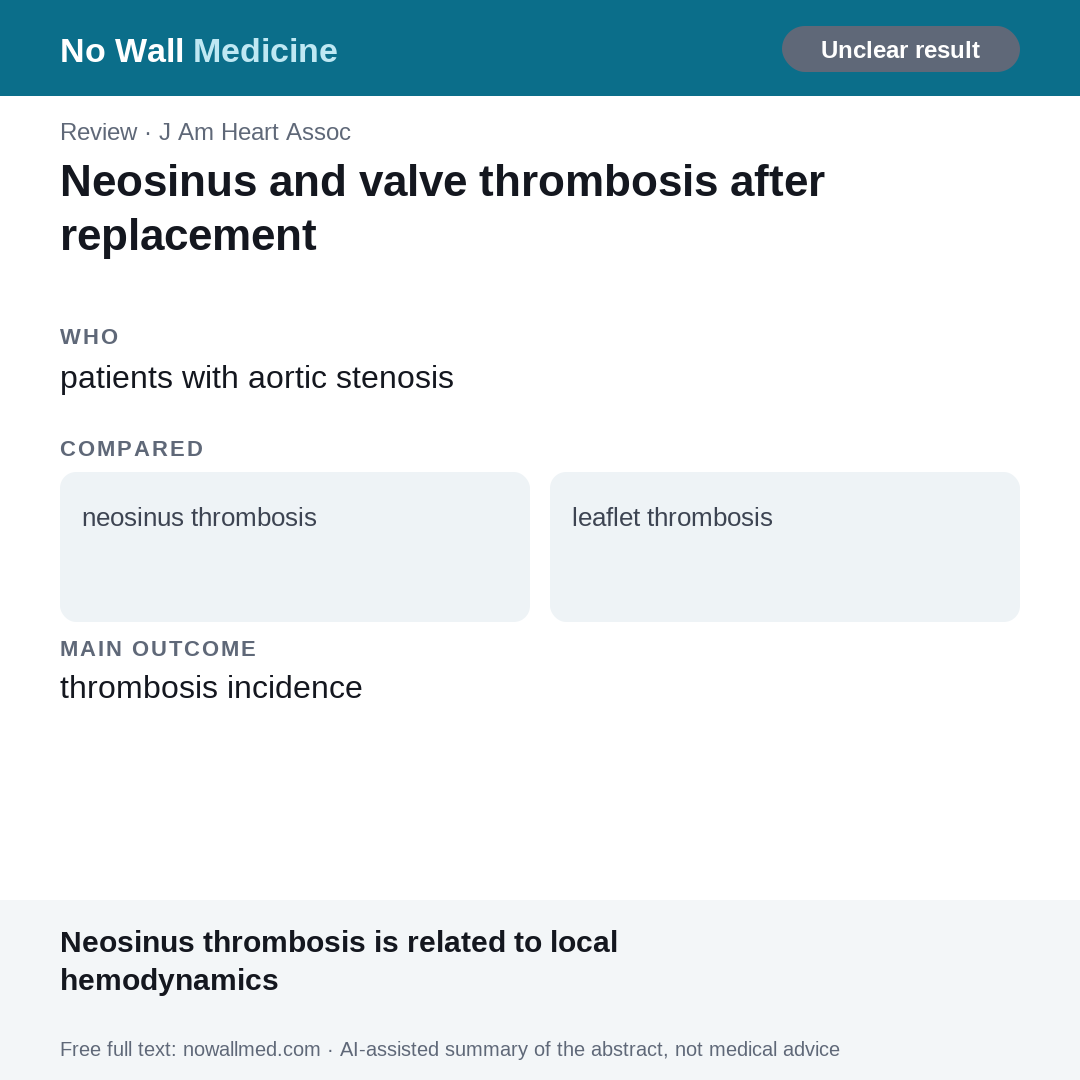
Neosinus and valve thrombosis after replacement
Who
patients with aortic stenosis
Compared
neosinus thrombosis
leaflet thrombosis
Main outcome
thrombosis incidence
Bottom line: Neosinus thrombosis is related to local hemodynamics
Limitation: lack of systematic integration
J Am Heart Assoc · 2026-04-20Download image
Why it matters: There has been a lack of systematic integration regarding how the new space formed after heart valve replacement relates to blood clot formation.
Key points
- Researchers reviewed existing evidence regarding the formation of a new space, called a neosinus, after heart valve replacement surgery.
- The review found that local hemodynamics, or the way blood flows within that new space, is the dominant and modifiable factor affecting leaflet thrombosis.
- Leaflet thrombosis is a form of valve dysfunction where blood clots form on the replacement valve leaflets.
Headline and key points written with AI from the paper’s abstract, with every number checked against it. Read the paper before relying on them.
Topics
Cite this article
Chen N, Mao Y, Zhang HP. Neosinus and Valve Thrombosis After Transcatheter Aortic Valve Replacement. J Am Heart Assoc. 2026. doi:10.1161/JAHA.125.048121
Spotted a mistake? Suggest a correction