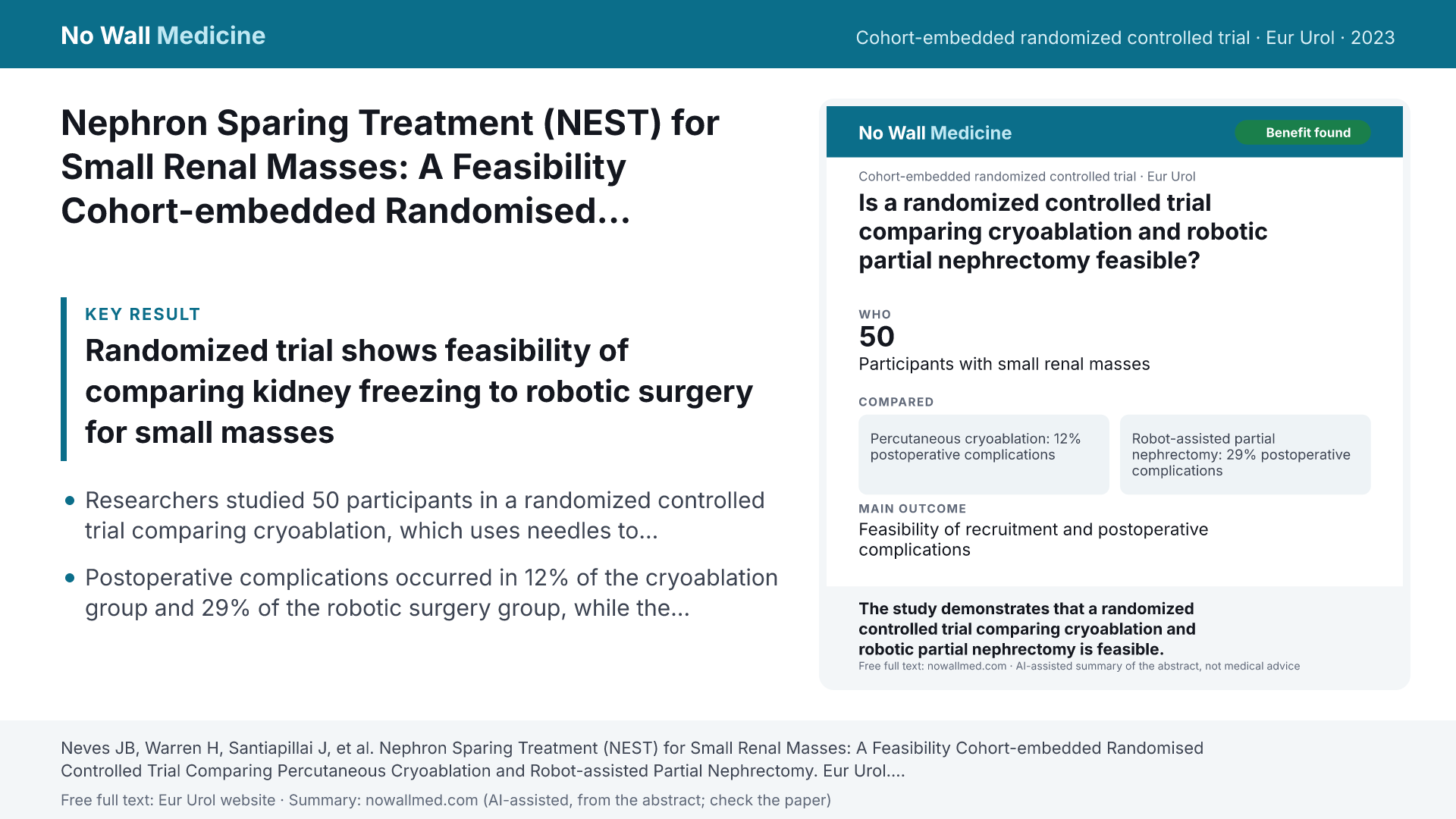
Randomized trial shows feasibility of comparing kidney freezing to robotic surgery for small masses
Nephron Sparing Treatment (NEST) for Small Renal Masses: A Feasibility Cohort-embedded Randomised Controlled Trial Comparing Percutaneous Cryoablation and Robot-assisted Partial Nephrectomy
Cohort-embedded randomized controlled trialBenefit found
Is a randomized controlled trial comparing cryoablation and robotic partial nephrectomy feasible?
Who
50
Participants with small renal masses
Compared
Percutaneous cryoablation: 12% postoperative complications
Robot-assisted partial nephrectomy: 29% postoperative complications
Main outcome
Feasibility of recruitment and postoperative complications
Bottom line: The study demonstrates that a randomized controlled trial comparing cryoablation and robotic partial nephrectomy is feasible.
Eur Urol · 2023-09-09 · Save PNG
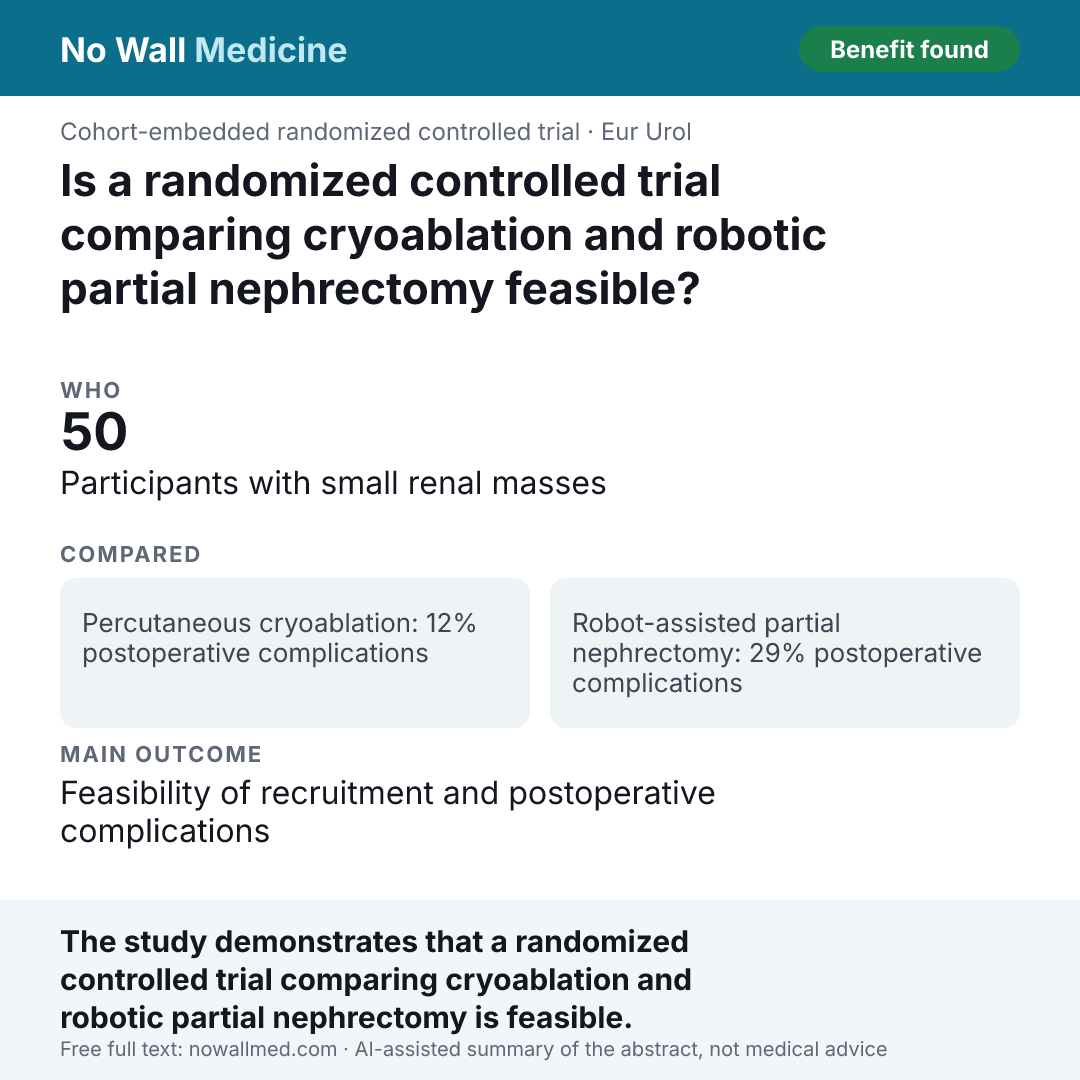
Clinical question: Is a randomized controlled trial comparing cryoablation and robotic partial nephrectomy feasible?
Why it matters: High-level evidence on managing small renal masses is lacking because previous randomized controlled trials failed to meet recruitment targets.
Key points
- Researchers studied 50 participants in a randomized controlled trial comparing cryoablation, which uses needles to freeze tumors, to robotic partial nephrectomy, which is surgery to remove part of the kidney.
- Postoperative complications occurred in 12% of the cryoablation group and 29% of the robotic surgery group, while the median hospital stay was 1 day for cryoablation versus 2 days for surgery.
- At 6 months, the mean change in renal function was -5.0 ml/min/1.73 m2 after cryoablation and -5.8 ml/min/1.73 m2 after robotic partial nephrectomy.
Headline and key points written with AI from the paper’s abstract, with every number checked against it. Read the paper before relying on them.
Was this summary helpful?
Subject terms
Headline, design, result, key points, caveat and citation as plain text.
Cite this article
Neves JB, Warren H, Santiapillai J, et al. Nephron Sparing Treatment (NEST) for Small Renal Masses: A Feasibility Cohort-embedded Randomised Controlled Trial Comparing Percutaneous Cryoablation and Robot-assisted Partial Nephrectomy. Eur Urol. 2024;85(4):333-336. doi:10.1016/j.eururo.2023.07.012
Spotted a mistake? Suggest a correction