Nerandomilast reduced risks of death and respiratory hospitalizations in progressive pulmonary fibrosis patients
Nerandomilast in progressive pulmonary fibrosis: data from the whole follow-up period of the FIBRONEER-ILD trial
Randomized trialBenefit found
Does nerandomilast reduce clinically important outcomes in progressive pulmonary fibrosis?
Who
1176
Patients with progressive pulmonary fibrosis
Compared
Placebo
Nerandomilast 9 mg
Nerandomilast 18 mg
Main outcome
Time to acute exacerbation, respiratory hospitalisation, or death
Result: hazard ratio 0.78 (95% CI 0.61-1.00) for 9 mg and 0.77 (95% CI 0.60-0.99) for 18 mg
Bottom line: Nerandomilast reduced the risk of acute exacerbation, respiratory hospitalisation, or death in patients with progressive pulmonary fibrosis.
Eur Respir J · 2026-07-09Download image
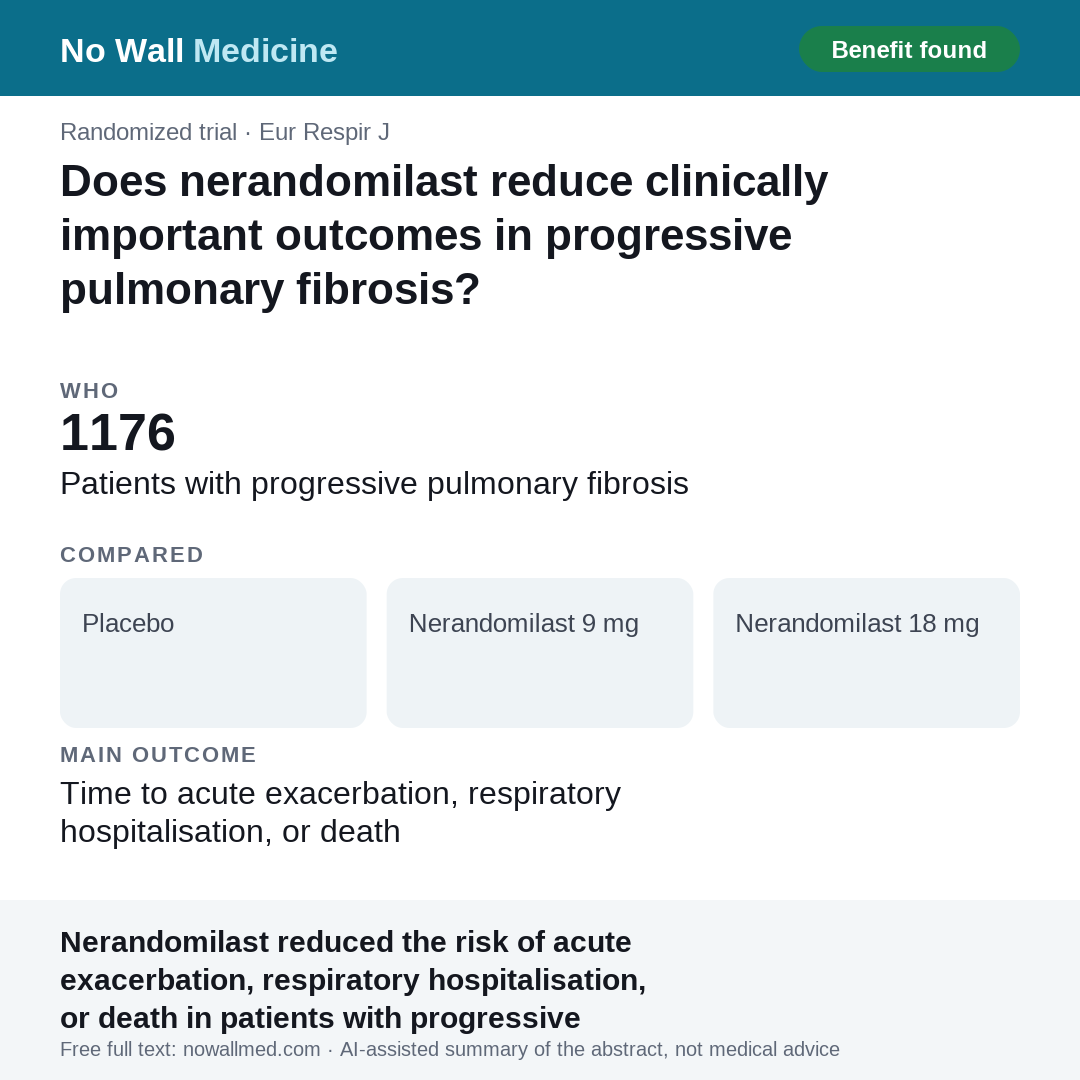
Clinical question: Does nerandomilast reduce clinically important outcomes in progressive pulmonary fibrosis?
Why it matters: Researchers sought to assess the long-term effects of nerandomilast on respiratory hospitalizations, acute lung disease flare-ups, and death in patients with progressive pulmonary fibrosis.
Key points
- Researchers studied 1176 patients with progressive pulmonary fibrosis, including 512 people taking the background medication nintedanib, comparing nerandomilast doses to a placebo.
- Nerandomilast 18 mg showed a hazard ratio of 0.77 for the key secondary end-point of death, respiratory hospitalization, or acute exacerbation of interstitial lung disease.
- The hazard ratio for death compared to placebo was 0.51 for both the 9 mg and 18 mg doses of nerandomilast.
Headline and key points written with AI from the paper’s abstract, with every number checked against it. Read the paper before relying on them.
Topics
Cite this article
Wijsenbeek MS, Assassi S, Azuma A, Cottin V, Hoffmann-Vold AM, Maher TM. Nerandomilast in progressive pulmonary fibrosis: data from the whole follow-up period of the FIBRONEER-ILD trial. Eur Respir J. 2026. doi:10.1183/13993003.01899-2025
Spotted a mistake? Suggest a correction