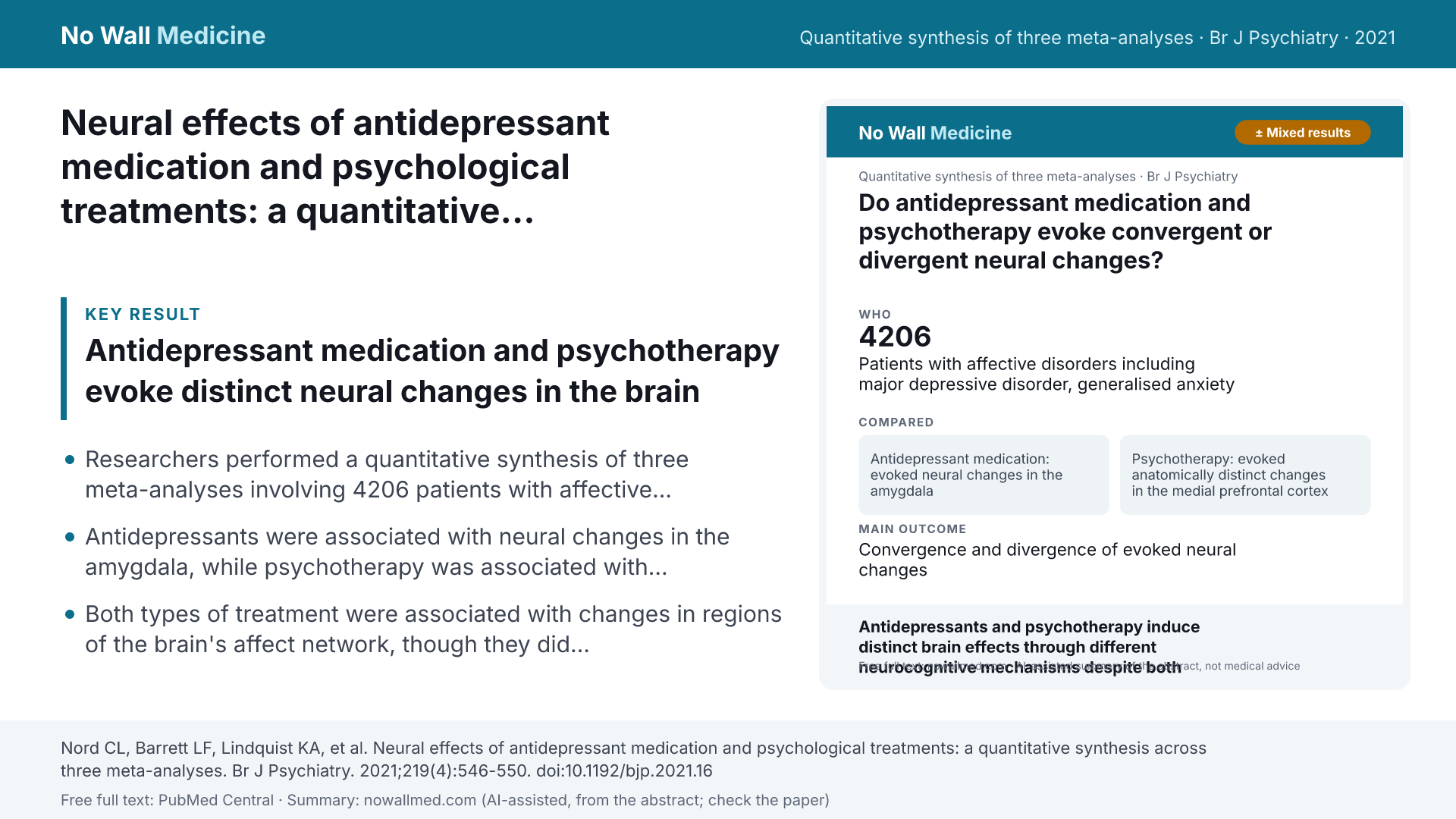
Antidepressant medication and psychotherapy evoke distinct neural changes in the brain
Neural effects of antidepressant medication and psychological treatments: a quantitative synthesis across three meta-analyses
Quantitative synthesis of three meta-analysesMixed results
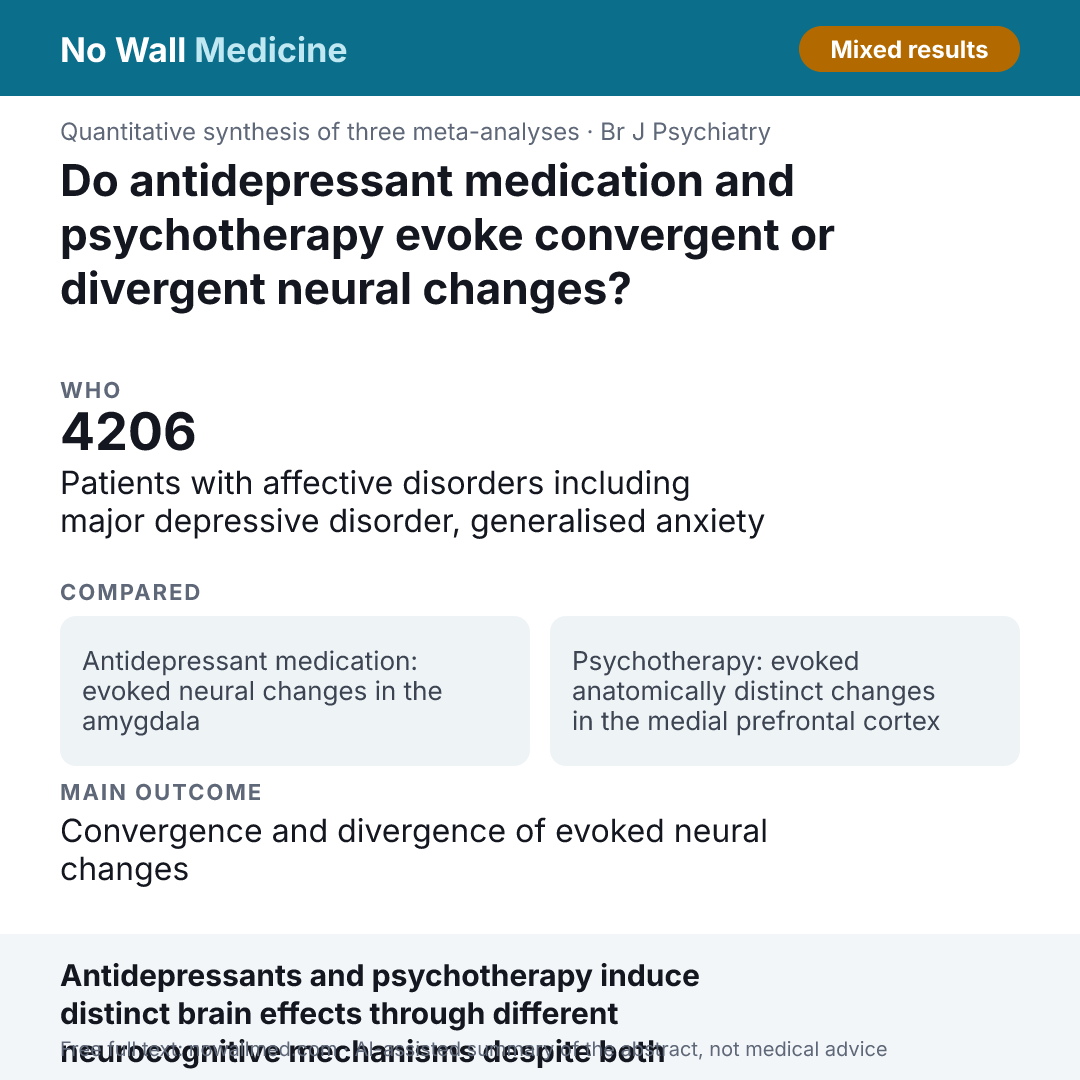
Do antidepressant medication and psychotherapy evoke convergent or divergent neural changes?
Who
4206
Patients with affective disorders including major depressive disorder, generalised anxiety disorder and panic disorder
Compared
Antidepressant medication: evoked neural changes in the amygdala
Psychotherapy: evoked anatomically distinct changes in the medial prefrontal cortex
Main outcome
Convergence and divergence of evoked neural changes
Bottom line: Antidepressants and psychotherapy induce distinct brain effects through different neurocognitive mechanisms despite both affecting the affect network.
Br J Psychiatry · 2021-02-26 · Save PNG
Clinical question: Do antidepressant medication and psychotherapy evoke convergent or divergent neural changes?
Key points
- Researchers performed a quantitative synthesis of three meta-analyses involving 4206 patients with affective disorders like major depressive disorder, generalized anxiety disorder, and panic disorder.
- Antidepressants were associated with neural changes in the amygdala, while psychotherapy was associated with anatomically distinct changes in the medial prefrontal cortex.
- Both types of treatment were associated with changes in regions of the brain's affect network, though they did not significantly converge on any single region.
Headline and key points written with AI from the paper’s abstract, with every number checked against it. Read the paper before relying on them.
Was this summary helpful?
Subject terms
Headline, design, result, key points, caveat and citation as plain text.
Cite this article
Nord CL, Barrett LF, Lindquist KA, et al. Neural effects of antidepressant medication and psychological treatments: a quantitative synthesis across three meta-analyses. Br J Psychiatry. 2021;219(4):546-550. doi:10.1192/bjp.2021.16
Spotted a mistake? Suggest a correction