Psilocybin is associated with increased self-inhibition and enhanced top-down connectivity in visual brain regions
Neural mechanisms of psychedelic visual imagery
Double-blind, randomised, placebo-controlled, cross-over studyBenefit found
What are the neural mechanisms of psychedelic visual imagery in humans?
Who
24
Healthy adults
Compared
psilocybin: increased self-inhibition of early and higher visual-association regions
placebo
Main outcome
directed connectivity changes to visual connectivity
Bottom line: Psilocybin increases top-down feedback connectivity and self-inhibition in visual regions, potentially driving eyes-closed visual imagery.
Mol Psychiatry · 2024-06-11Download image
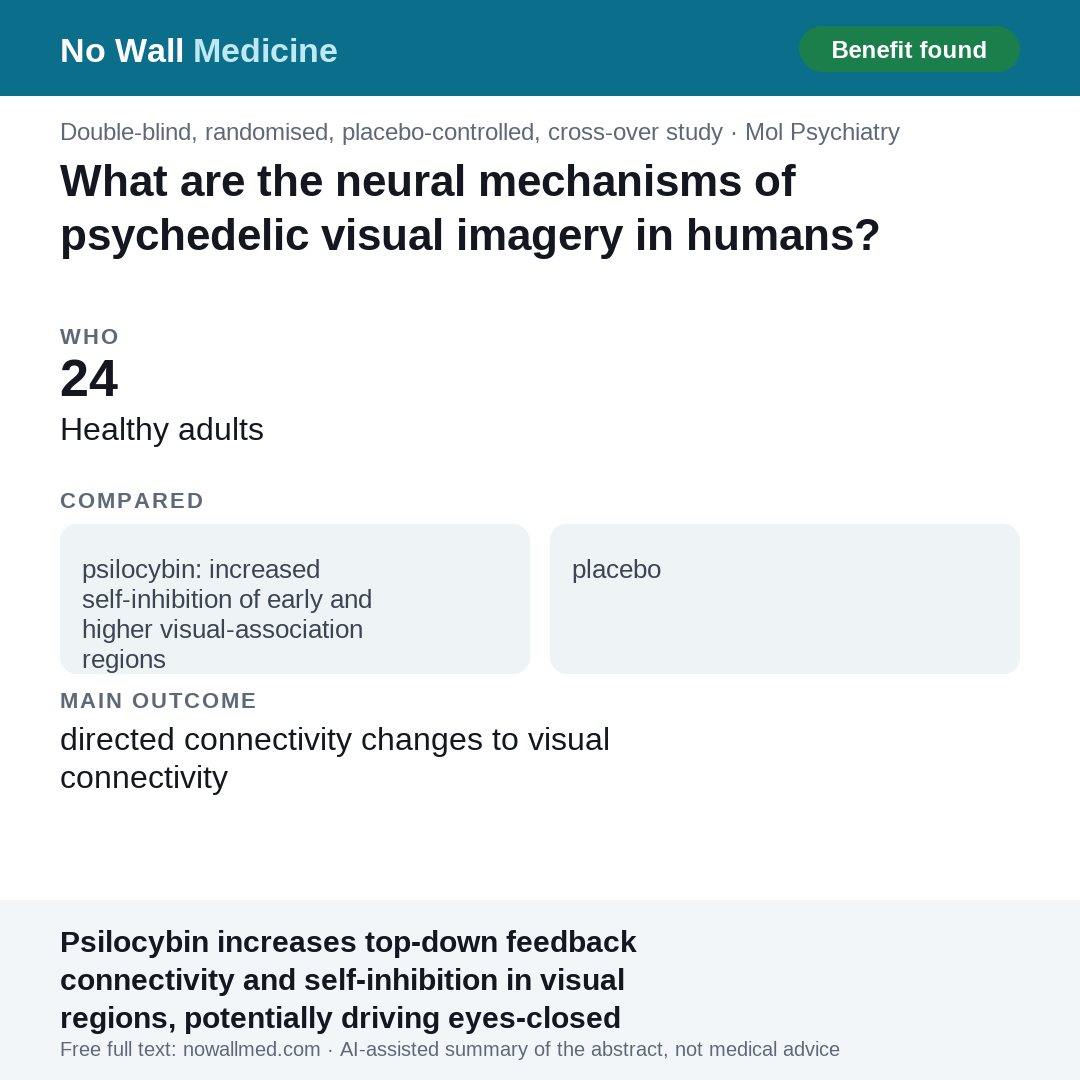
Clinical question: What are the neural mechanisms of psychedelic visual imagery in humans?
Why it matters: It was unknown if the preclinical theory that serotonin 2A receptor activation reduces synaptic gain applies to the neural connectivity underlying visual imagery in humans.
Key points
- Researchers conducted a double-blind, randomized, placebo-controlled, cross-over study of 24 healthy adults using functional magnetic resonance imaging to measure brain connectivity.
- Psilocybin administration was associated with increased self-inhibition in early and higher visual-association regions and reduced inhibition from association regions to earlier visual areas.
- Decreased sensitivity to neural inputs following psilocybin was associated with the perception of eyes-closed visual imagery.
Headline and key points written with AI from the paper’s abstract, with every number checked against it. Read the paper before relying on them.
Was this summary helpful?
Subject terms
Cite this article
Stoliker D, Preller KH, Novelli L, Anticevic A, Egan GF, Vollenweider FX. Neural mechanisms of psychedelic visual imagery. Mol Psychiatry. 2024. doi:10.1038/s41380-024-02632-3
Spotted a mistake? Suggest a correction
Top studies every Monday
The week’s key trials and guidelines in your specialties, plus any topics you follow. By email, free.
Get the weekly digest