Neurocognitive Functioning in Individuals at Clinical High Risk for Psychosis: A Systematic Review and Meta-analysis
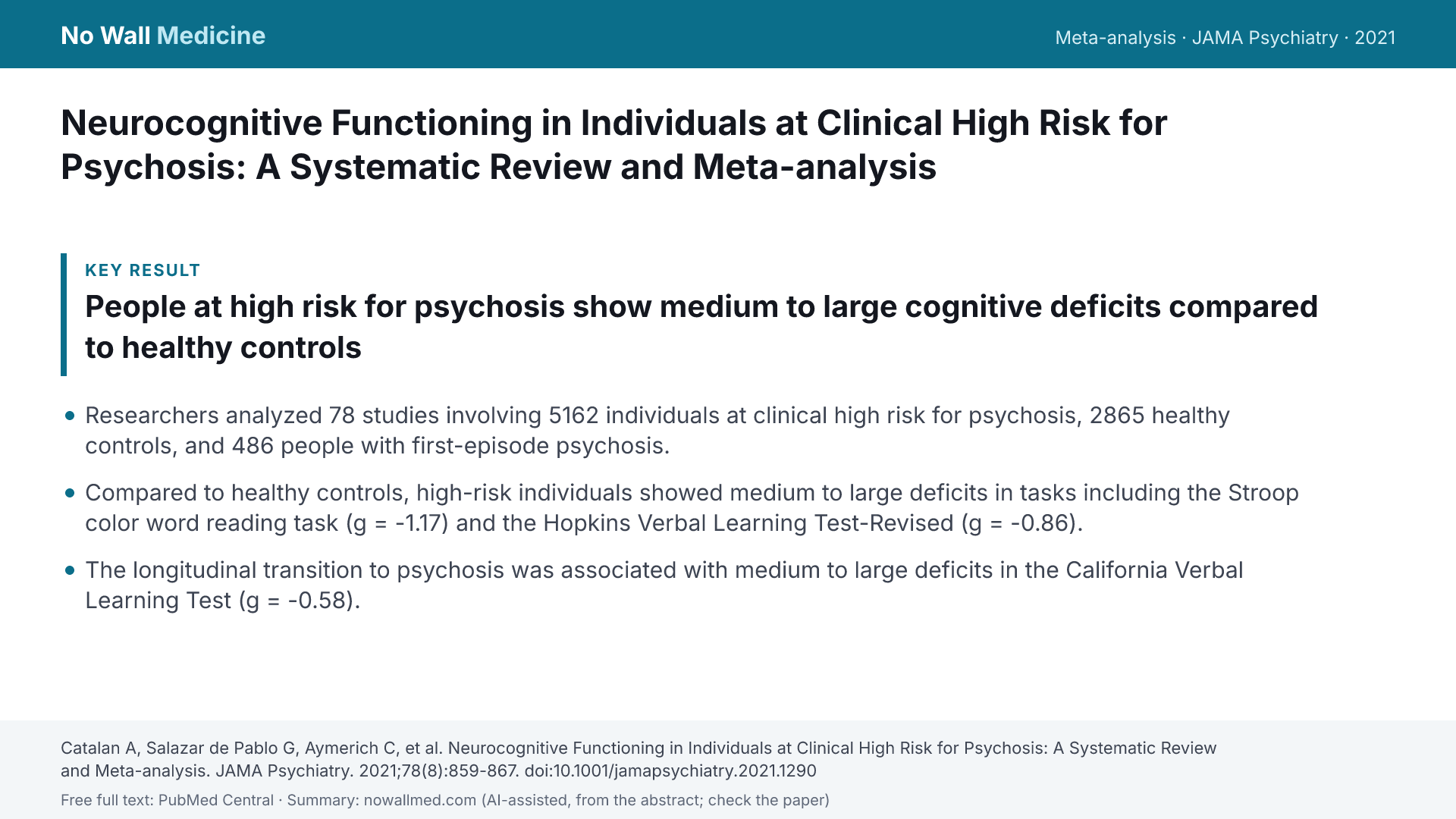
Key result: People at high risk for psychosis show medium to large cognitive deficits compared to healthy controls
Key points
- Researchers analyzed 78 studies involving 5162 individuals at clinical high risk for psychosis, 2865 healthy controls, and 486 people with first-episode psychosis.
- Compared to healthy controls, high-risk individuals showed medium to large deficits in tasks including the Stroop color word reading task (g = -1.17) and the Hopkins Verbal Learning Test-Revised (g = -0.86).
- The longitudinal transition to psychosis was associated with medium to large deficits in the California Verbal Learning Test (g = -0.58).
Why it matters: The consistency and magnitude of neurocognitive functioning in individuals at clinical high risk for psychosis are currently undetermined.
Discussion prompts
- Would these patients look like yours? Who was left out?
- Is the main outcome one that matters to patients?
- Is the difference large enough to change what you do?
Cite: Catalan A, Salazar de Pablo G, Aymerich C, et al. Neurocognitive Functioning in Individuals at Clinical High Risk for Psychosis: A Systematic Review and Meta-analysis. JAMA Psychiatry. 2021. doi:10.1001/jamapsychiatry.2021.1290
Free full text: PubMed Central · Summary and visual abstract: nowallmed.com/a/neurocognitive-functioning-in-individuals-at-clinical-high-risk-for-1ktv0oj/ (AI-assisted from the abstract; check the paper before relying on it).