Nitric oxide during heart surgery did not change neurodevelopmental outcomes in infants
Neurodevelopmental Outcomes After Nitric Oxide During Cardiopulmonary Bypass for Open Heart Surgery: A Randomized Clinical Trial
Double-masked randomized clinical trialNo clear difference
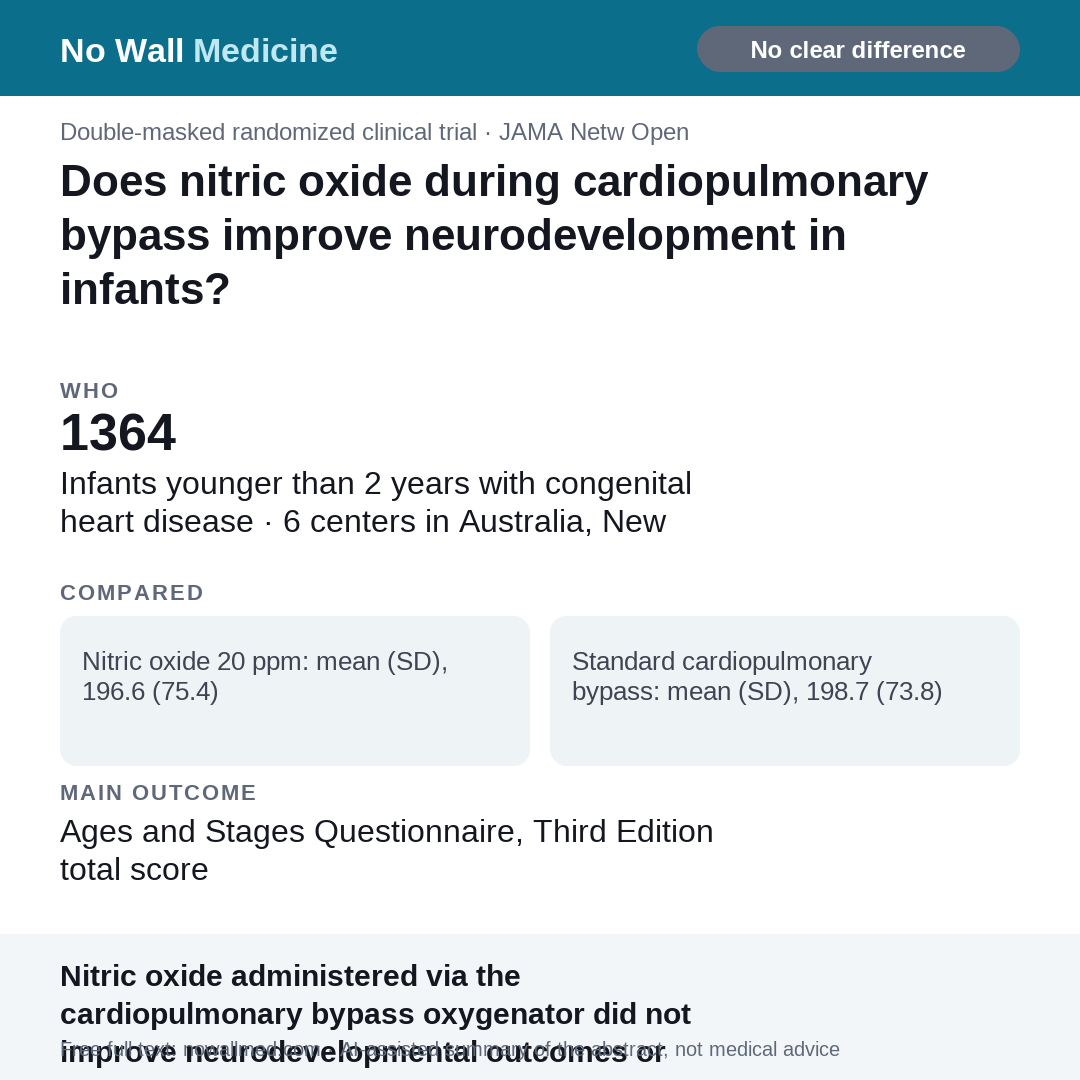
Does nitric oxide during cardiopulmonary bypass improve neurodevelopment in infants?
Who
1364
Infants younger than 2 years with congenital heart disease · 6 centers in Australia, New Zealand, and the Netherlands
Compared
Nitric oxide 20 ppm: mean (SD), 196.6 (75.4)
Standard cardiopulmonary bypass: mean (SD), 198.7 (73.8)
Main outcome
Ages and Stages Questionnaire, Third Edition total score
Result: adjusted mean difference, -2.24; 95% CI, -11.84 to 7.36
Bottom line: Nitric oxide administered via the cardiopulmonary bypass oxygenator did not improve neurodevelopmental outcomes or health-related quality of life.
JAMA Netw Open · 2025-02-03Download image
Clinical question: Does nitric oxide during cardiopulmonary bypass improve neurodevelopment in infants?
Why it matters: It was unknown if adding nitric oxide to the heart-lung machine oxygenator could improve neurodevelopment or quality of life for infants with congenital heart defects.
Key points
- Researchers studied 1364 infants under 2 years old undergoing open heart surgery using a heart-lung machine, comparing nitric oxide to standard care.
- At 12 months, there were no differences in neurodevelopment scores between the nitric oxide group (mean 196.6) and the standard care group (mean 198.7).
- Lower neurodevelopment scores were associated with prematurity, univentricular lesions, congenital syndromes, and longer intensive care unit stays.
Headline and key points written with AI from the paper’s abstract, with every number checked against it. Read the paper before relying on them.
Topics
Cite this article
Long DA, Gibbons KS, Horton SB, Johnson K, Buckley DHF, Erickson S. Neurodevelopmental Outcomes After Nitric Oxide During Cardiopulmonary Bypass for Open Heart Surgery: A Randomized Clinical Trial. JAMA Netw Open. 2025. doi:10.1001/jamanetworkopen.2024.58040
Spotted a mistake? Suggest a correction
Top studies every Monday
The week’s key trials and guidelines in your specialties, plus any topics you follow. By email, free.
Get the weekly digest