Neurodevelopmental Outcomes following Intrauterine Growth Restriction and Very Preterm Birth
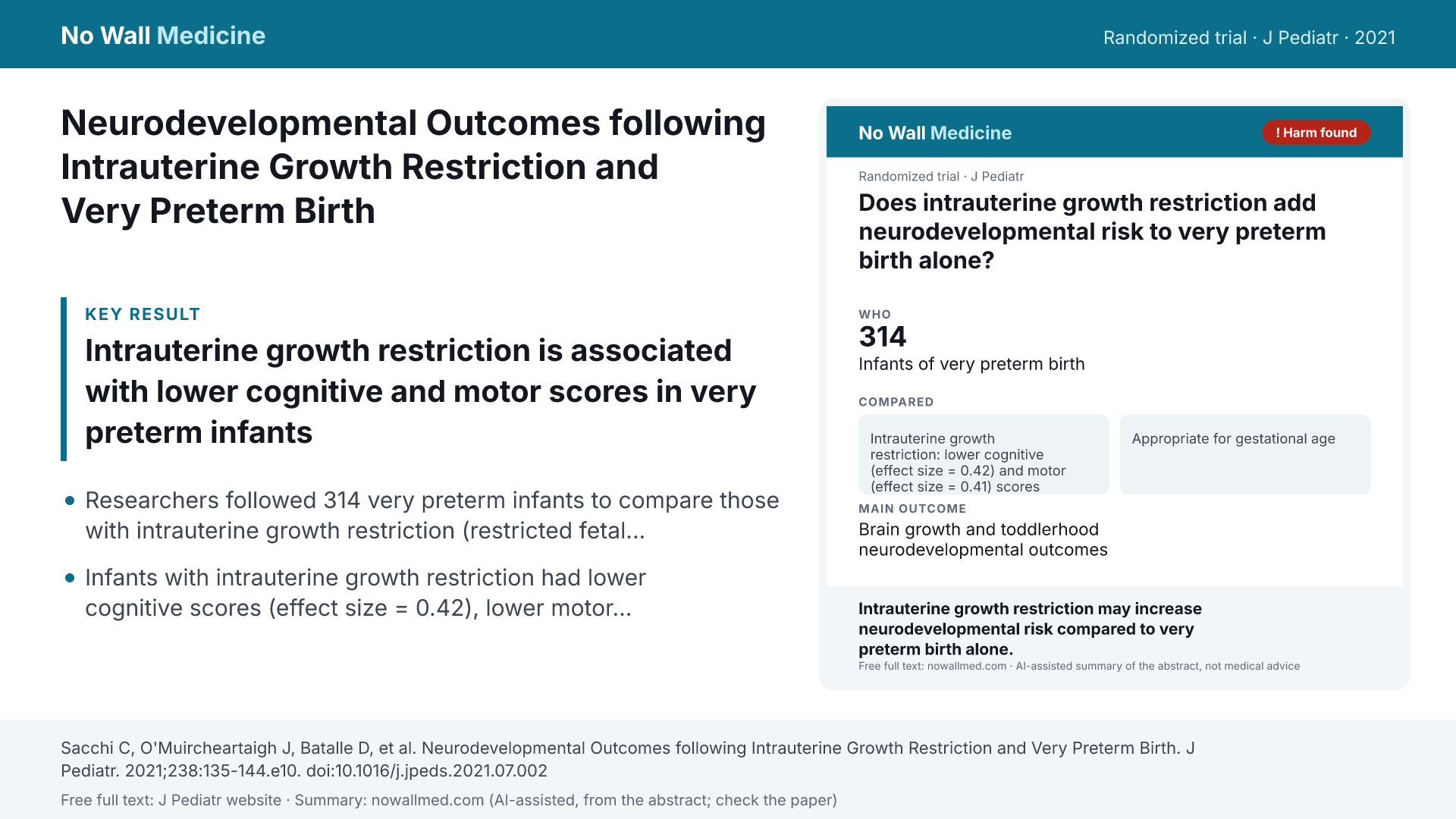
Key result: Intrauterine growth restriction is associated with lower cognitive and motor scores in very preterm infants
Randomized trialHarm found
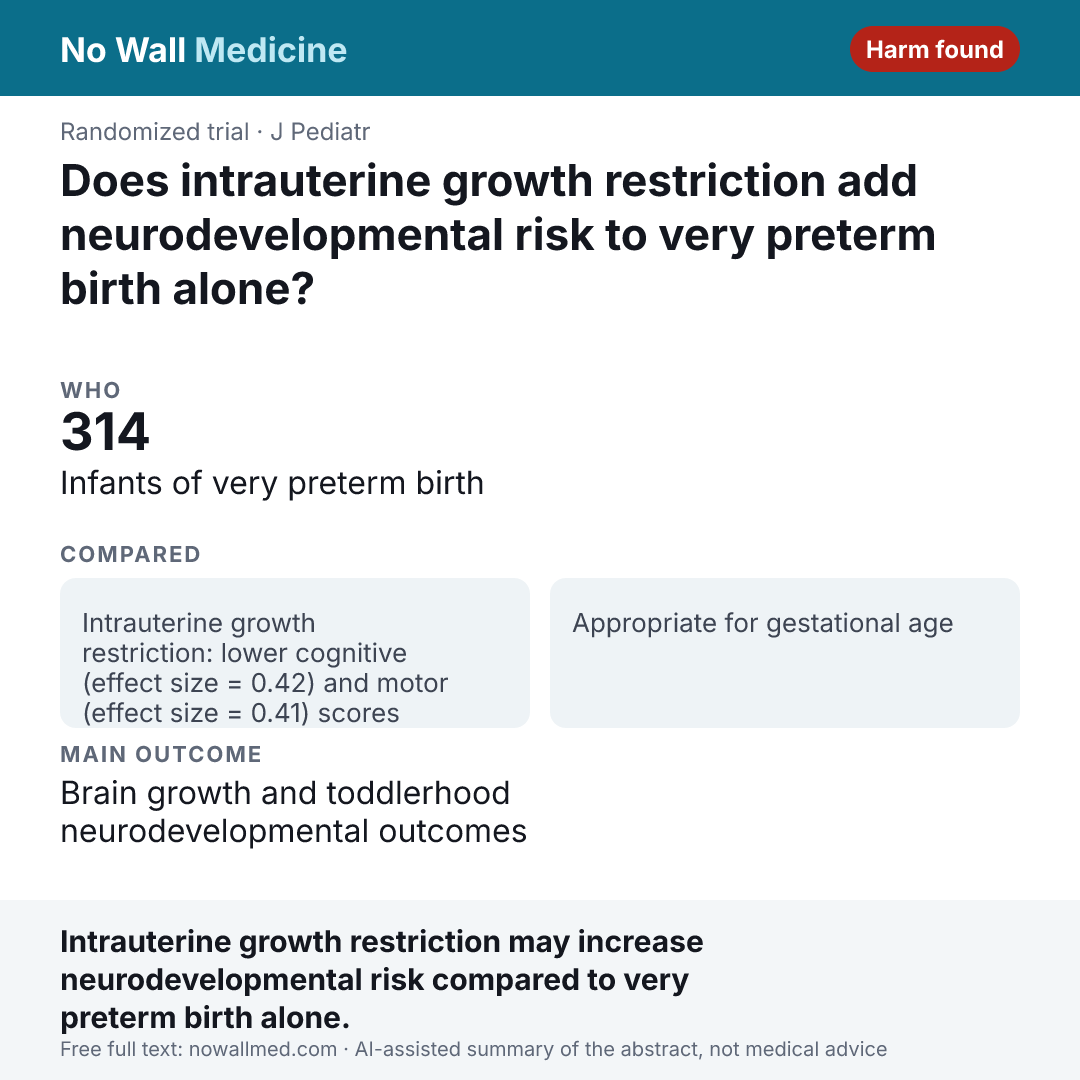
Does intrauterine growth restriction add neurodevelopmental risk to very preterm birth alone?
Who
314
Infants of very preterm birth
Compared
Intrauterine growth restriction: lower cognitive (effect size = 0.42) and motor (effect size = 0.41) scores
Appropriate for gestational age
Main outcome
Brain growth and toddlerhood neurodevelopmental outcomes
Result: OR = 2.12
Bottom line: Intrauterine growth restriction may increase neurodevelopmental risk compared to very preterm birth alone.
J Pediatr · 2021-07-08 · Save PNG
Key points
- Researchers followed 314 very preterm infants to compare those with intrauterine growth restriction (restricted fetal growth) to those born appropriate for their gestational age.
- Infants with intrauterine growth restriction had lower cognitive scores (effect size = 0.42), lower motor scores (effect size = 0.41), and were more likely to screen positive for autism (OR = 2.12).
- Brain imaging showed relative decreases in gray matter volume in limbic regions and relative increases in frontoinsular, temporal-parietal, and frontal areas in the growth-restricted group.
Discussion prompts
- Would these patients look like yours? Who was left out?
- Is the main outcome one that matters to patients?
- Is the difference large enough to change what you do?
Cite: Sacchi C, O'Muircheartaigh J, Batalle D, et al. Neurodevelopmental Outcomes following Intrauterine Growth Restriction and Very Preterm Birth. J Pediatr. 2021;238:135-144.e10. doi:10.1016/j.jpeds.2021.07.002
Free full text: J Pediatr website · Summary and visual abstract: nowallmed.com/a/neurodevelopmental-outcomes-following-intrauterine-growth-restriction-fmdfi7/ (AI-assisted from the abstract; check the paper before relying on it).