No single standardized neonatal neurodevelopmental screening tool was identified for use in low-income and middle-income countries
Neurodevelopmental screening for neonates less than 44 weeks gestation in low-income and middle-income countries: a systematic review
Systematic reviewUnclear result
What standardised neurodevelopmental assessments are used for neonates in low-income and middle-income countries?
Who
Neonates before 44 weeks corrected gestational age in low-income and middle-income countries · Low-income and middle-income countries
Compared
25.4%Neonatal Behavioural Neurological Assessment
22.4%General Movements Assessment
16.4%Hammersmith Neonatal Neurological Examination/Dubowitz
10.4%Neonatal Behavioural Assessment Scale
Main outcome
Standardised neurodevelopmental assessments used in low-income and middle-income countries
Bottom line: No single rapid, globally validated neurodevelopmental screening assessment exists for neonates in low-income and middle-income countries.
BMJ Glob Health · 2025-04-02Download image
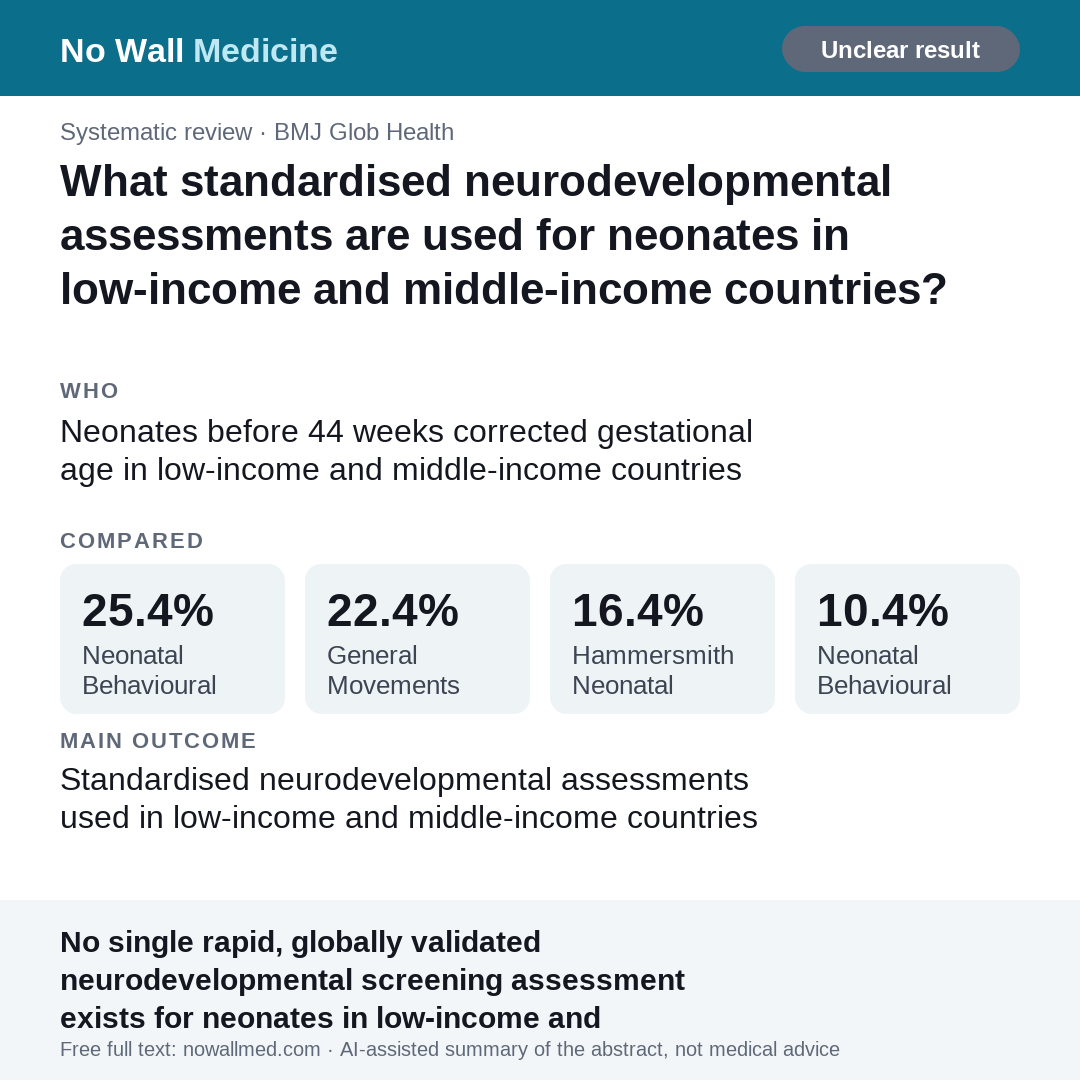
Clinical question: What standardised neurodevelopmental assessments are used for neonates in low-income and middle-income countries?
Why it matters: Little is known about which standardized neurodevelopmental screening tools are used for newborns in low-income and middle-income countries.
Key points
- Researchers reviewed 67 studies from low-income and middle-income countries to identify standardized neurodevelopmental assessments used for newborns before 44 weeks corrected gestational age.
- The Neonatal Behavioural Neurological Assessment was used in 25.4% of studies, followed by the General Movements Assessment at 22.4% and the Hammersmith Neonatal Neurological Examination/Dubowitz at 16.4%.
- Physicians and paramedical staff performed the screening assessments in only 16.4% of the included studies.
Headline and key points written with AI from the paper’s abstract, with every number checked against it. Read the paper before relying on them.
Was this summary helpful?
Abstract
Introduction
With global improvements in neonatal survival, more small and sick newborns in low-income and middle-income countries (LMICs) are at increased risk of neurodevelopmental disability and delay. While there is increased recognition of the importance of early identification of neurodevelopmental differences and timely initiation of therapy, little is known about standardised neonatal neurodevelopmental screening tools in these settings. Methods
We performed a systematic review to determine what standardised neurodevelopmental assessments had been used in LMICs for neonates before 44 weeks corrected gestational age and published in the literature. We excluded short-term clinical assessments designed for specific pathologies. We performed the search across seven databases, screened studies for eligibility and inclusion and extracted bibliographic data, country, patient characteristics, assessments and study aims. Results were summarised in tabular and graphical presentation. Results
There were 2477 records screened, yielding 67 studies for inclusion. Studies in Asian countries made up 65.7%, while Latin America and Africa made up 19.4% and 16.4%, respectively. Physicians and paramedical staff performed the screening assessments in only 16.4% of studies, and 92.5% of studies used inpatient recruitment. The Neonatal Behavioural Neurological Assessment (25.4%) was the most frequently used screening tool followed by the General Movements Assessment (22.4%), the Hammersmith Neonatal Neurological Examination/Dubowitz (16.4%) and the Neonatal Behavioural Assessment Scale (10.4%). Conclusions
We did not identify any one neonatal neurodevelopmental screening assessment that is rapid, globally validated, identifies targets for intervention, has high predictive prognostic value and does not require neonatal or kinesiologic expertise or uncommon equipment. Such an assessment, in concert with evidence-based intervention, therapeutic delivery platforms, established referral pathways and trained personnel would improve functional outcomes for high-risk small and sick neonates in LMICs.
Abstract reproduced under the article’s CC BY NC licence.
Subject terms
Cite this article
Al-Haddad BJS, Olson E, Reardon E, Bonney E. Neurodevelopmental screening for neonates less than 44 weeks gestation in low-income and middle-income countries: a systematic review. BMJ Glob Health. 2025. doi:10.1136/bmjgh-2024-017683
Spotted a mistake? Suggest a correction
Top studies every Monday
The week’s key trials and guidelines in your specialties, plus any topics you follow. By email, free.
Get the weekly digest