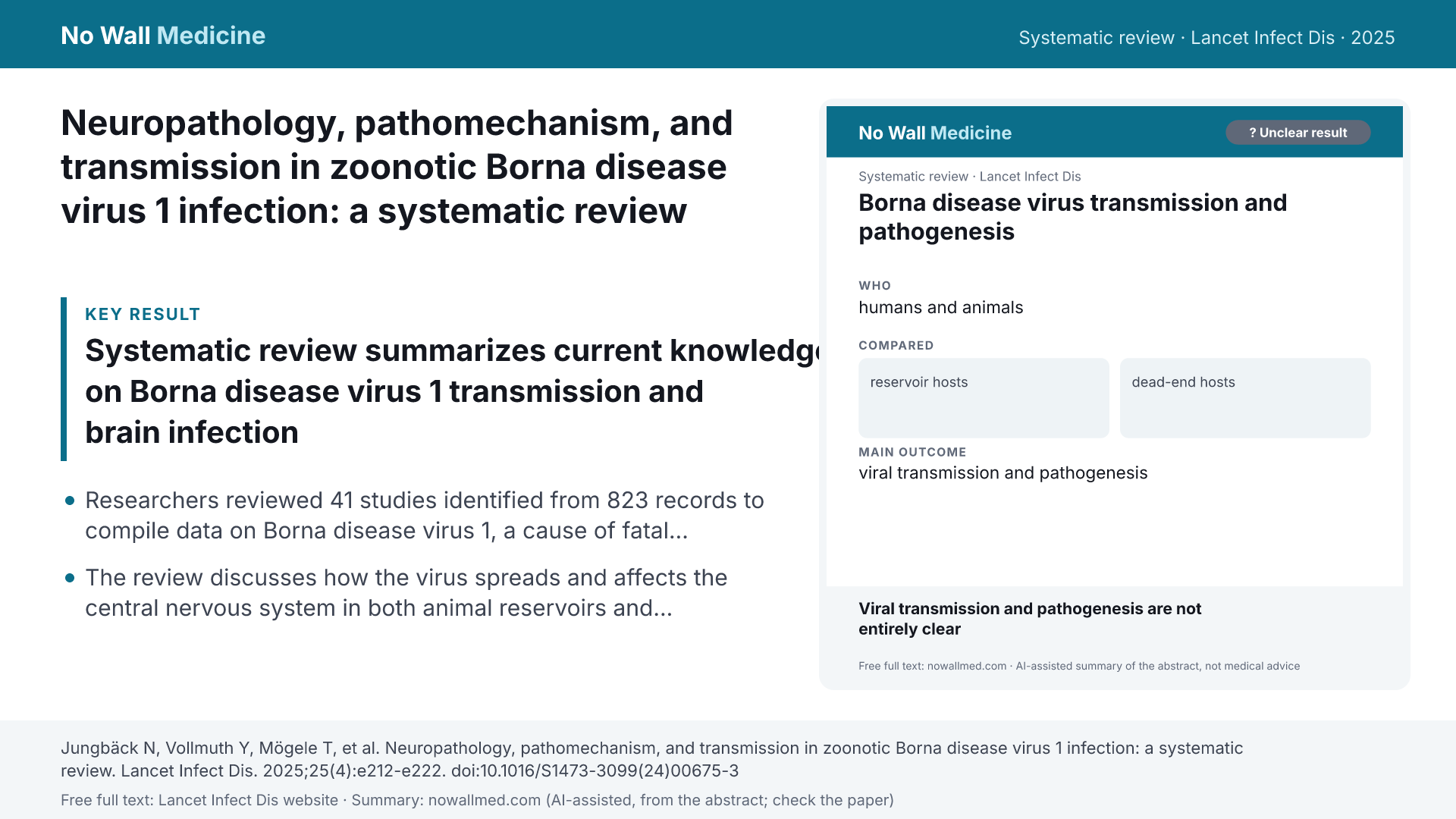
Systematic review summarizes current knowledge on Borna disease virus 1 transmission and brain infection
Neuropathology, pathomechanism, and transmission in zoonotic Borna disease virus 1 infection: a systematic review
Systematic reviewUnclear result
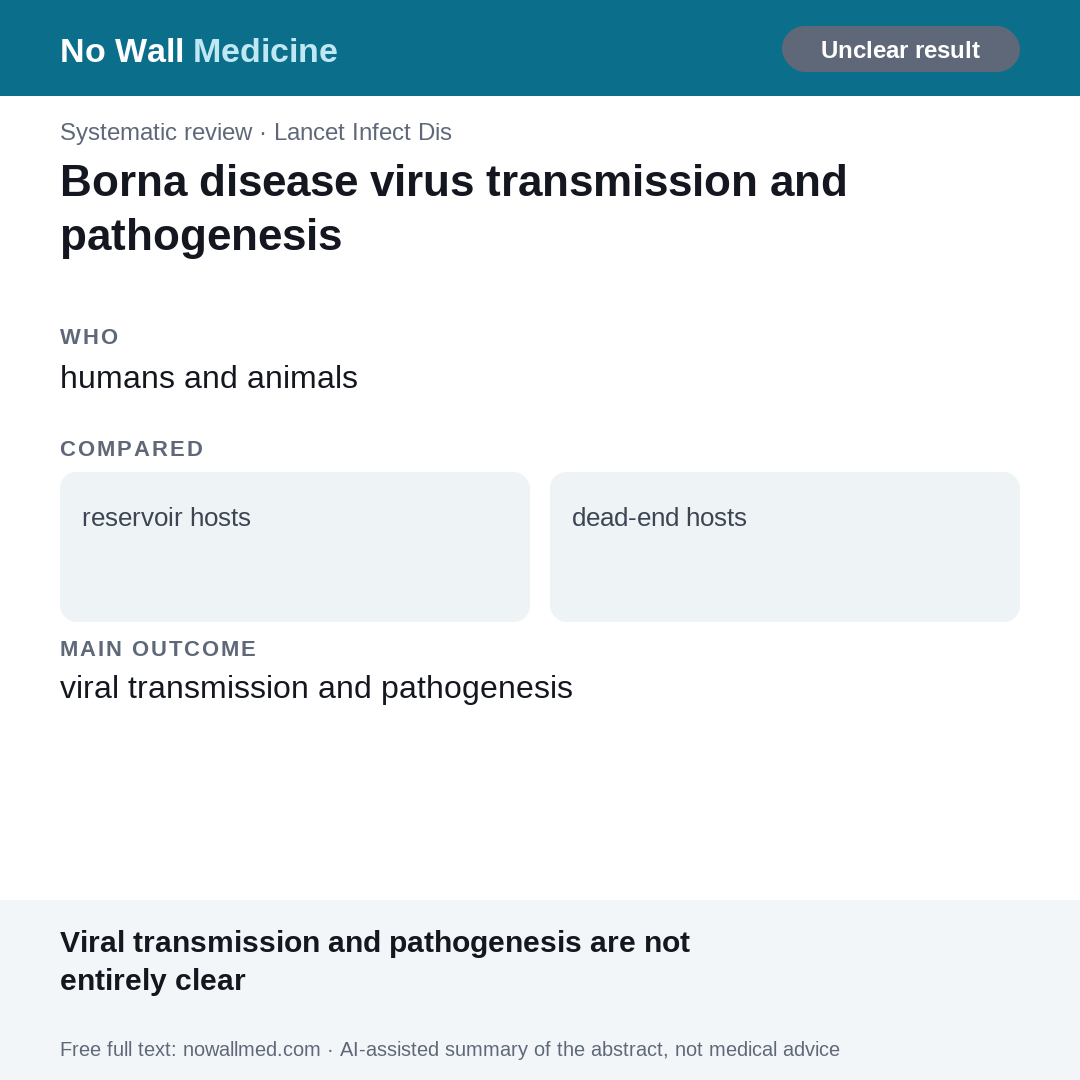
Borna disease virus transmission and pathogenesis
Who
humans and animals
Compared
reservoir hosts
dead-end hosts
Main outcome
viral transmission and pathogenesis
Bottom line: Viral transmission and pathogenesis are not entirely clear
Lancet Infect Dis · 2025-01-07Download image
Why it matters: The specific mechanisms of viral entry, propagation, and spread within the human central nervous system are not entirely clear.
Key points
- Researchers reviewed 41 studies identified from 823 records to compile data on Borna disease virus 1, a cause of fatal brain inflammation in humans.
- The review discusses how the virus spreads and affects the central nervous system in both animal reservoirs and human dead-end hosts.
- Current knowledge regarding the exact entry points and how the virus moves through the human central nervous system remains unclear.
Headline and key points written with AI from the paper’s abstract, with every number checked against it. Read the paper before relying on them.
Was this summary helpful?
Abstract
Borna disease, which is a severe encephalitis that primarily affects horses and sheep, has been recognised for over two centuries. Borna disease virus 1 (BoDV-1) has been identified as a cause of a predominantly fatal encephalitis in humans. Little scientific data exist regarding the virus' transmission, entry portal, and excretion routes. Lesional patterns, immunological responses, and pathogenetic mechanisms remain largely unexplored in both reservoir and dead-end hosts. This systematic review compiles current knowledge on these aspects and provides guidance for future research. PubMed, ScienceDirect, and EBSCO were searched for publications from Jan 1, 2000, to April 30, 2024. 823 records were found, of which 41 studies were included. This systematic review discusses BoDV-1 transmission, pathogenesis, histopathological changes, and immunology in both reservoir and dead-end hosts, with special regard for humans. The exact propagation mechanisms, entry portal, and viral spread within the CNS are not entirely clear in humans. Although more data exist in animals, much remains hypothetical. Future research should focus on identifying potential entry sites and viral spread in dead-end hosts, which could help to clarify the pathogenesis and lesion distribution in the CNS, thereby contributing to a better understanding of BoDV-1 infection in humans and parallels with animal infections.
Abstract reproduced under the article’s CC BY NC ND licence.
Subject terms
Headline, design, result, key points, caveat and citation as plain text.
Cite this article
Jungbäck N, Vollmuth Y, Mögele T, et al. Neuropathology, pathomechanism, and transmission in zoonotic Borna disease virus 1 infection: a systematic review. Lancet Infect Dis. 2025. doi:10.1016/S1473-3099(24)00675-3
Spotted a mistake? Suggest a correction