Inflammation-targeted therapies showed most consistent photoreceptor rescue in rodents
Neuroprotective Agents for Photoreceptor Rescue Following Experimental Retinal Detachment in Rodents: A Systematic Review
Systematic reviewNo clear difference
Do neuroprotective interventions preserve photoreceptors in rodent models of retinal detachment?
Who
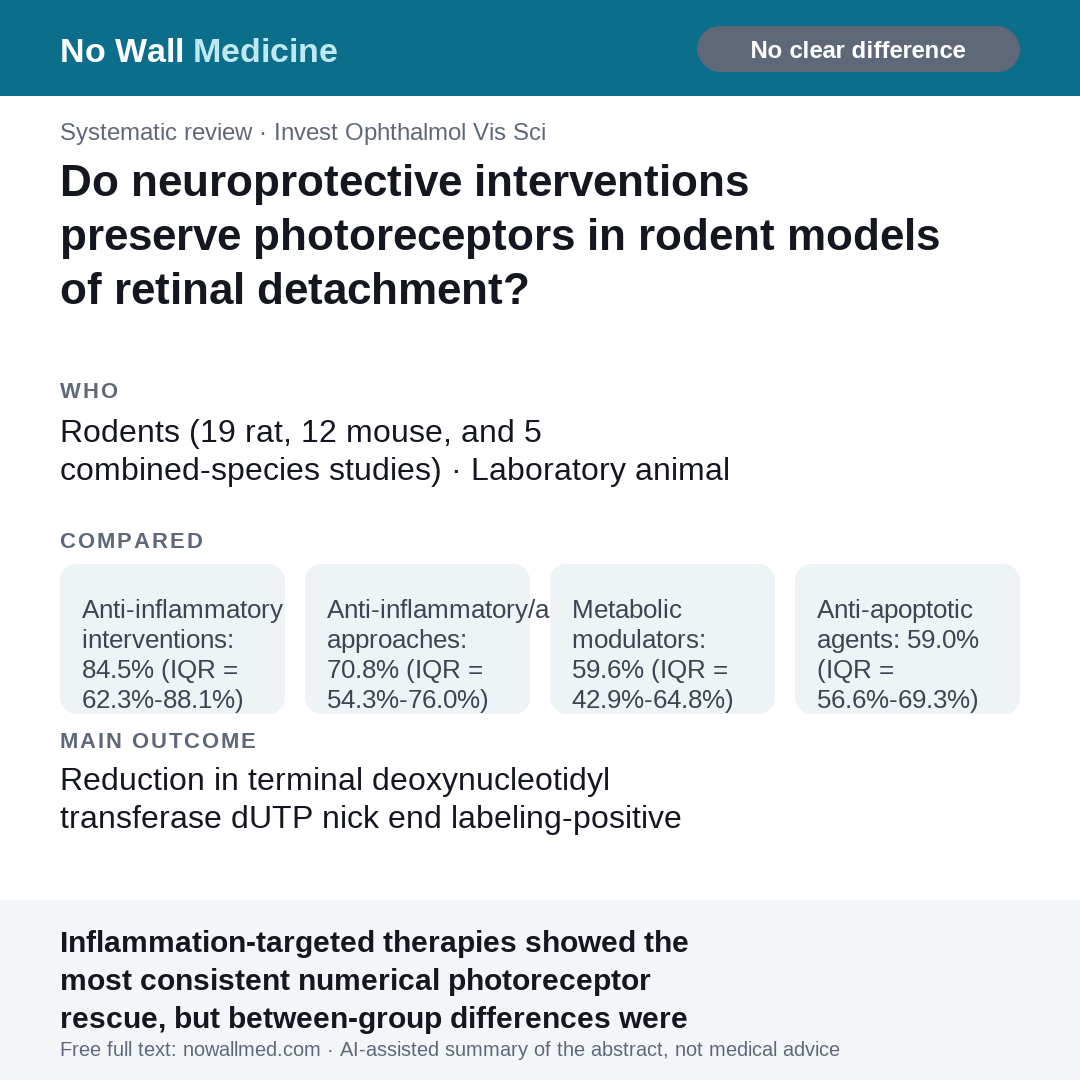
Rodents (19 rat, 12 mouse, and 5 combined-species studies) · Laboratory animal models
Compared
Anti-inflammatory interventions: 84.5% (IQR = 62.3%-88.1%) TUNEL reduction
Anti-inflammatory/antioxidant approaches: 70.8% (IQR = 54.3%-76.0%) TUNEL reduction
Metabolic modulators: 59.6% (IQR = 42.9%-64.8%) TUNEL reduction
Anti-apoptotic agents: 59.0% (IQR = 56.6%-69.3%) TUNEL reduction
Main outcome
Reduction in terminal deoxynucleotidyl transferase dUTP nick end labeling-positive cells
Result: Kruskal-Wallis P = 0.32
Bottom line: Inflammation-targeted therapies showed the most consistent numerical photoreceptor rescue, but between-group differences were not statistically significant.
Limitation: Risk of bias was largely unclear across selection and performance domains.
Invest Ophthalmol Vis Sci · 2026-06-16Download image
Clinical question: Do neuroprotective interventions preserve photoreceptors in rodent models of retinal detachment?
Why it matters: Doctors have had little evidence on effective neuroprotective interventions for retinal detachment
Key points
- Thirty-six studies in rodents evaluated neuroprotective agents for photoreceptor preservation.
- Anti-inflammatory interventions achieved 84.5% median TUNEL reduction.
- Between-group differences were not statistically significant.
Limitation the authors note: The risk of bias was largely unclear across selection and performance domains
Headline and key points written with AI from the paper’s abstract, with every number checked against it. Read the paper before relying on them.
Topics
Cite this article
Baroutis KG, Baroutis D, Ploumi I, Bantounou MA, Emfietzoglou M, Chatziralli I. Neuroprotective Agents for Photoreceptor Rescue Following Experimental Retinal Detachment in Rodents: A Systematic Review. Invest Ophthalmol Vis Sci. 2026. doi:10.1167/iovs.67.6.28
Spotted a mistake? Suggest a correction