Researchers plan a trial to test if limb blood flow cycles protect the brain after cardiac arrest
Neuroprotective effect of early remote ischaemic post-conditioning after out-of-hospital cardiac arrest (RIPOST-CA): study protocol for a randomised, single-blinded, monocentric, controlled trial
Randomised, single-blinded, monocentric, controlled trialUnclear result
Does early remote ischaemic post-conditioning reduce brain injury after out-of-hospital cardiac arrest?
Who
48
Comatose adults resuscitated from out-of-hospital cardiac arrest · Single-centre
Compared
Standard post-resuscitation care with sham cuff
Standard care plus three sessions of conditioning
Main outcome
Change in serum neurofilament light chain
Bottom line: This study protocol describes a trial to evaluate remote ischaemic post-conditioning on brain-injury biomarkers.
Resusc Plus · 2026-09-24Download image
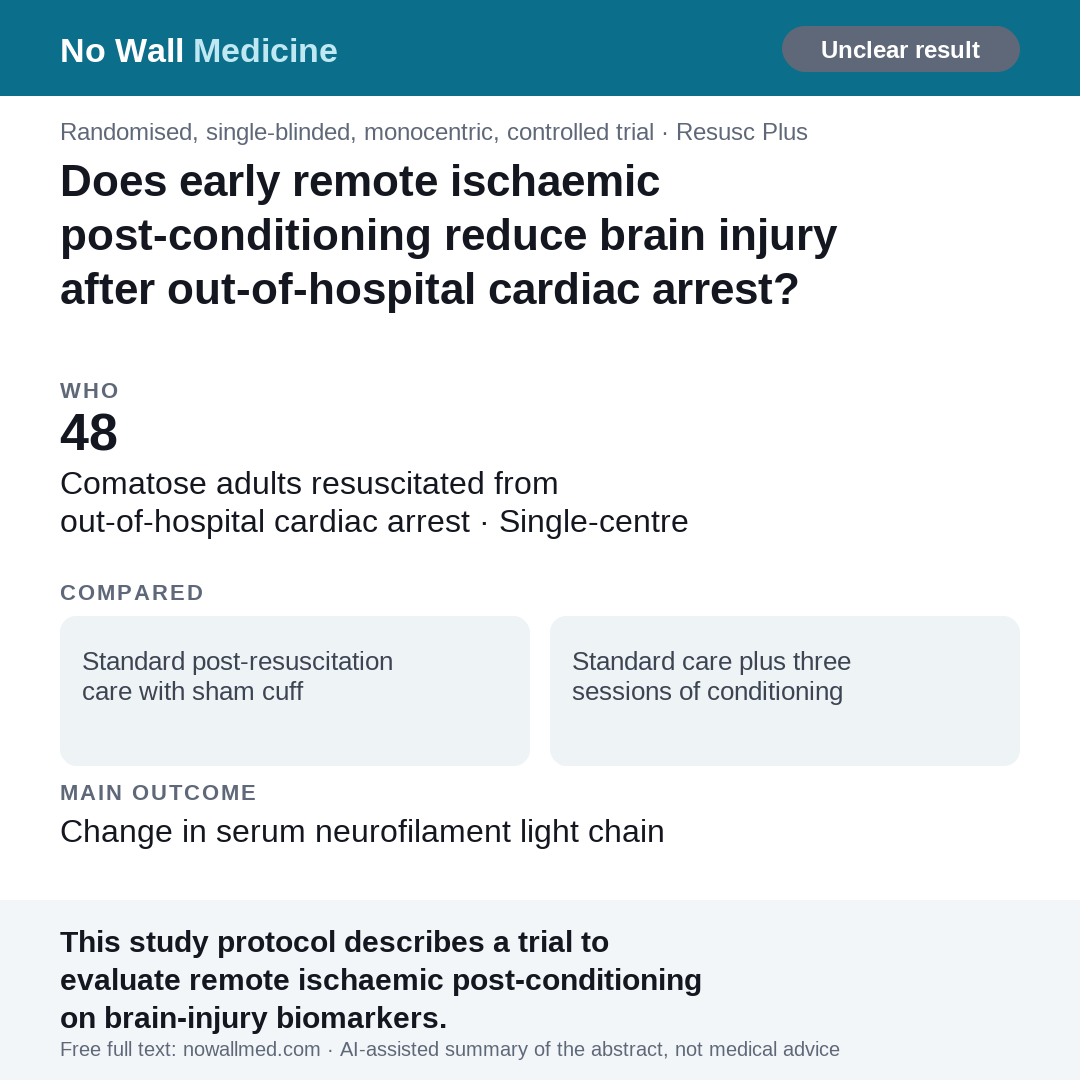
Clinical question: Does early remote ischaemic post-conditioning reduce brain injury after out-of-hospital cardiac arrest?
Why it matters: No specific treatment currently exists for the ischaemia-reperfusion syndrome that drives brain injury after out-of-hospital cardiac arrest.
Key points
- The study will enroll 48 comatose adults resuscitated from out-of-hospital cardiac arrest to compare standard care with standard care plus three sessions of remote ischaemic post-conditioning.
- The primary measurement is the change in serum neurofilament light chain, a protein marker of nerve cell damage, between the 6th and 72nd hour after blood flow returns.
- Secondary outcomes include intensive care unit mortality and neurological outcomes measured by the modified Rankin Scale at intensive care unit discharge and at 90 days.
Headline and key points written with AI from the paper’s abstract, with every number checked against it. Read the paper before relying on them.
Cite this article
Chelly J, Cheyssac R, Bertrand T, Gardan V, Jobic A, Rahmati M. Neuroprotective effect of early remote ischaemic post-conditioning after out-of-hospital cardiac arrest (RIPOST-CA): study protocol for a randomised, single-blinded, monocentric, controlled trial. Resusc Plus. 2026. doi:10.1016/j.resplu.2026.101503
Spotted a mistake? Suggest a correction