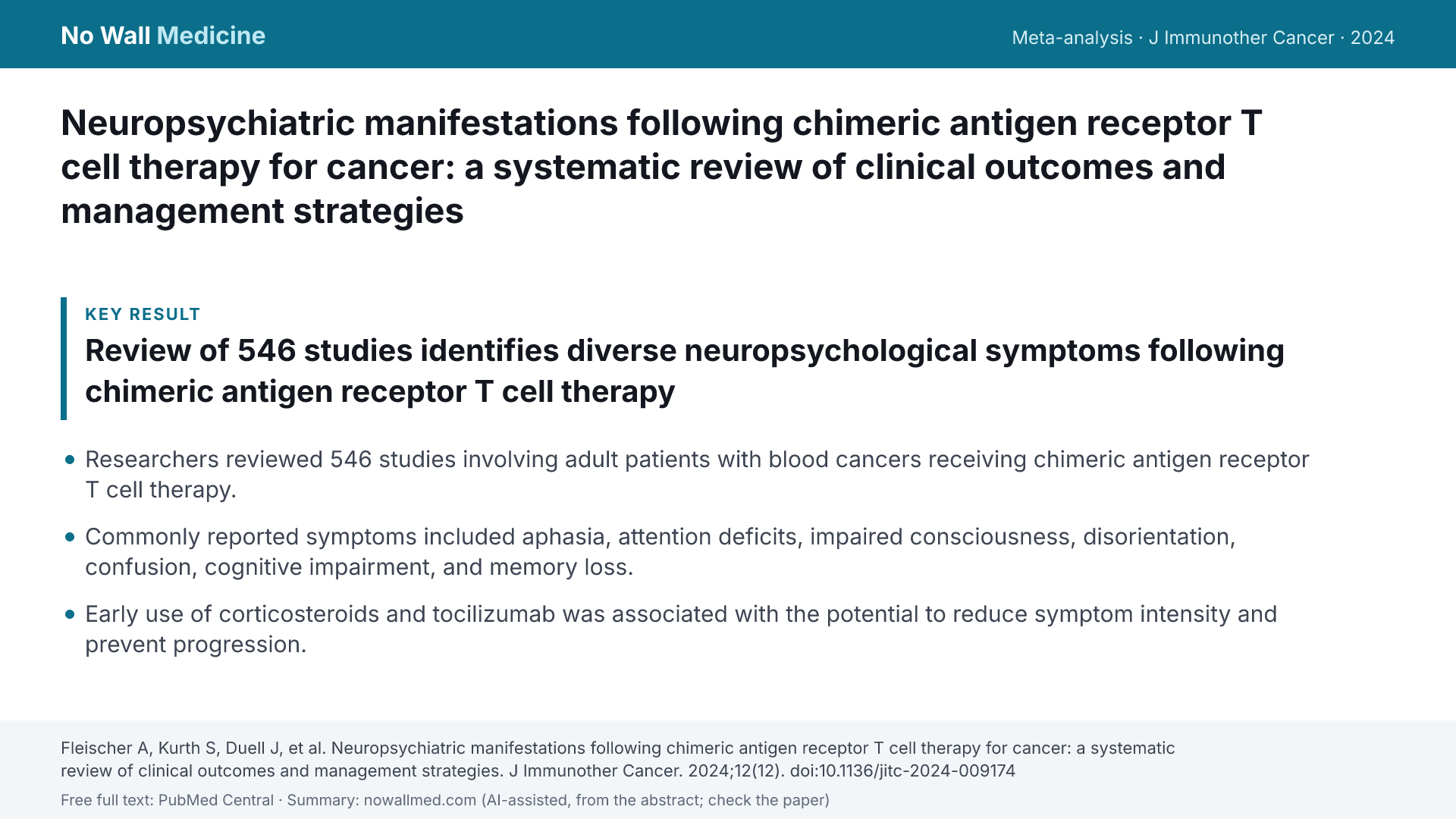
Review of 546 studies identifies diverse neuropsychological symptoms following chimeric antigen receptor T cell therapy
Neuropsychiatric manifestations following chimeric antigen receptor T cell therapy for cancer: a systematic review of clinical outcomes and management strategies
Why it matters: The specific neurological and psychological side effects and the laboratory findings associated with chimeric antigen receptor T cell therapy were not fully categorized.
Key points
- Researchers reviewed 546 studies involving adult patients with blood cancers receiving chimeric antigen receptor T cell therapy.
- Commonly reported symptoms included aphasia, attention deficits, impaired consciousness, disorientation, confusion, cognitive impairment, and memory loss.
- Early use of corticosteroids and tocilizumab was associated with the potential to reduce symptom intensity and prevent progression.
Headline and key points written with AI from the paper’s abstract, with every number checked against it. Read the paper before relying on them.
Was this summary helpful?
Abstract
Background
Chimeric antigen receptor (CAR)-T cell therapy has emerged as a transformative modality in the treatment of patients with cancer. However, it is increasingly evident that this therapeutic approach is not without its challenges. The unique nature of CAR-T cells as living drugs introduces a distinct set of side effects. As the application of CAR-T cell therapy expands to treat a broader range of diseases, it becomes increasingly important to devise effective strategies for handling the associated toxicities. Challenges in treating patients with CAR-T cells include addressing complications such as cytokine release syndrome, immune effector cell-associated neurotoxicity syndrome, and cytopenias. This comprehensive review seeks to systematically identify, categorize and elucidate all previously described neurological and psychological side effects associated with CAR-T cell therapy, shedding light on the pertinent laboratory findings that underscore these phenomena. Methods
PubMed, Springer Link, and ScienceDirect were systematically searched for empirical studies on adult patients with cancer receiving CAR-T cell therapy for hemato-oncological malignancies. Quality assessment was conducted using Version 2 of the Cochrane risk-of-bias tool (RoB 2) for randomized trials and adherence to the STROBE (Strengthening the Reporting of Observational Studies in Epidemiology) checklist for observational studies. The synthesis of findings was conducted via a narrative approach, consolidating the diverse array of data into a coherent framework. Results
From an initial pool of 2,276 citations, 546 studies met the inclusion criteria, exhibiting a rich tapestry of heterogeneity in terms of study characteristics and patient samples. The incidence of neuropsychological symptoms varied notably across different CAR-T cell products and hematological malignancies. Among the most frequently reported neuropsychological symptoms were aphasia, attention deficits, impaired consciousness, and disorientation, alongside a constellation of other symptoms including confusion, cognitive impairment, memory loss, writing difficulties, fatigue, headache, agitation, tremor, seizures, and psychomotor retardation. Early intervention strategies, including corticosteroids and tocilizumab, have shown the potential to reduce the intensity of neuropsychological symptoms and prevent their progression to critical complications. Conclusion
These insights underscore the imperative of extending neuropsychological assessments beyond the conventional Immune Effector Cell-Associated Encephalopathy score framework.
Abstract reproduced under the article’s CC BY NC licence.
Subject terms
Headline, design, result, key points, caveat and citation as plain text.
Cite this article
Fleischer A, Kurth S, Duell J, et al. Neuropsychiatric manifestations following chimeric antigen receptor T cell therapy for cancer: a systematic review of clinical outcomes and management strategies. J Immunother Cancer. 2024. doi:10.1136/jitc-2024-009174
Spotted a mistake? Suggest a correction