Acute nicotine administration impairs discrimination between threat and safety in non-smokers
Nicotine reduces discrimination between threat and safety in the hippocampus, nucleus accumbens and amygdala
Double-blinded pharmacological functional magnetic resonance imaging studyHarm found
Does acute nicotine affect fear acquisition and extinction in non-smokers?
Who
88
Non-smokers
Compared
Nicotine: decreased discrimination between threat and safety in subjective fear
Placebo controls
Main outcome
Fear acquisition and extinction and neural discrimination
Bottom line: Single doses of nicotine impair neural substrates of adaptive aversive learning in non-smokers.
Transl Psychiatry · 2024-08-03Download image
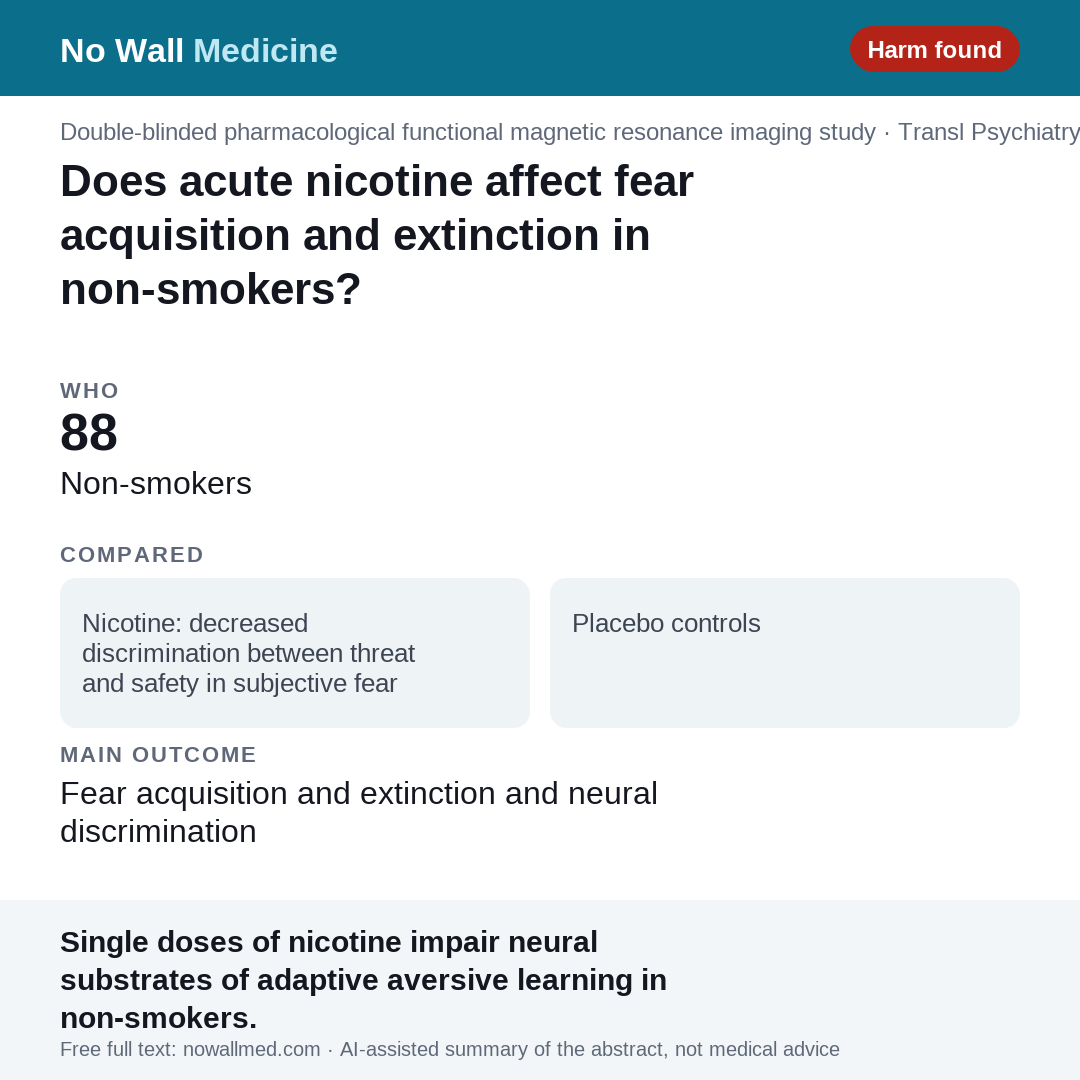
Clinical question: Does acute nicotine affect fear acquisition and extinction in non-smokers?
Why it matters: It was unclear if nicotine exerts a causal pharmacological effect on the affective and neural mechanisms that underlie aversive learning.
Key points
- Researchers studied 88 non-smokers using a double-blinded pharmacological functional magnetic resonance imaging (fMRI) study to measure fear acquisition and extinction.
- Nicotine administration was associated with decreased discrimination between threat and safety in subjective fear and decreased differential activation in the hippocampus.
- Nicotine was also associated with enhanced physiological arousal to learned threats and overactivation of the ventral tegmental area.
Headline and key points written with AI from the paper’s abstract, with every number checked against it. Read the paper before relying on them.
Was this summary helpful?
Subject terms
Cite this article
Mueller M, Fadai T, Rauh J, Haaker J. Nicotine reduces discrimination between threat and safety in the hippocampus, nucleus accumbens and amygdala. Transl Psychiatry. 2024. doi:10.1038/s41398-024-03040-5
Spotted a mistake? Suggest a correction
Top studies every Monday
The week’s key trials and guidelines in your specialties, plus any topics you follow. By email, free.
Get the weekly digest