Nintedanib effect on lung function decline was similar across different patient subgroups
Nintedanib in Patients With Systemic Sclerosis-Associated Interstitial Lung Disease: Subgroup Analyses by Autoantibody Status and Modified Rodnan Skin Thickness Score
Subgroup analyses of a randomized trialNo clear difference
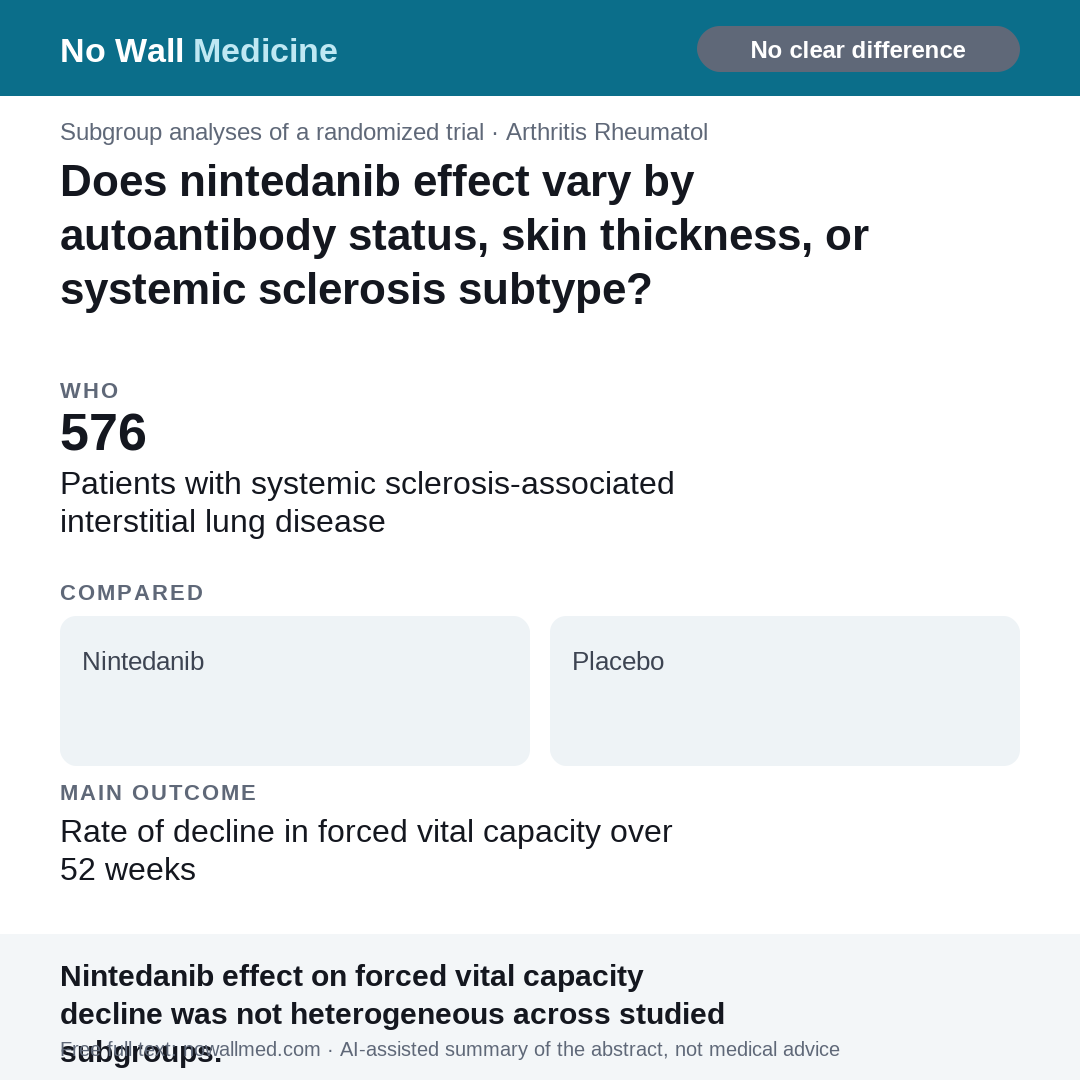
Does nintedanib effect vary by autoantibody status, skin thickness, or systemic sclerosis subtype?
Who
576
Patients with systemic sclerosis-associated interstitial lung disease
Compared
Nintedanib
Placebo
Main outcome
Rate of decline in forced vital capacity over 52 weeks
Bottom line: Nintedanib effect on forced vital capacity decline was not heterogeneous across studied subgroups.
Limitation: All exploratory interaction P values were nonsignificant
Arthritis Rheumatol · 2022-02-13Download image
Clinical question: Does nintedanib effect vary by autoantibody status, skin thickness, or systemic sclerosis subtype?
Why it matters: It was unknown if the effectiveness of nintedanib in slowing lung function decline varied depending on specific patient characteristics like autoantibody status or skin thickness.
Key points
- Researchers analyzed 576 patients with systemic sclerosis-associated interstitial lung disease randomized to receive nintedanib or a placebo.
- The drug's effect on the rate of decline in forced vital capacity, a measure of lung volume, was not significantly different across subgroups of antibody status, skin thickness, or disease subtype.
- Numerical differences in lung function decline were observed, such as 88.7 ml/year in patients with skin thickness scores of 18 or higher compared to 26.4 ml/year in those with lower scores.
Headline and key points written with AI from the paper’s abstract, with every number checked against it. Read the paper before relying on them.
Was this summary helpful?
Subject terms
Cite this article
Kuwana M, Allanore Y, Denton CP, Distler JHW, Steen V, Khanna D. Nintedanib in Patients With Systemic Sclerosis-Associated Interstitial Lung Disease: Subgroup Analyses by Autoantibody Status and Modified Rodnan Skin Thickness Score. Arthritis Rheumatol. 2022. doi:10.1002/art.41965
Spotted a mistake? Suggest a correction
Top studies every Monday
The week’s key trials and guidelines in your specialties, plus any topics you follow. By email, free.
Get the weekly digest