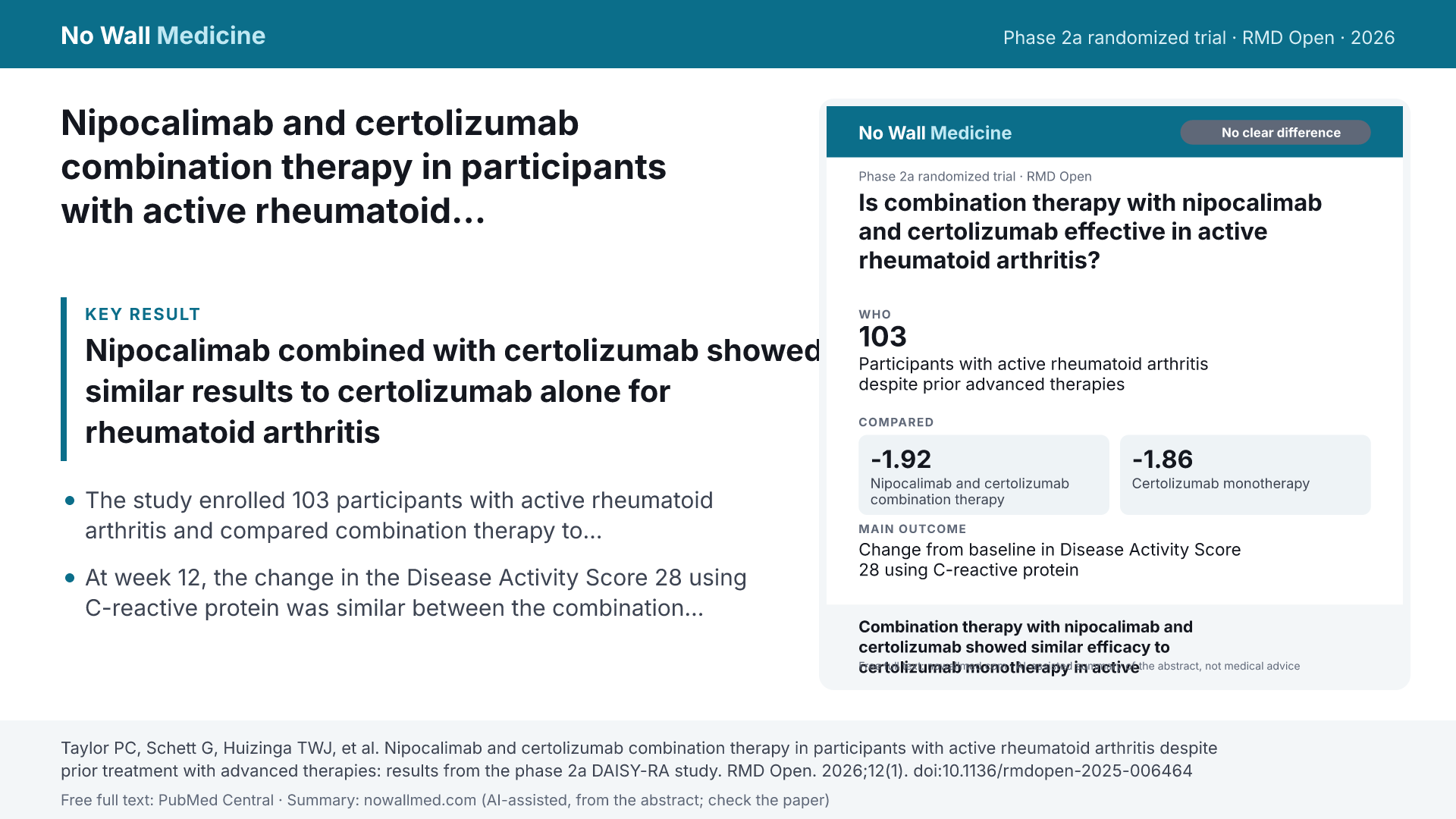
Nipocalimab combined with certolizumab showed similar results to certolizumab alone for rheumatoid arthritis
Nipocalimab and certolizumab combination therapy in participants with active rheumatoid arthritis despite prior treatment with advanced therapies: results from the phase 2a DAISY-RA study
Phase 2a randomized trialNo clear difference
Is combination therapy with nipocalimab and certolizumab effective in active rheumatoid arthritis?
Who
103
Participants with active rheumatoid arthritis despite prior advanced therapies
Compared
-1.92Nipocalimab and certolizumab combination therapy (90% CI -2.48 to -1.36)
-1.86Certolizumab monotherapy (90% CI -2.44 to -1.28)
Main outcome
Change from baseline in Disease Activity Score 28 using C-reactive protein
Result: p=0.822
Bottom line: Combination therapy with nipocalimab and certolizumab showed similar efficacy to certolizumab monotherapy in active rheumatoid arthritis.
RMD Open · 2026-03-04Download image
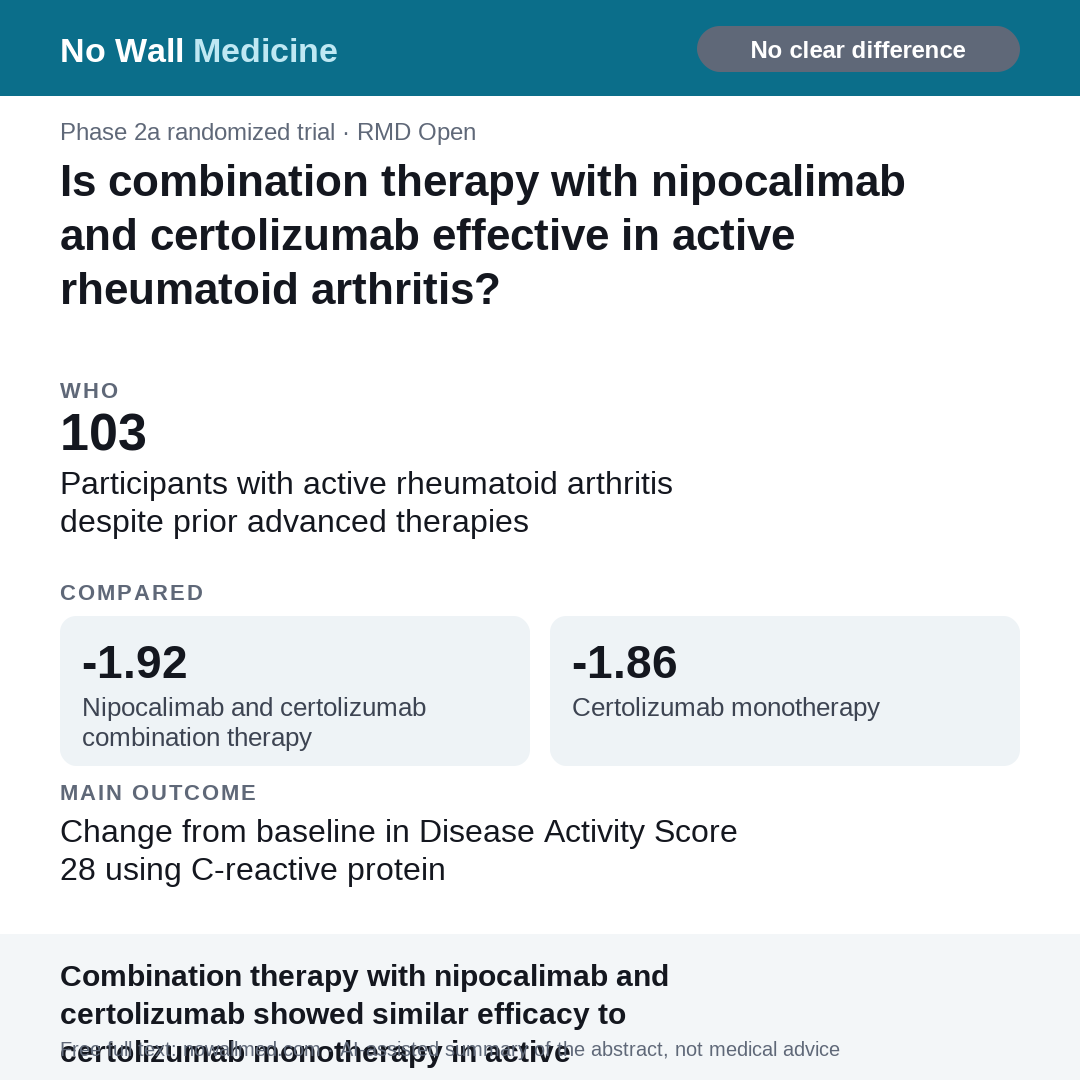
Clinical question: Is combination therapy with nipocalimab and certolizumab effective in active rheumatoid arthritis?
Key points
- The study enrolled 103 participants with active rheumatoid arthritis and compared combination therapy to certolizumab monotherapy over 30 weeks.
- At week 12, the change in the Disease Activity Score 28 using C-reactive protein was similar between the combination group and monotherapy group (p=0.822).
- Serious adverse events were reported in 11.3% of the combination therapy group compared to 2.4% in the monotherapy group.
Headline and key points written with AI from the paper’s abstract, with every number checked against it. Read the paper before relying on them.
Was this summary helpful?
Abstract
Objectives
To investigate the efficacy, safety, pharmacokinetics, immunogenicity and pharmacodynamics of combination therapy with nipocalimab and certolizumab in participants with active rheumatoid arthritis (RA) despite treatment with advanced therapies. Methods
In this phase 2a study, participants were randomised 3:2 to receive combination therapy with nipocalimab (intravenous 30 mg/kg) and certolizumab (subcutaneous 400 mg at weeks 0, 2, 4, then 200 mg) or certolizumab monotherapy every 2 weeks from weeks 0 to 24. The primary endpoint was change from baseline in Disease Activity Score 28 using C-reactive protein (DAS28-CRP) at week 12. Other outcomes were assessed through week 30. Results
103 participants were enrolled (combination therapy/monotherapy, n=62/41). At week 12, the primary endpoint was similar between groups (least squares mean 90% CI -1.92 (-2.48 to -1.36) vs -1.86 (-2.44 to -1.28); p=0.822). Secondary endpoints were also similar between groups, although numerically higher proportions of participants treated with combination therapy versus monotherapy achieved ≥50% response in American College of Rheumatology criteria (ACR50), DAS28-CRP <2.6 and DAS28-CRP ≤3.2 at week 12. Serious adverse events were reported in 11.3% of participants in the combination therapy group and 2.4% in the monotherapy group. In combination with certolizumab, nipocalimab exhibited nonlinear pharmacokinetics with accelerated clearance and substantially, reversibly reduced serum immunoglobulin G, including anticitrullinated protein antibody levels. Conclusions
Combination therapy of nipocalimab with certolizumab showed a similar outcome in the primary endpoint and secondary endpoints compared with certolizumab monotherapy in participants with active RA.
Abstract reproduced under the article’s CC BY NC licence.
Subject terms
Headline, design, result, key points, caveat and citation as plain text.
Cite this article
Taylor PC, Schett G, Huizinga TWJ, et al. Nipocalimab and certolizumab combination therapy in participants with active rheumatoid arthritis despite prior treatment with advanced therapies: results from the phase 2a DAISY-RA study. RMD Open. 2026. doi:10.1136/rmdopen-2025-006464
Spotted a mistake? Suggest a correction