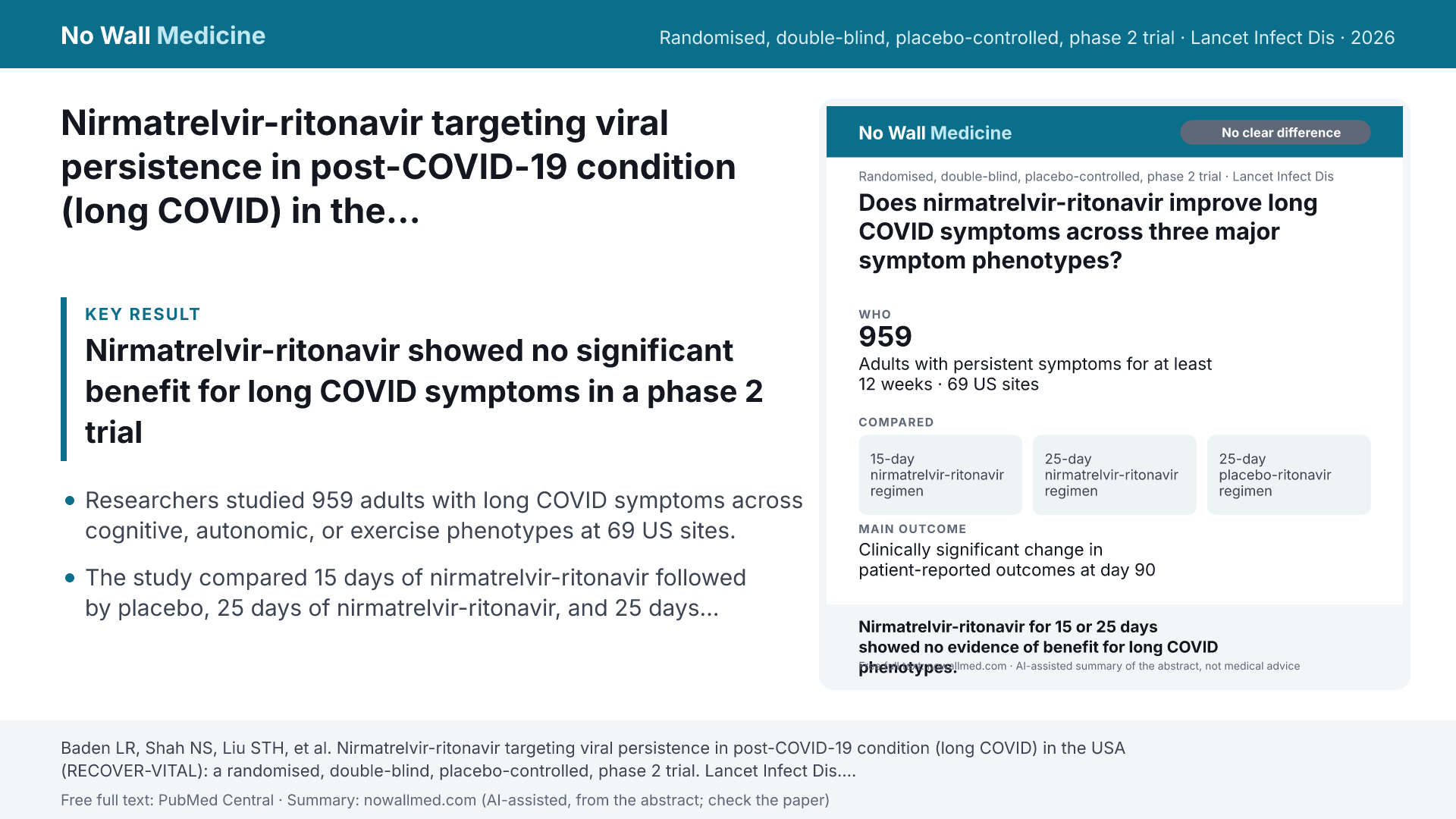
Nirmatrelvir-ritonavir showed no significant benefit for long COVID symptoms in a phase 2 trial
Nirmatrelvir-ritonavir targeting viral persistence in post-COVID-19 condition (long COVID) in the USA (RECOVER-VITAL): a randomised, double-blind, placebo-controlled, phase 2 trial
Randomised, double-blind, placebo-controlled, phase 2 trialNo clear difference
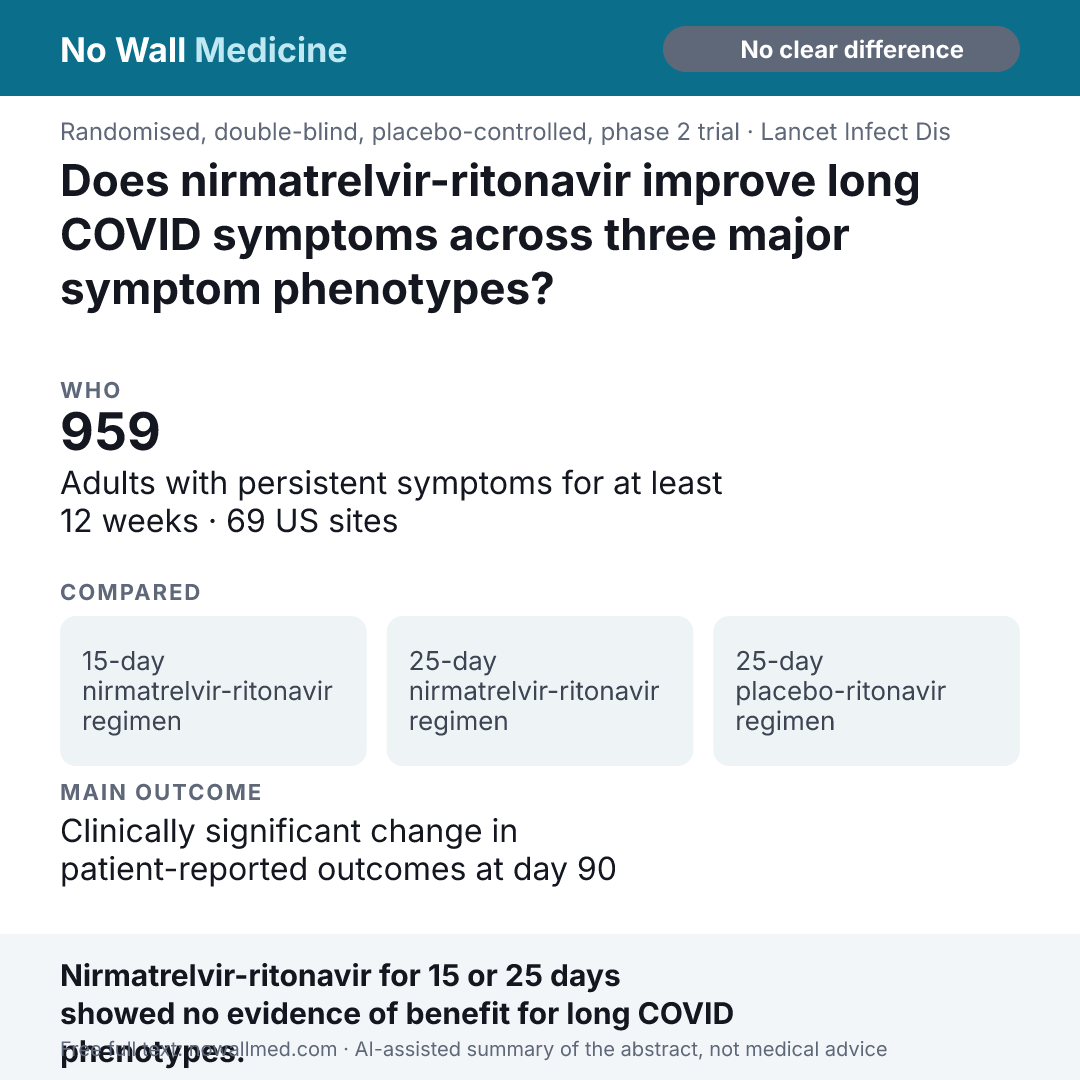
Does nirmatrelvir-ritonavir improve long COVID symptoms across three major symptom phenotypes?
Who
959
Adults with persistent symptoms for at least 12 weeks · 69 US sites
Compared
15-day nirmatrelvir-ritonavir regimen
25-day nirmatrelvir-ritonavir regimen
25-day placebo-ritonavir regimen
Main outcome
Clinically significant change in patient-reported outcomes at day 90
Bottom line: Nirmatrelvir-ritonavir for 15 or 25 days showed no evidence of benefit for long COVID phenotypes.
Funded by: National Institutes of Health
Lancet Infect Dis · 2026-08-31 · Save PNG
Clinical question: Does nirmatrelvir-ritonavir improve long COVID symptoms across three major symptom phenotypes?
Why it matters: The cause of long COVID is unknown, but one leading hypothesis is that the virus persists in the body.
Key points
- Researchers studied 959 adults with long COVID symptoms across cognitive, autonomic, or exercise phenotypes at 69 US sites.
- The study compared 15 days of nirmatrelvir-ritonavir followed by placebo, 25 days of nirmatrelvir-ritonavir, and 25 days of placebo-ritonavir.
- No statistically significant benefits were observed for any phenotype regarding the primary endpoints or secondary outcomes.
Headline and key points written with AI from the paper’s abstract, with every number checked against it. Read the paper before relying on them.
Was this summary helpful?
Abstract
Background
Post-acute sequelae of SARS-CoV-2 infection, more commonly known as long COVID, has emerged as a major health problem. The pathogenesis of long COVID is unknown, but among the leading hypotheses is viral persistence. We aimed to investigate whether the use of the SARS-CoV-2 antiviral nirmatrelvir-ritonavir improved long COVID symptoms. Methods
We conducted a double-blind, placebo-controlled, randomised trial involving adults who had developed persistent symptoms (≥12 weeks) associated with three major symptom phenotypes (cognitive, autonomic, or exercise) after acute SARS-CoV-2 infection at 69 US sites. Participants were eligible if they were 18 years or older and had a previous suspected, probable, or confirmed SARS-CoV-2 infection, as defined by the Pan American Health Organization. Eligible participants were also required to have either at least two moderate symptoms from the same phenotype or one severe phenotype-associated symptom, as identified with the Cluster Targeted COVID-19 Symptom Questions. Participants were randomly allocated in a double-blind manner in a 1:1:1 ratio using permuted blocks of size 30 to receive either 15 days of active intervention followed by 10 days of placebo (300 mg nirmatrelvir-100 mg ritonavir twice daily, then 100 mg ritonavir-placebo); 25 days of active intervention (300 mg nirmatrelvir-100 mg ritonavir twice daily); or 25 days of placebo-ritonavir (100 mg ritonavir-placebo). A clinically significant change in patient-reported outcomes at day 90 comprised the primary endpoint: Patient-Reported Outcomes Measurement Information System Cognitive Function Short Form 8a, Orthostatic Hypotension Questionnaire question 1, and a modified version of the DePaul Symptom Questionnaire Post-Exertional Malaise short form. Secondary outcomes were phenotype-specific performance measures. The study was registered at ClinicalTrials.gov (NCT05595369) and is complete. Findings
Between July 27, 2023, and Sept 6, 2024, 1207 individuals were screened. Of these, 964 were randomly allocated and 959 participants, excluding four participants who were later found ineligible and one who did not initiate treatment, were enrolled in the three phenotypes: 332 to cognitive, 334 to autonomic, and 332 to exercise. In the 959 participants in the mITT population, 643 (67%) self-reported as female, 314 (33%) were male, and two participants had a sex of unknown or undifferentiated; 750 (78%) were White; and 108 (11%) were Hispanic, Latino, or Spanish. The median age was 49 years (IQR 38-59). No statistically significant benefits were observed for any phenotype for primary endpoints. For the cognitive phenotype, adjusted differences compared to placebo were 3·2% (95% CI -10·4 to 16·8, p=0·65) for the 25-day regimen and -2·2% (-15·5 to 11·1, p=0·74) for the 15-day regimen. For the autonomic phenotype, adjusted differences were -6·4% (-18·5 to 5·7, p=0·30) for the 25-day regimen compared to placebo and -0·1% (-12·5 to 12·3, p=0·99) for the 15-day regimen compared to placebo. For exercise, adjusted differences were -7·8% (-19·5 to 3·8, p=0·19) for the 25-day regimen compared to placebo and 0·9% (-11·4 to 13·2, p=0·88) for the 15-day regimen compared to placebo. There were no differences in secondary endpoints, and no safety signals were observed; there were no deaths, and 52 serious adverse events occurred in 42 (4%) of 963 participants over the course of the study. Interpretation
Nirmatrelvir-ritonavir for 15 days or 25 days showed no evidence of benefit in long COVID in any of the three phenotypes studied. These findings suggest additional approaches to measuring the symptom burden and treating Long COVID are needed. Funding
National Institutes of Health.
Abstract reproduced under the article’s CC BY NC ND licence.
Headline, design, result, key points, caveat and citation as plain text.
Cite this article
Baden LR, Shah NS, Liu STH, et al. Nirmatrelvir-ritonavir targeting viral persistence in post-COVID-19 condition (long COVID) in the USA (RECOVER-VITAL): a randomised, double-blind, placebo-controlled, phase 2 trial. Lancet Infect Dis. 2026;26(12):1239-1252. doi:10.1016/S1473-3099(26)00406-8
Spotted a mistake? Suggest a correction