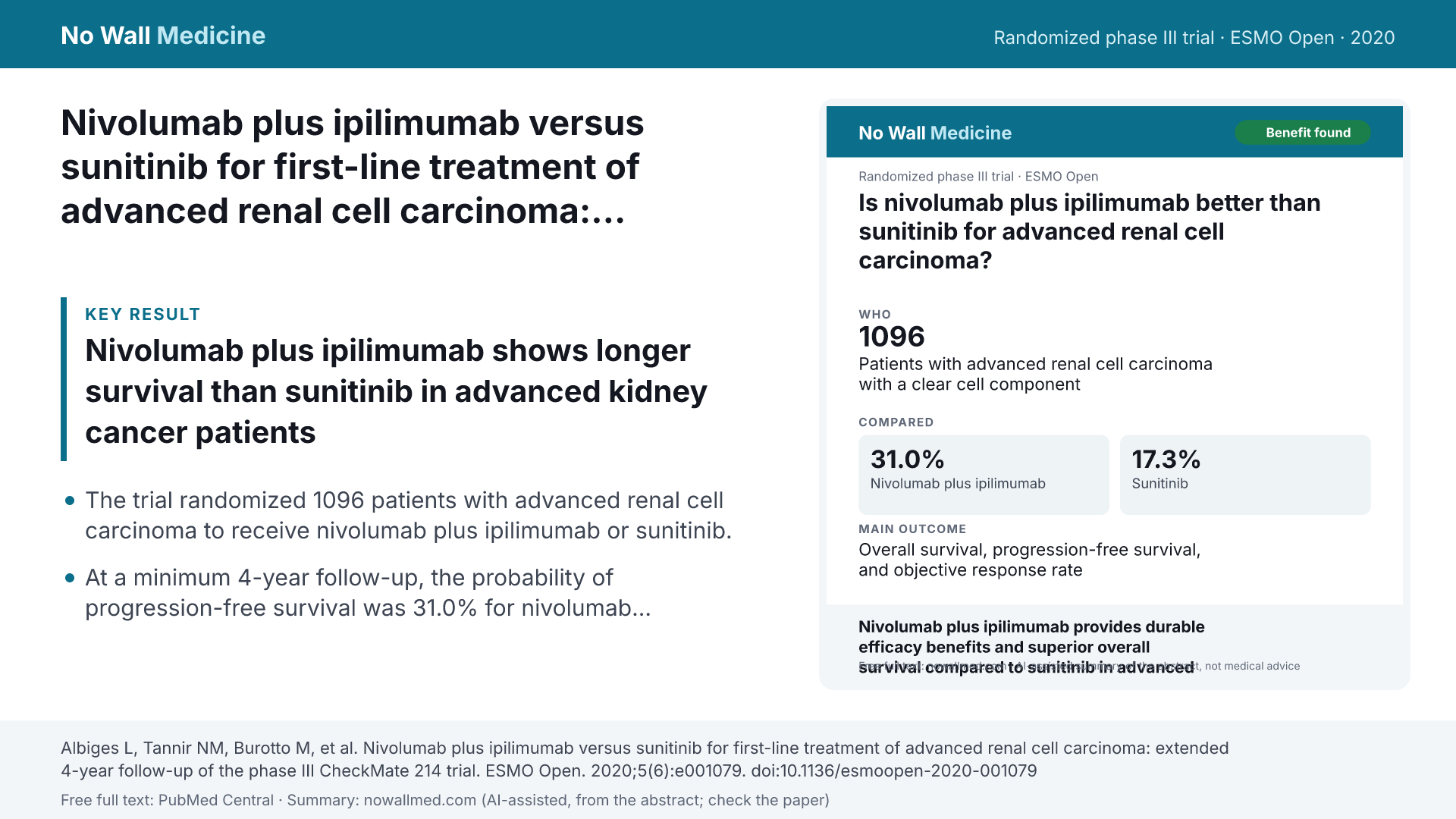
Nivolumab plus ipilimumab shows longer survival than sunitinib in advanced kidney cancer patients
Nivolumab plus ipilimumab versus sunitinib for first-line treatment of advanced renal cell carcinoma: extended 4-year follow-up of the phase III CheckMate 214 trial
Randomized phase III trialBenefit found
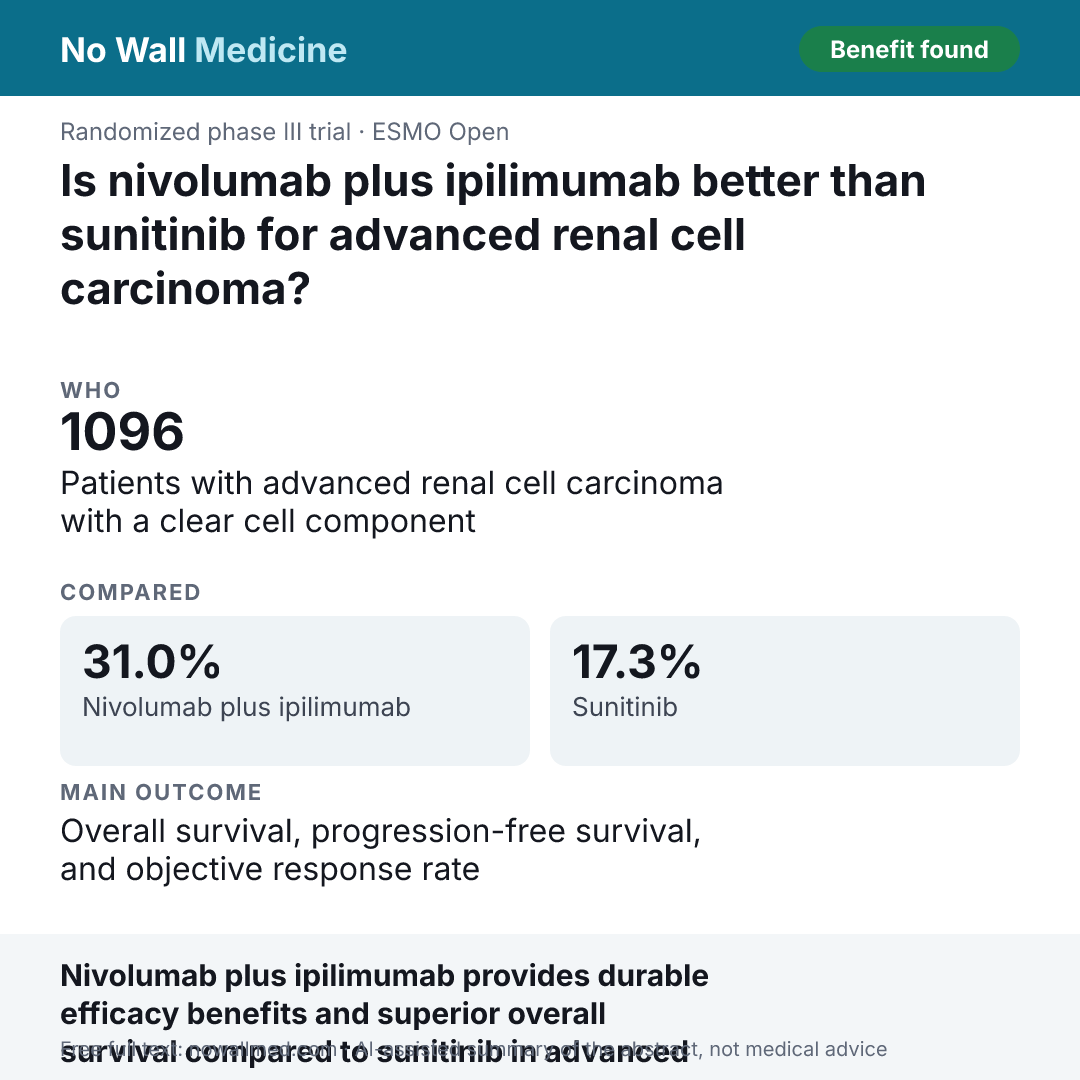
Is nivolumab plus ipilimumab better than sunitinib for advanced renal cell carcinoma?
Who
1096
Patients with advanced renal cell carcinoma with a clear cell component
Compared
31.0%Nivolumab plus ipilimumab (ITT four-year progression-free survival probability)
17.3%Sunitinib (ITT four-year progression-free survival probability)
Main outcome
Overall survival, progression-free survival, and objective response rate
Result: hazard ratio 0.69 (95% CI 0.59 to 0.81)
Bottom line: Nivolumab plus ipilimumab provides durable efficacy benefits and superior overall survival compared to sunitinib in advanced renal cell carcinoma.
ESMO Open · 2020-11-28 · Save PNG
Same trial (NCT02231749)
Papers we list that report this registered trial, oldest first. Read a secondary analysis alongside the main results.
- Longer follow-up Benefit found
This paper ESMO Open 2020-11 - Secondary analysis Benefit found
Nivolumab plus ipilimumab was associated with better survival and tumor shrinkage than sunitinib Eur Urol 2021-11 - Longer follow-up Benefit found
Nivolumab plus ipilimumab showed longer survival than sunitinib in advanced sarcomatoid renal cell carcinoma J Immunother Cancer 2022-12 - Main results Benefit found
Nivolumab plus ipilimumab was associated with longer treatment-free survival than sunitinib in advanced kidney cancer J Immunother Cancer 2024-07 - Longer follow-up Benefit found
Nivolumab plus ipilimumab improved survival compared to sunitinib in advanced renal cell carcinoma Ann Oncol 2026-03
Clinical question: Is nivolumab plus ipilimumab better than sunitinib for advanced renal cell carcinoma?
Key points
- The trial randomized 1096 patients with advanced renal cell carcinoma to receive nivolumab plus ipilimumab or sunitinib.
- At a minimum 4-year follow-up, the probability of progression-free survival was 31.0% for nivolumab plus ipilimumab versus 17.3% for sunitinib in the intent-to-treat group.
- The probability of response lasting 4 years or more was 59% for nivolumab plus ipilimumab versus 30% for sunitinib in the intent-to-treat group.
Headline and key points written with AI from the paper’s abstract, with every number checked against it. Read the paper before relying on them.
Was this summary helpful?
Abstract
Purpose
To report updated analyses of the phase III CheckMate 214 trial with extended minimum follow-up assessing long-term outcomes with first-line nivolumab plus ipilimumab (NIVO+IPI) versus (vs) sunitinib (SUN) in patients with advanced renal cell carcinoma (aRCC). Methods
Patients with aRCC with a clear cell component were stratified by International Metastatic Renal Cell Carcinoma Database Consortium risk and randomised to NIVO (3 mg/kg) plus IPI (1 mg/kg) every three weeks ×4 doses, followed by NIVO (3 mg/kg) every two weeks; or SUN (50 mg) once per day ×4 weeks (6-week cycle). Efficacy endpoints included overall survival (OS), progression-free survival (PFS) and objective response rate (ORR) per independent radiology review committee in patients with intermediate/poor-risk disease (I/P; primary), intent-to-treat patients (ITT; secondary) and in patients with favourable-risk disease (FAV; exploratory). Results
Overall, 1096 patients were randomised (ITT: NIVO+IPI, n=550, SUN, n=546; I/P: NIVO+IPI, n=425, SUN, n=422; FAV: NIVO+IPI, n=125, SUN, n=124). After 4 years minimum follow-up, OS (HR; 95% CI) remained superior with NIVO+IPI vs SUN in ITT (0.69; 0.59 to 0.81) and I/P patients (0.65; 0.54 to 0.78). Four-year PFS probabilities were 31.0% vs 17.3% (ITT) and 32.7% vs 12.3% (I/P), with NIVO+IPI vs SUN. ORR remained higher with NIVO+IPI vs SUN in ITT (39.1% vs 32.4%) and I/P (41.9% vs 26.8%) patients. In FAV patients, the HRs (95% CI) for OS and PFS were 0.93 (0.62 to 1.40) and 1.84 (1.29 to 2.62); ORR was lower with NIVO+IPI vs SUN. However, more patients in all risk groups achieved complete responses with NIVO+IPI: ITT (10.7% vs 2.6%), I/P (10.4% vs 1.4%) and FAV (12.0% vs 6.5%). Probability (95% CI) of response ≥4 years was higher with NIVO+IPI vs SUN (ITT, 59% (0.51 to 0.66) vs 30% (0.21 to 0.39); I/P, 59% (0.50 to 0.67) vs 24% (0.14 to 0.36); and FAV, 60% (0.41 to 0.75) vs 38% (0.22 to 0.54)) regardless of risk category. Safety remained favourable with NIVO+IPI vs SUN. Conclusion
After long-term follow-up, NIVO+IPI continues to demonstrate durable efficacy benefits vs SUN, with manageable safety. Trial registration details
ClinicalTrials.gov identifier: NCT02231749.
Abstract reproduced under the article’s CC BY NC licence.
Subject terms
Headline, design, result, key points, caveat and citation as plain text.
Cite this article
Albiges L, Tannir NM, Burotto M, et al. Nivolumab plus ipilimumab versus sunitinib for first-line treatment of advanced renal cell carcinoma: extended 4-year follow-up of the phase III CheckMate 214 trial. ESMO Open. 2020;5(6):e001079. doi:10.1136/esmoopen-2020-001079
Spotted a mistake? Suggest a correction