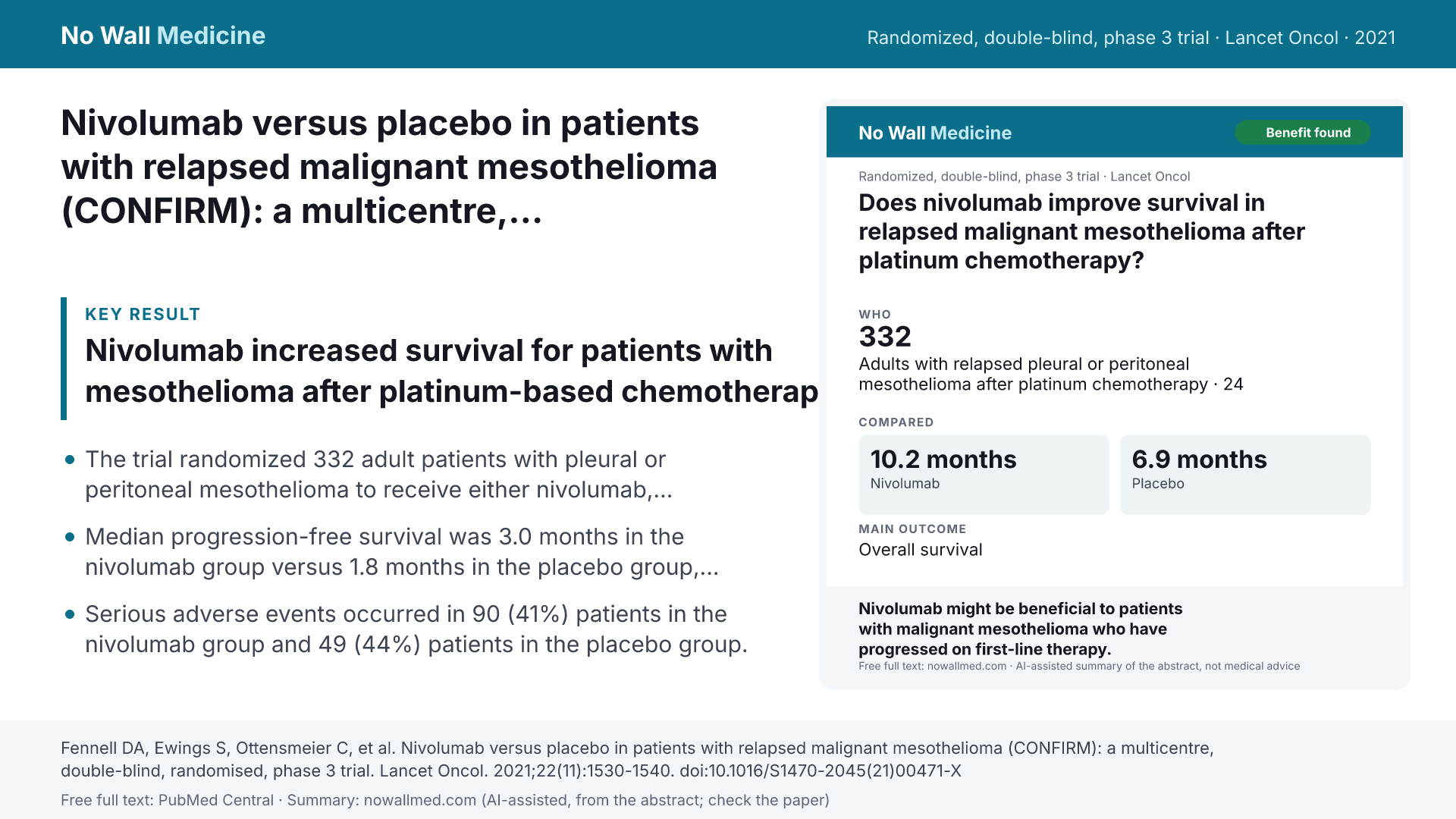
Nivolumab increased survival for patients with mesothelioma after platinum-based chemotherapy
Nivolumab versus placebo in patients with relapsed malignant mesothelioma (CONFIRM): a multicentre, double-blind, randomised, phase 3 trial
Randomized, double-blind, phase 3 trialBenefit found
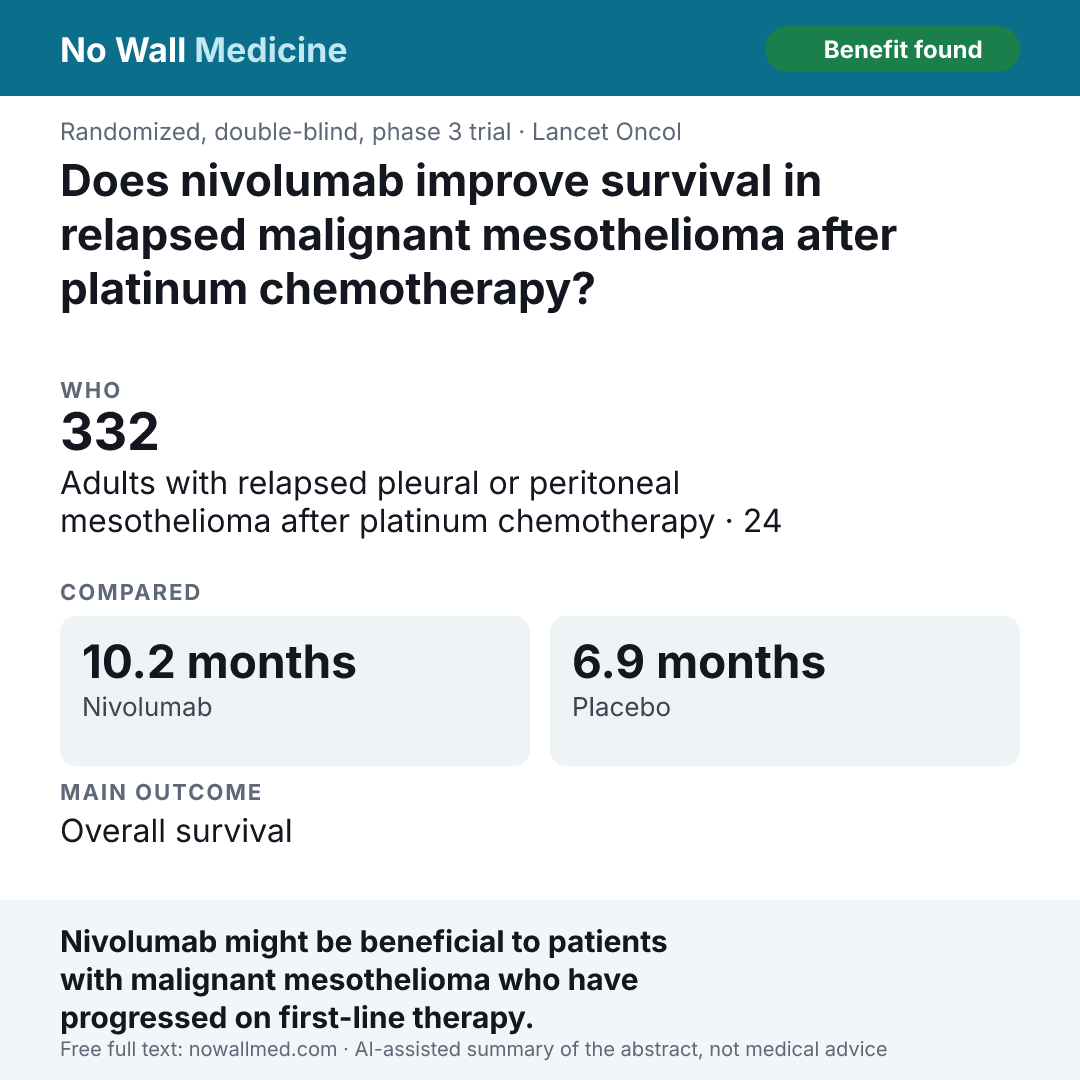
Does nivolumab improve survival in relapsed malignant mesothelioma after platinum chemotherapy?
Who
332
Adults with relapsed pleural or peritoneal mesothelioma after platinum chemotherapy · 24 hospitals in the UK
Compared
10.2 monthsNivolumab (95% CI 8.5-12.1)
6.9 monthsPlacebo (95% CI 5.0-8.0)
Main outcome
Overall survival
Result: adjusted hazard ratio 0.69 (95% CI 0.52-0.91)
Bottom line: Nivolumab might be beneficial to patients with malignant mesothelioma who have progressed on first-line therapy.
Funded by: Stand up to Cancer-Cancer Research UK and Bristol Myers Squibb
Lancet Oncol · 2021-10-14 · Save PNG
Clinical question: Does nivolumab improve survival in relapsed malignant mesothelioma after platinum chemotherapy?
Key points
- The trial randomized 332 adult patients with pleural or peritoneal mesothelioma to receive either nivolumab, an anti-PD-1 antibody, or a placebo.
- Median progression-free survival was 3.0 months in the nivolumab group versus 1.8 months in the placebo group, and median overall survival was 10.2 months versus 6.9 months.
- Serious adverse events occurred in 90 (41%) patients in the nivolumab group and 49 (44%) patients in the placebo group.
Headline and key points written with AI from the paper’s abstract, with every number checked against it. Read the paper before relying on them.
Was this summary helpful?
Abstract
Background
No phase 3 trial has yet shown improved survival for patients with pleural or peritoneal malignant mesothelioma who have progressed following platinum-based chemotherapy. The aim of this study was to assess the efficacy and safety of nivolumab, an anti-PD-1 antibody, in these patients. Methods
This was a multicentre, placebo-controlled, double-blind, parallel group, randomised, phase 3 trial done in 24 hospitals in the UK. Adult patients (aged ≥18 years) with an Eastern Cooperative Oncology Group performance status of 0 or 1, with histologically confirmed pleural or peritoneal mesothelioma, who had received previous first-line platinum-based chemotherapy and had radiological evidence of disease progression, were randomly assigned (2:1) to receive nivolumab at a flat dose of 240 mg every 2 weeks over 30 min intravenously or placebo until disease progression or a maximum of 12 months. The randomisation sequence was generated within an interactive web response system (Alea); patients were stratified according to epithelioid versus non-epithelioid histology and were assigned in random block sizes of 3 and 6. Participants and treating clinicians were masked to group allocation. The co-primary endpoints were investigator-assessed progression-free survival and overall survival, analysed according to the treatment policy estimand (an equivalent of the intention-to-treat principle). All patients who were randomly assigned were included in the safety population, reported according to group allocation. This trial is registered with Clinicaltrials.gov, NCT03063450. Findings
Between May 10, 2017, and March 30, 2020, 332 patients were recruited, of whom 221 (67%) were randomly assigned to the nivolumab group and 111 (33%) were assigned to the placebo group). Median follow-up was 11·6 months (IQR 7·2-16·8). Median progression-free survival was 3·0 months (95% CI 2·8-4·1) in the nivolumab group versus 1·8 months (1·4-2·6) in the placebo group (adjusted hazard ratio [HR] 0·67 [95% CI 0·53-0·85; p=0·0012). Median overall survival was 10·2 months (95% CI 8·5-12·1) in the nivolumab group versus 6·9 months (5·0-8·0) in the placebo group (adjusted HR 0·69 [95% CI 0·52-0·91]; p=0·0090). The most frequently reported grade 3 or worse treatment-related adverse events were diarrhoea (six [3%] of 221 in the nivolumab group vs two [2%] of 111 in the placebo group) and infusion-related reaction (six [3%] vs none). Serious adverse events occurred in 90 (41%) patients in the nivolumab group and 49 (44%) patients in the placebo group. There were no treatment-related deaths in either group. Interpretation
Nivolumab represents a treatment that might be beneficial to patients with malignant mesothelioma who have progressed on first-line therapy. Funding
Stand up to Cancer-Cancer Research UK and Bristol Myers Squibb.
Abstract reproduced under the article’s CC BY licence.
Subject terms
Headline, design, result, key points, caveat and citation as plain text.
Cite this article
Fennell DA, Ewings S, Ottensmeier C, et al. Nivolumab versus placebo in patients with relapsed malignant mesothelioma (CONFIRM): a multicentre, double-blind, randomised, phase 3 trial. Lancet Oncol. 2021;22(11):1530-1540. doi:10.1016/S1470-2045(21)00471-X
Spotted a mistake? Suggest a correction