No-Touch Versus Conventional Vein Harvesting Techniques at 12 Months After Coronary Artery Bypass Grafting Surgery: Multicenter Randomized, Controlled Trial
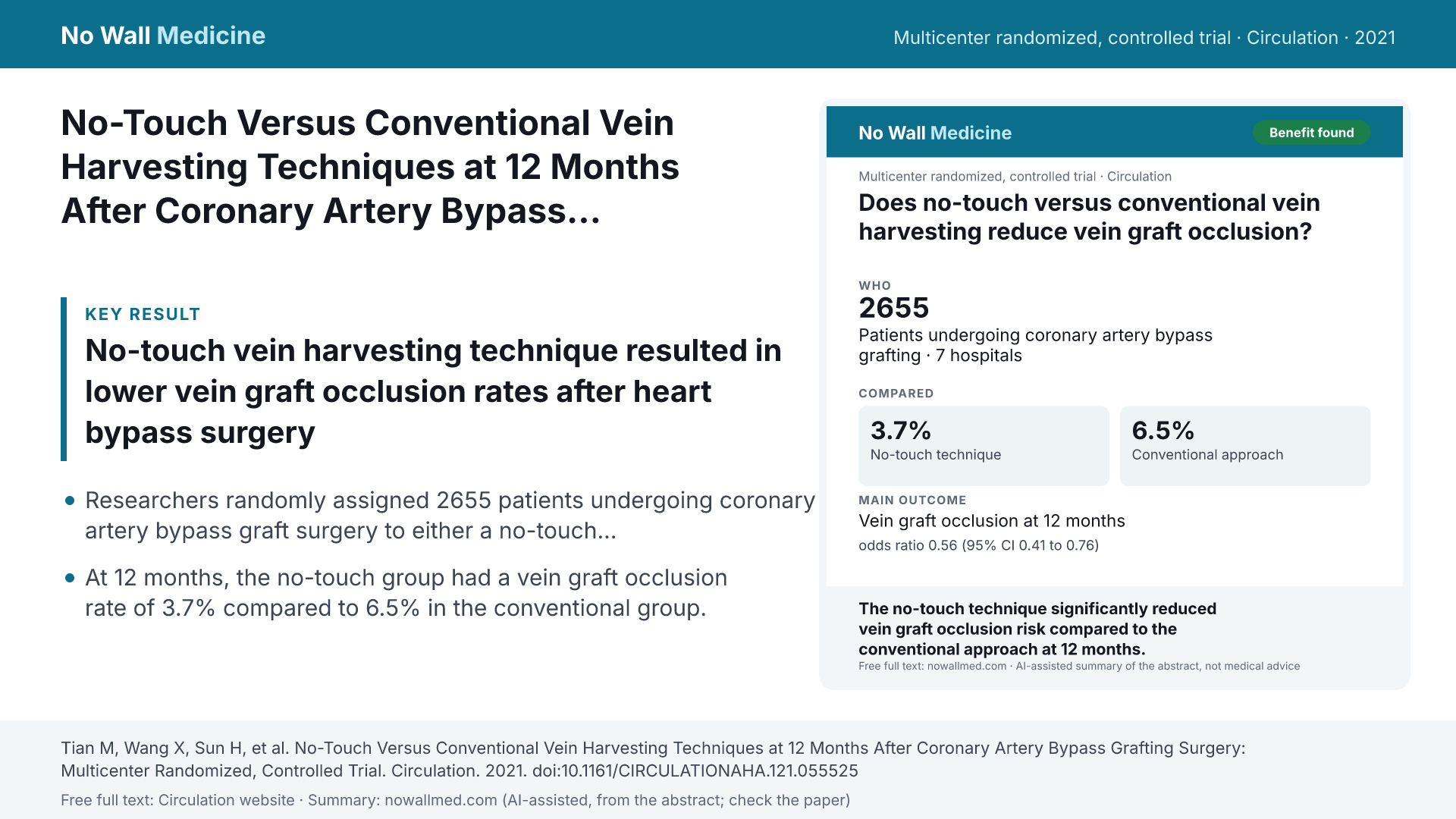
Key result: No-touch vein harvesting technique resulted in lower vein graft occlusion rates after heart bypass surgery
Multicenter randomized, controlled trialBenefit found
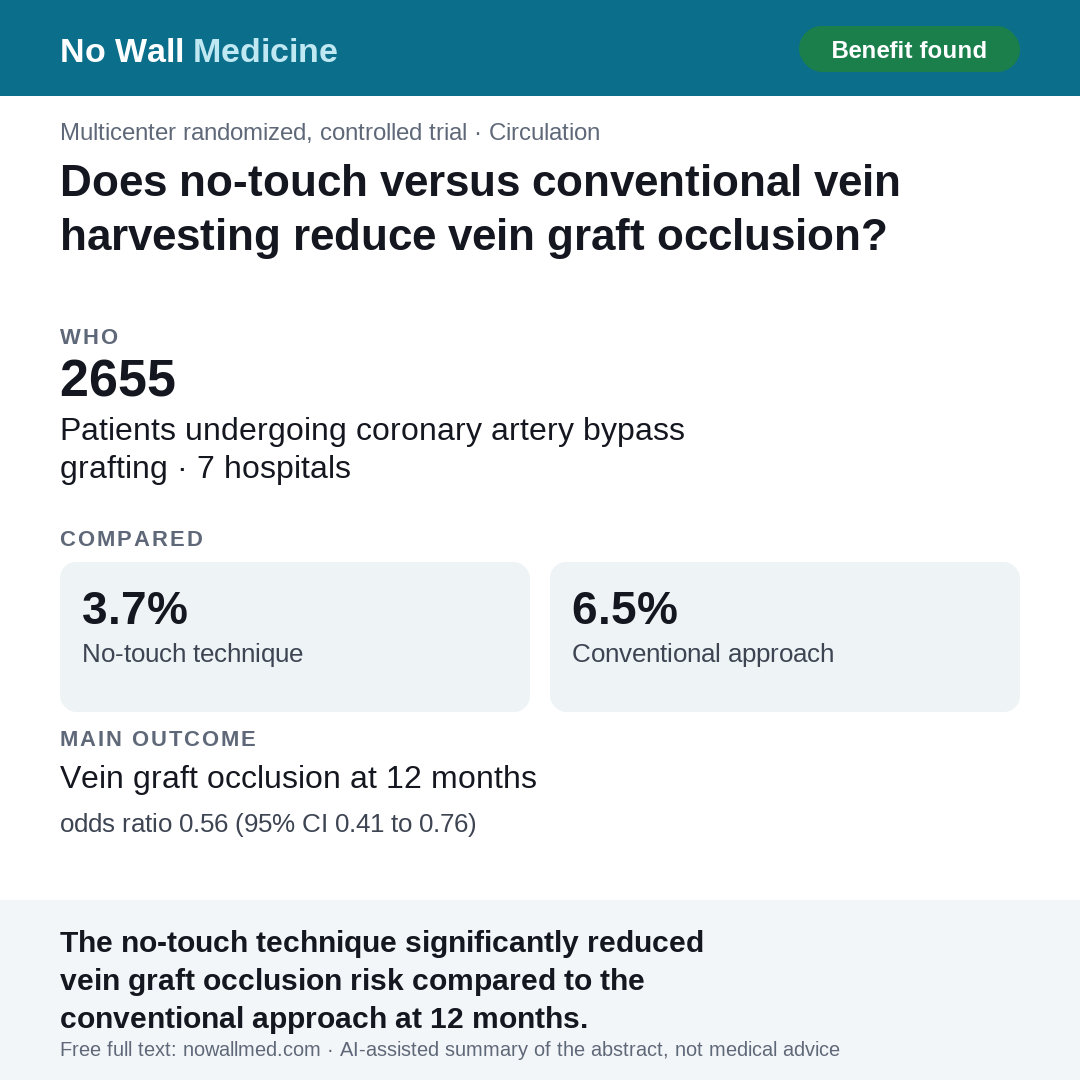
Does no-touch versus conventional vein harvesting reduce vein graft occlusion?
Who
2655
Patients undergoing coronary artery bypass grafting · 7 hospitals
Compared
3.7%No-touch technique
6.5%Conventional approach
Main outcome
Vein graft occlusion at 12 months
Result: odds ratio 0.56 (95% CI 0.41 to 0.76)
Bottom line: The no-touch technique significantly reduced vein graft occlusion risk compared to the conventional approach at 12 months.
Circulation · 2021-09-13Download image
Key points
- Researchers randomly assigned 2655 patients undergoing coronary artery bypass graft surgery to either a no-touch vein harvesting technique or a conventional approach.
- At 12 months, the no-touch group had a vein graft occlusion rate of 3.7% compared to 6.5% in the conventional group.
- The no-touch technique was associated with higher rates of leg wound surgical interventions at 3 months, with 10.3% versus 4.3%.
Discussion prompts
- Would these patients look like yours? Who was left out?
- Is the main outcome one that matters to patients?
- Is the difference large enough to change what you do?
Cite: Tian M, Wang X, Sun H, et al. No-Touch Versus Conventional Vein Harvesting Techniques at 12 Months After Coronary Artery Bypass Grafting Surgery: Multicenter Randomized, Controlled Trial. Circulation. 2021. doi:10.1161/CIRCULATIONAHA.121.055525
Free full text: Circulation website · Summary and visual abstract: nowallmed.com/a/no-touch-versus-conventional-vein-harvesting-techniques-at-12-months-e29ytz/ (AI-assisted from the abstract; check the paper before relying on it).