Node-RADS shows high diagnostic accuracy and increasing malignancy rates across categories in systematic review
Node-RADS: a systematic review and meta-analysis of diagnostic performance, category-wise malignancy rates, and inter-observer reliability
Systematic review and meta-analysisBenefit found
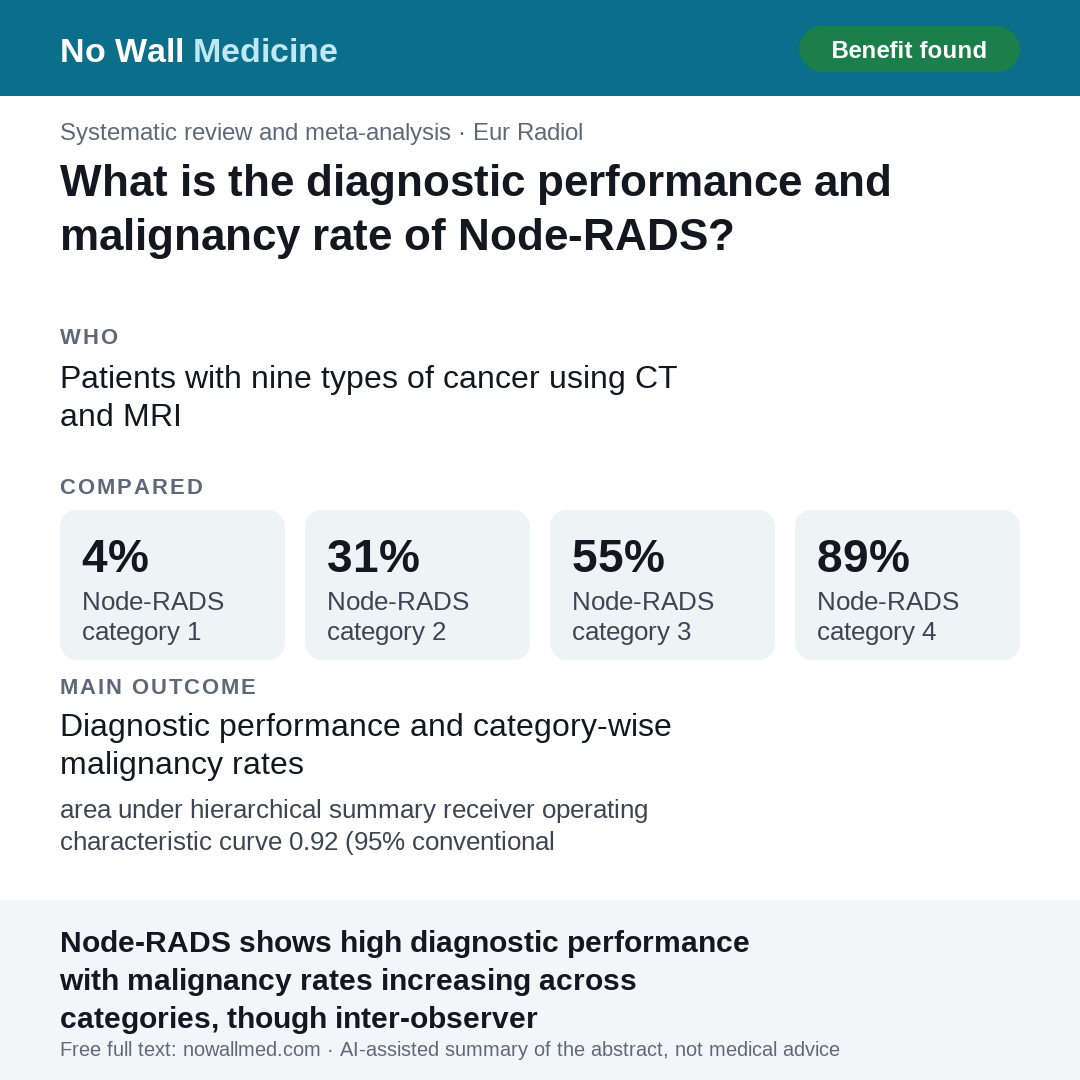
What is the diagnostic performance and malignancy rate of Node-RADS?
Who
Patients with nine types of cancer using CT and MRI
Compared
4%Node-RADS category 1 (0-10%)
31%Node-RADS category 2 (9-58%)
55%Node-RADS category 3 (34-75%)
89%Node-RADS category 4 (73-99%)
Main outcome
Diagnostic performance and category-wise malignancy rates
Result: area under hierarchical summary receiver operating characteristic curve 0.92 (95% conventional interval 0.89-0.94)
Bottom line: Node-RADS shows high diagnostic performance with malignancy rates increasing across categories, though inter-observer reliability remains insufficient.
Limitation: Inappropriate index test, unknown timing, and unclear blindness during the rating process.
Eur Radiol · 2024-11-06Download image
Clinical question: What is the diagnostic performance and malignancy rate of Node-RADS?
Why it matters: The evidence supporting the application and reliability of the Node Reporting and Data System 1.0 for reporting lymph node cancer involvement had not been summarized.
Key points
- Researchers analyzed nine studies involving six computed tomography and three magnetic resonance imaging studies covering nine cancer types to evaluate the Node Reporting and Data System 1.0.
- The area under the receiver operating characteristic curve was 0.92 for Node-RADS scores of 3 or higher and 0.91 for scores of 4 or higher.
- Malignancy rates for Node-RADS categories 1 through 5 were 4% (0-10%), 31% (9-58%), 55% (34-75%), 89% (73-99%), and 100% (97-100%), respectively.
Headline and key points written with AI from the paper’s abstract, with every number checked against it. Read the paper before relying on them.
Was this summary helpful?
Subject terms
Cite this article
Zhong J, Mao S, Chen H, Wang Y, Yin Q, Cen Q. Node-RADS: a systematic review and meta-analysis of diagnostic performance, category-wise malignancy rates, and inter-observer reliability. Eur Radiol. 2024. doi:10.1007/s00330-024-11160-1
Spotted a mistake? Suggest a correction
Top studies every Monday
The week’s key trials and guidelines in your specialties, plus any topics you follow. By email, free.
Get the weekly digest