Review shows inconsistent definitions and high bias in studies of antibiotic misalignment and infection outcomes
Nomenclature, definitions, and methodological approaches to estimate the association between antimicrobial treatment and clinical outcomes of drug-resistant bloodstream infections
Systematic reviewMixed results
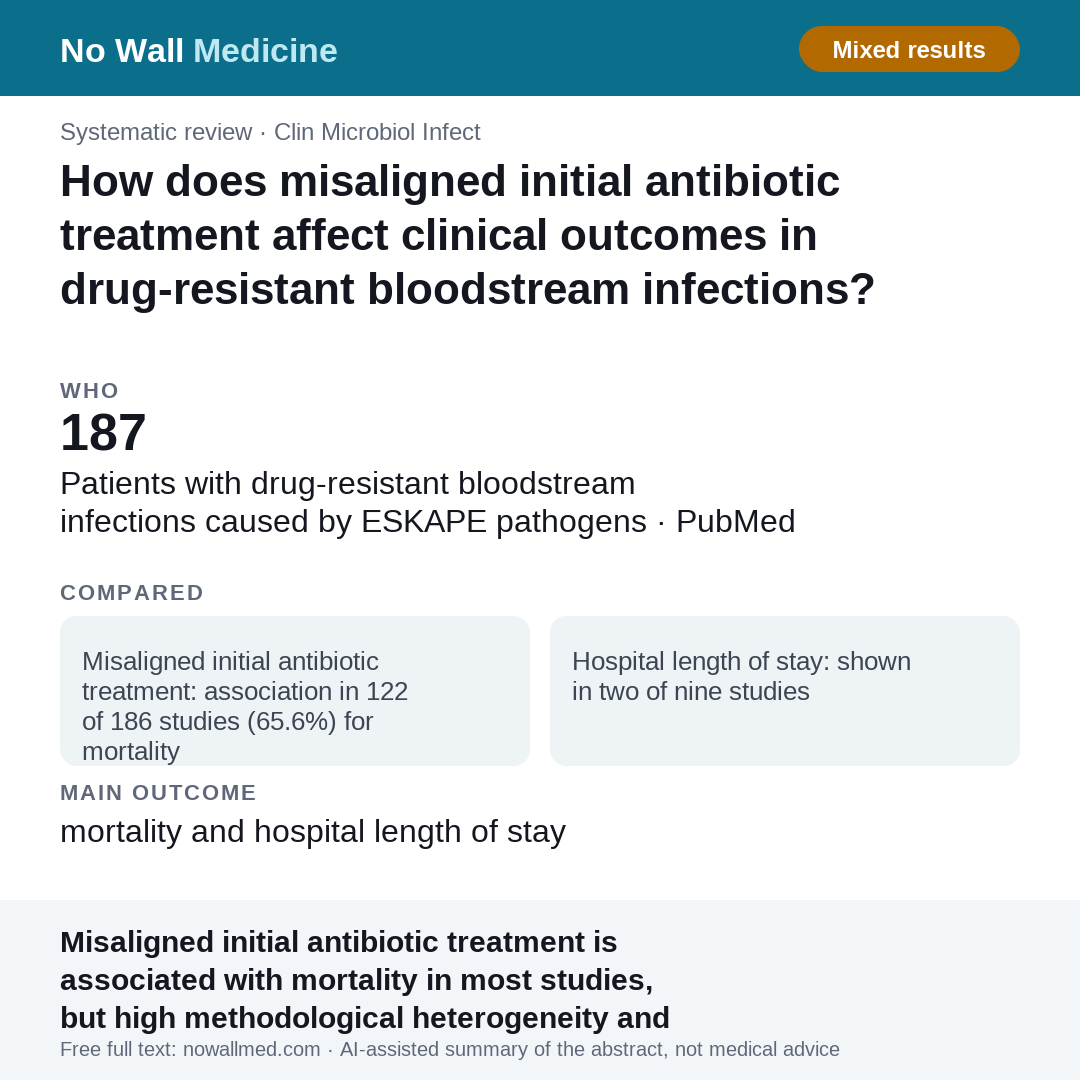
How does misaligned initial antibiotic treatment affect clinical outcomes in drug-resistant bloodstream infections?
Who
187
Patients with drug-resistant bloodstream infections caused by ESKAPE pathogens · PubMed and EMBASE
Compared
Misaligned initial antibiotic treatment: association in 122 of 186 studies (65.6%) for mortality
Hospital length of stay: shown in two of nine studies
Main outcome
mortality and hospital length of stay
Bottom line: Misaligned initial antibiotic treatment is associated with mortality in most studies, but high methodological heterogeneity and bias exist.
Limitation: No study scored a low risk of bias due to residual confounding and time-dependent bias.
Clin Microbiol Infect · 2025-08-06Download image
Clinical question: How does misaligned initial antibiotic treatment affect clinical outcomes in drug-resistant bloodstream infections?
Why it matters: The causal effect of misaligned initial antibiotic treatment on patient outcomes is unclear due to methodological differences in existing observational studies.
Key points
- Researchers conducted a systematic review of 187 studies involving patients with drug-resistant bloodstream infections caused by specific bacteria.
- In 65.6% of 186 studies, (in)appropriate initial antibiotic treatment was associated with mortality, though definitions of misalignment varied widely.
- No study in the review scored a low risk of bias because of time-dependent bias and residual confounding.
Limitation the authors note: The authors state that no study scored a low risk of bias due to residual confounding and time-dependent bias.
Headline and key points written with AI from the paper’s abstract, with every number checked against it. Read the paper before relying on them.
Topics
Cite this article
Hassoun-Kheir N, Redin MR, Labi AK, Loftus M, Stewardson AJ, Harbarth S. Nomenclature, definitions, and methodological approaches to estimate the association between antimicrobial treatment and clinical outcomes of drug-resistant bloodstream infections. Clin Microbiol Infect. 2025. doi:10.1016/j.cmi.2025.07.033
Spotted a mistake? Suggest a correction
Top studies every Monday
The week’s key trials and guidelines in your specialties, plus any topics you follow. By email, free.
Get the weekly digest