Low oxygen levels during surgery may reduce lung complications after abdominal surgery
Non-drug perioperative interventions to reduce postoperative pulmonary complications after abdominal surgery: systematic review and meta-analysis
Systematic review and meta-analysisBenefit found
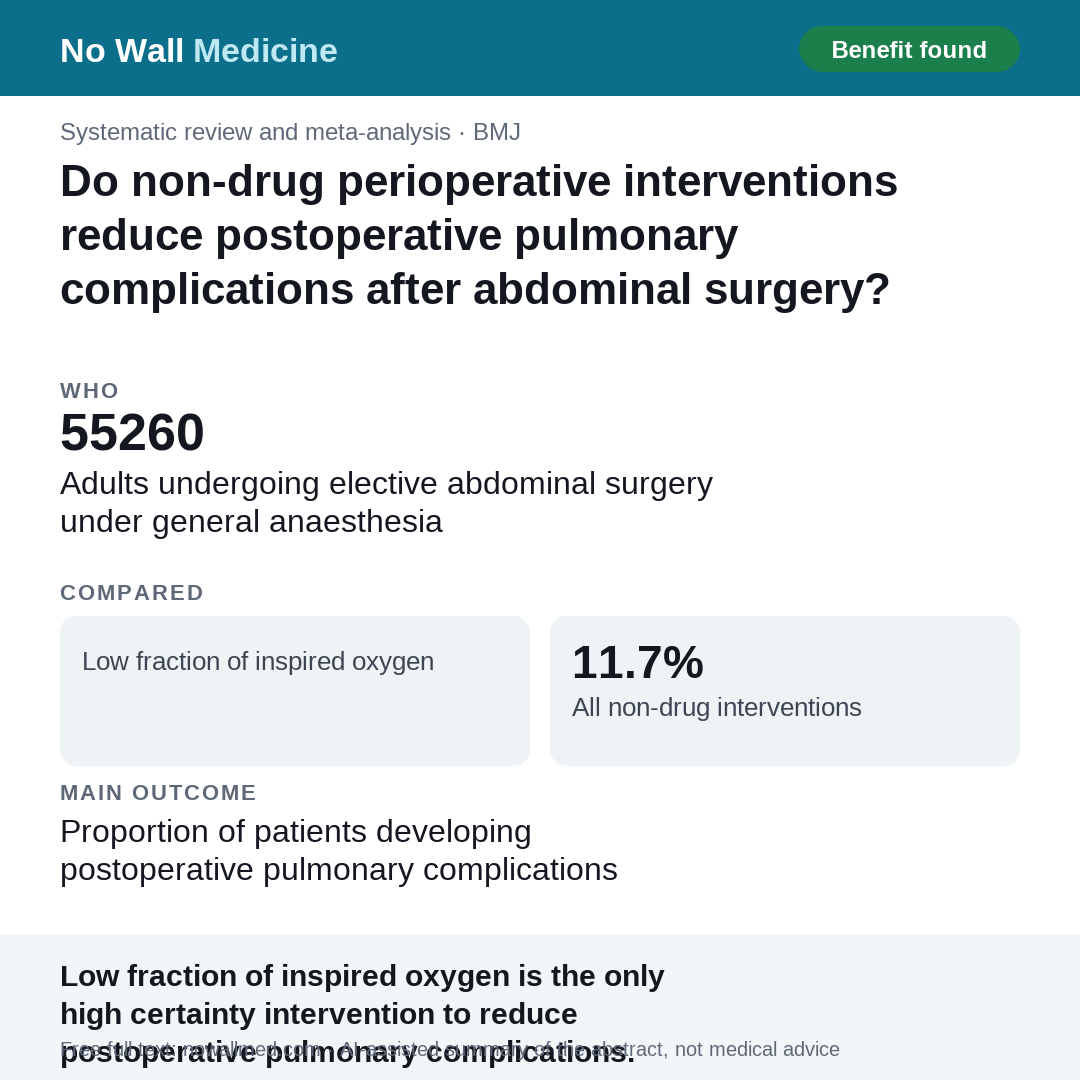
Do non-drug perioperative interventions reduce postoperative pulmonary complications after abdominal surgery?
Who
55260
Adults undergoing elective abdominal surgery under general anaesthesia
Compared
Low fraction of inspired oxygen
11.7%All non-drug interventions
Main outcome
Proportion of patients developing postoperative pulmonary complications
Result: risk ratio 0.81 (95% confidence interval 0.71 to 0.92)
Bottom line: Low fraction of inspired oxygen is the only high certainty intervention to reduce postoperative pulmonary complications.
BMJ · 2026-04-09Download image
Clinical question: Do non-drug perioperative interventions reduce postoperative pulmonary complications after abdominal surgery?
Why it matters: Doctors need to know which non-drug interventions effectively prevent lung complications in adults undergoing elective abdominal surgery under general anesthesia.
Key points
- Researchers analyzed 255 randomized controlled trials involving 55,260 participants to evaluate non-drug interventions for preventing postoperative pulmonary complications.
- High certainty evidence showed that a low fraction of inspired oxygen reduced complications with a risk ratio of 0.81.
- Other beneficial interventions included lung protective ventilation, physiotherapy, analgesia, and nutrition, while goal directed haemodynamic therapy showed no evidence of benefit.
Headline and key points written with AI from the paper’s abstract, with every number checked against it. Read the paper before relying on them.
Abstract
Objective
To evaluate the effectiveness of perioperative non-drug interventions in reducing postoperative pulmonary complications (PPCs) in adults undergoing abdominal surgery. Design
Systematic review and meta-analysis. Data sources
Ovid MEDLINE, Embase, and Web of Science from database inception to January 2025 and updated in January 2026, with no language restrictions. Study selection
Randomised controlled trials assessing the effectiveness of perioperative non-drug interventions for the prevention of PPCs in adults undergoing elective abdominal surgery under general anaesthesia, with clearly defined PPCs. Main outcome measures
The primary outcome was the proportion of patients developing PPCs. Secondary outcomes included the proportion of patients with PPC subtypes according to European Perioperative Clinical Outcome definitions (respiratory infection, respiratory failure, pleural effusion, atelectasis, or pneumothorax) and hospital length of stay. Data extraction and synthesis
Two reviewers independently screened studies, extracted data, and assessed risk of bias with the Cochrane RoB 2.0 tool. Data were synthesised using meta-analyses and trial sequential analyses, with the evidence certainty assessed using the Grading of Recommendations, Assessment, Development and Evaluation (GRADE) approach. Results
255 trials including 55 260 participants were included, evaluating 10 types of interventions with 39 subtypes for PPC prevention. PPCs occurred in 6467 (11.7%) participants across all included trials. High certainty evidence showed that low fraction of inspired oxygen (FiO2) significantly reduced PPCs (risk ratio 0.81, 95% confidence interval 0.71 to 0.92). Moderate certainty evidence showed benefit for four intervention types: lung protective ventilation (risk ratio 0.66, 0.57 to 0.76), physiotherapy (0.55, 0.46 to 0.65), analgesia (0.73, 0.64 to 0.84), and nutrition (0.74, 0.63 to 0.87), with individualised positive end expiratory pressure, composite lung protective ventilation, early mobilisation, and epidural analgesia also showing benefit at the subtype level. Trial sequential analysis confirmed sufficient cumulative evidence for all the above interventions except early mobilisation. By contrast, goal directed haemodynamic therapy, targeted blood pressure management, restrictive fluid therapy, and postoperative bi-level positive airway pressure showed no evidence of benefit, with moderate certainty. Conclusions
This synthesis establishes an evidence hierarchy for PPC prevention in abdominal surgery. Low FiO2 is the only intervention supported by high certainty evidence and should be prioritised in clinical practice. Other beneficial strategies include lung protective ventilation, physiotherapy, analgesic techniques, and nutrition interventions. Conversely, the role of goal directed haemodynamic therapy-despite its widespread use-warrants reconsideration for PPC prevention. These findings facilitate prioritisation of effective interventions and development of evidence based guidelines. Study registration
PROSPERO CRD42025637449.
Abstract reproduced under the article’s CC BY NC licence.
Topics
Spotted a mistake? Suggest a correction