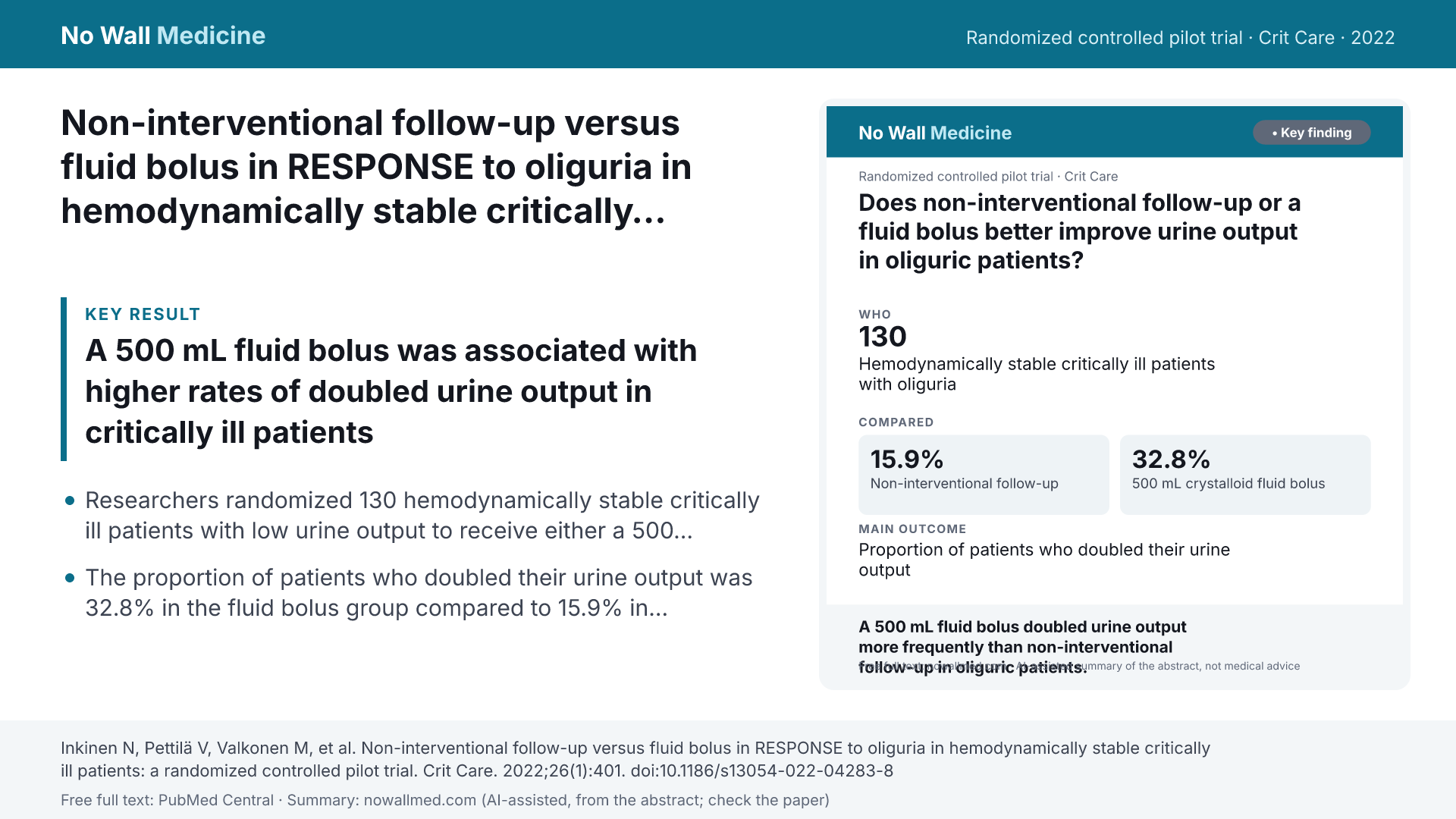
A 500 mL fluid bolus was associated with higher rates of doubled urine output in critically ill patients
Non-interventional follow-up versus fluid bolus in RESPONSE to oliguria in hemodynamically stable critically ill patients: a randomized controlled pilot trial
Randomized controlled pilot trialBenefit found
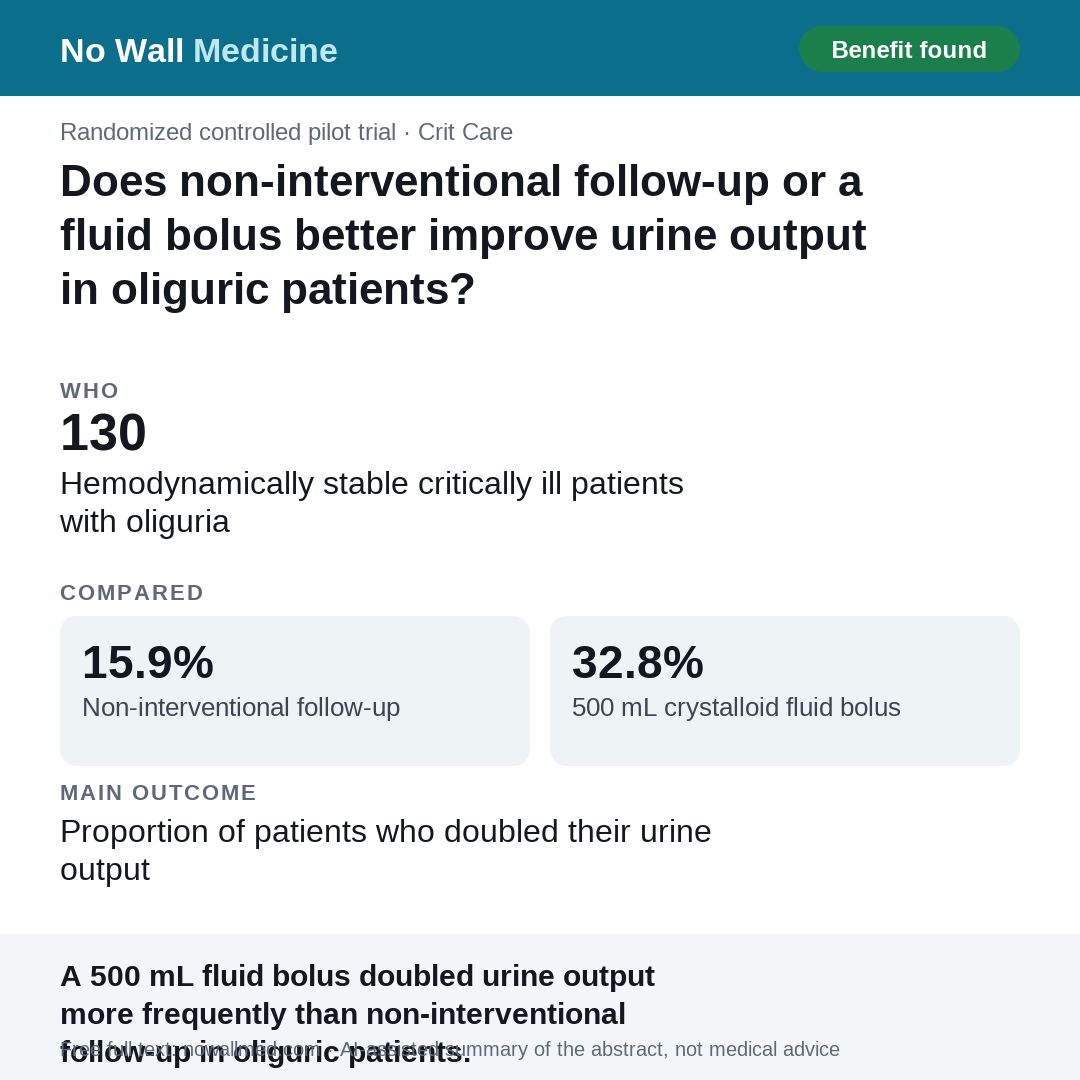
Does non-interventional follow-up or a fluid bolus better improve urine output in oliguric patients?
Who
130
Hemodynamically stable critically ill patients with oliguria
Compared
15.9%Non-interventional follow-up
32.8%500 mL crystalloid fluid bolus
Main outcome
Proportion of patients who doubled their urine output
Result: risk ratio 0.49 (95% CI 0.23-0.71)
Bottom line: A 500 mL fluid bolus doubled urine output more frequently than non-interventional follow-up in oliguric patients.
Crit Care · 2022-12-22Download image
Clinical question: Does non-interventional follow-up or a fluid bolus better improve urine output in oliguric patients?
Why it matters: It is controversial whether administering a fluid bolus provides actual benefit for critically ill patients experiencing oliguria, which is defined as urine output less than 0.5 mL/kg/h.
Key points
- Researchers randomized 130 hemodynamically stable critically ill patients with low urine output to receive either a 500 mL crystalloid fluid bolus or non-interventional follow-up for 2 hours.
- The proportion of patients who doubled their urine output was 32.8% in the fluid bolus group compared to 15.9% in the follow-up group.
- The fluid bolus group had a median urine output change of 19 mL compared to -7 mL in the follow-up group and a lower median duration of low urine output.
Headline and key points written with AI from the paper’s abstract, with every number checked against it. Read the paper before relying on them.
Was this summary helpful?
Subject terms
Cite this article
Inkinen N, Pettilä V, Valkonen M, et al. Non-interventional follow-up versus fluid bolus in RESPONSE to oliguria in hemodynamically stable critically ill patients: a randomized controlled pilot trial. Crit Care. 2022. doi:10.1186/s13054-022-04283-8
Spotted a mistake? Suggest a correction