Repetitive transcranial magnetic stimulation may improve symptoms in treatment-resistant schizophrenia patients
Non-invasive brain stimulation augmentation therapy for treatment-resistant schizophrenia: a systematic review and network meta-analysis
Systematic review and network meta-analysisMixed results
What is the efficacy and safety of non-invasive brain stimulation for treatment-resistant schizophrenia?
Who
3416
Participants with treatment-resistant schizophrenia
Compared
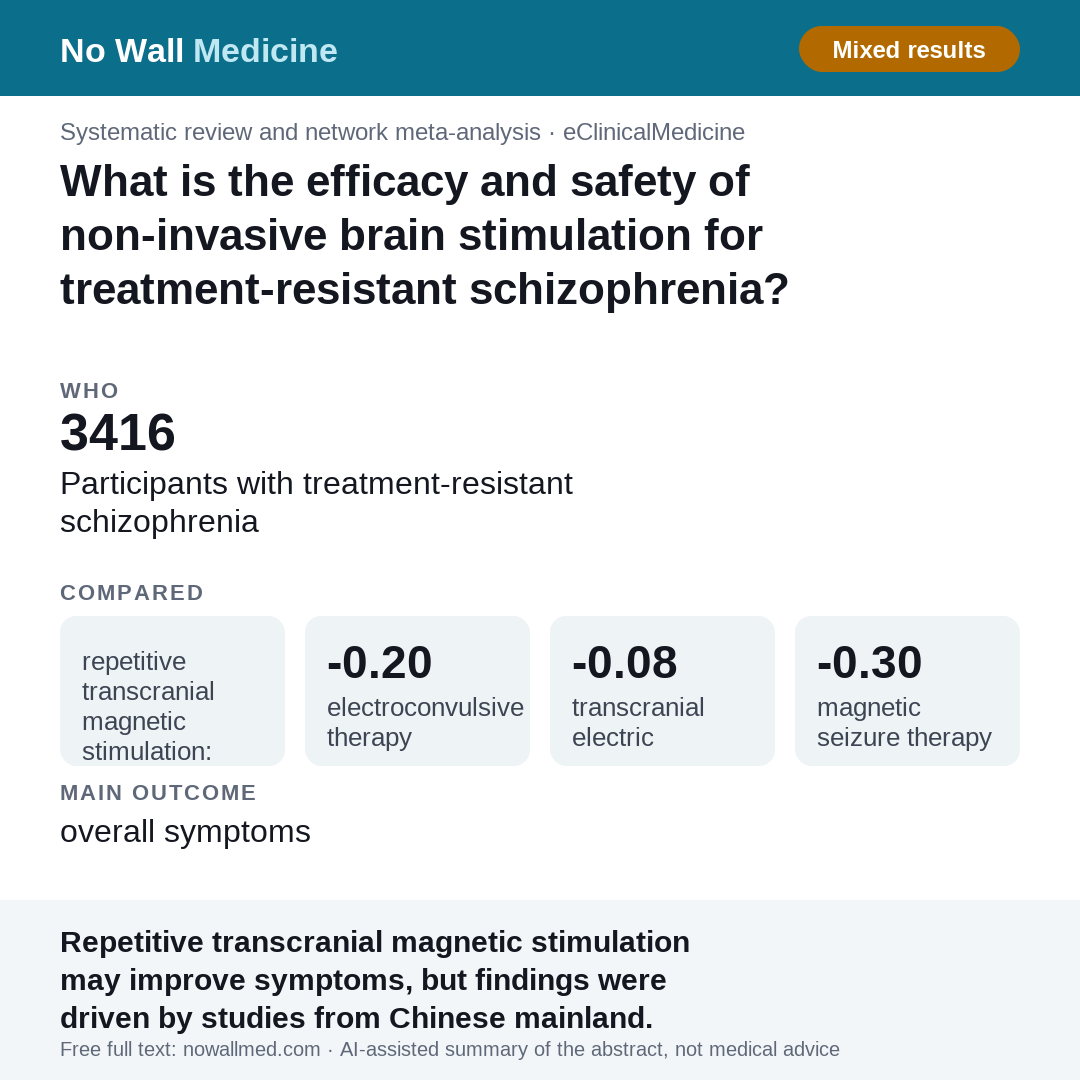
repetitive transcranial magnetic stimulation: SMD -0.47 (95% CI [-0.62; -0.31])
-0.20electroconvulsive therapy (95% CI [-0.78; 0.37])
-0.08transcranial electric stimulation (95% CI [-0.38; 0.22])
-0.30magnetic seizure therapy (95% CI [-1.73; 1.13])
Main outcome
overall symptoms
Result: SMD -0.47 (95% CI [-0.62; -0.31]) for rTMS
Bottom line: Repetitive transcranial magnetic stimulation may improve symptoms, but findings were driven by studies from Chinese mainland.
Funded by: German Federal Ministry of Education and Research
eClinicalMedicine · 2025-10-22Download image
Clinical question: What is the efficacy and safety of non-invasive brain stimulation for treatment-resistant schizophrenia?
Why it matters: Guidelines remain controversial regarding whether non-invasive brain stimulation is effective and which specific methods or targets are preferred for treatment-resistant schizophrenia.
Key points
- Researchers analyzed 78 randomized controlled trials involving 3416 participants with treatment-resistant schizophrenia to compare different brain stimulation methods.
- Repetitive transcranial magnetic stimulation was more efficacious for overall symptoms than sham stimulation (SMD -0.47, 95% CI [-0.62; -0.31]), though this effect was not significant when excluding Chinese mainland studies.
- No clear differences were found for electroconvulsive therapy, transcranial electric stimulation, or magnetic seizure therapy compared to sham stimulation.
Headline and key points written with AI from the paper’s abstract, with every number checked against it. Read the paper before relying on them.
Cite this article
Wei Y, Lorenz C, Siafis S, Schneider-Thoma J, Kim DD, Wu H. Non-invasive brain stimulation augmentation therapy for treatment-resistant schizophrenia: a systematic review and network meta-analysis. eClinicalMedicine. 2025. doi:10.1016/j.eclinm.2025.103583
Spotted a mistake? Suggest a correction