Artificial intelligence algorithms show promise for predicting embryo chromosomal status using imaging
Non-invasive prediction of human embryonic ploidy using artificial intelligence: a systematic review and meta-analysis
Systematic review and meta-analysisBenefit found
How accurate is artificial intelligence for non-invasive prediction of embryonic ploidy?
Who
6879
6879 embryos (3110 euploid and 3769 aneuploid)
Compared
Artificial intelligence prediction: sensitivity 0.71 (95% CI: 0.59-0.81)
Artificial intelligence prediction: specificity 0.75 (95% CI: 0.69-0.80)
Main outcome
predicting embryonic euploidy
Result: area under the curve 0.80 (95% CI 0.76 to 0.83)
Bottom line: Artificial intelligence shows promising performance as an auxiliary decision-making tool for predicting embryonic euploidy using imaging.
Limitation: Heterogeneity was influenced by decision support system type, external validation, risk of bias, and publication year.
Funded by: National Key R&D Program of China and Shengjing Hospital
eClinicalMedicine · 2024-10-24Download image
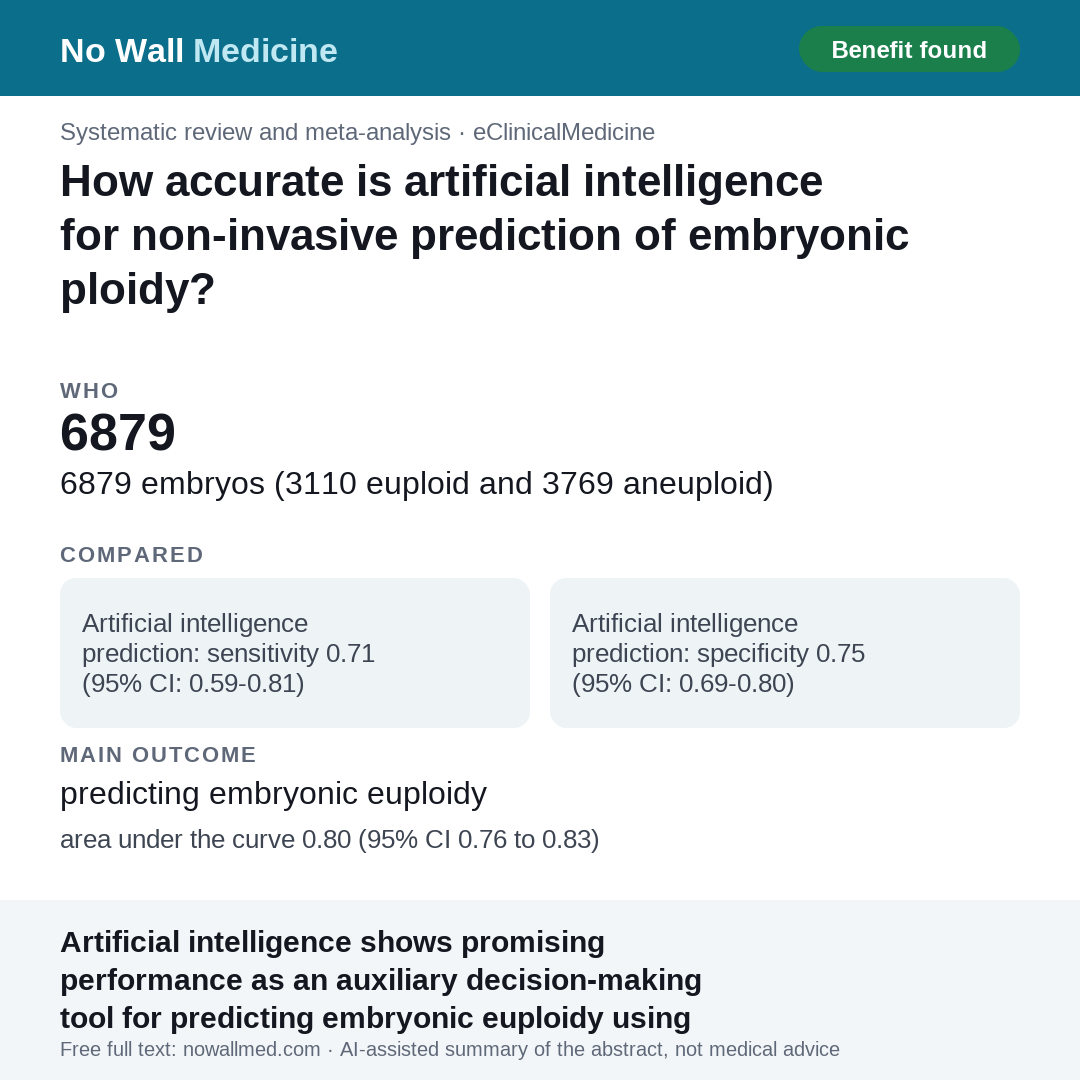
Clinical question: How accurate is artificial intelligence for non-invasive prediction of embryonic ploidy?
Why it matters: Preimplantation genetic testing for aneuploidy, which involves invasive biopsy to detect chromosomal abnormalities, has high economic burden and ethical constraints.
Key points
- Researchers analyzed 12 studies involving 6879 embryos, consisting of 3110 euploid and 3769 aneuploid embryos, to evaluate artificial intelligence performance.
- The pooled sensitivity for predicting embryonic euploidy, which means having the correct number of chromosomes, was 0.71 and specificity was 0.75.
- The area under the curve for these artificial intelligence predictions was 0.80.
Headline and key points written with AI from the paper’s abstract, with every number checked against it. Read the paper before relying on them.
Was this summary helpful?
Cite this article
Xin X, Wu S, Xu H, Ma Y, Bao N, Gao M. Non-invasive prediction of human embryonic ploidy using artificial intelligence: a systematic review and meta-analysis. eClinicalMedicine. 2024. doi:10.1016/j.eclinm.2024.102897
Spotted a mistake? Suggest a correction
Top studies every Monday
The week’s key trials and guidelines in your specialties, plus any topics you follow. By email, free.
Get the weekly digest