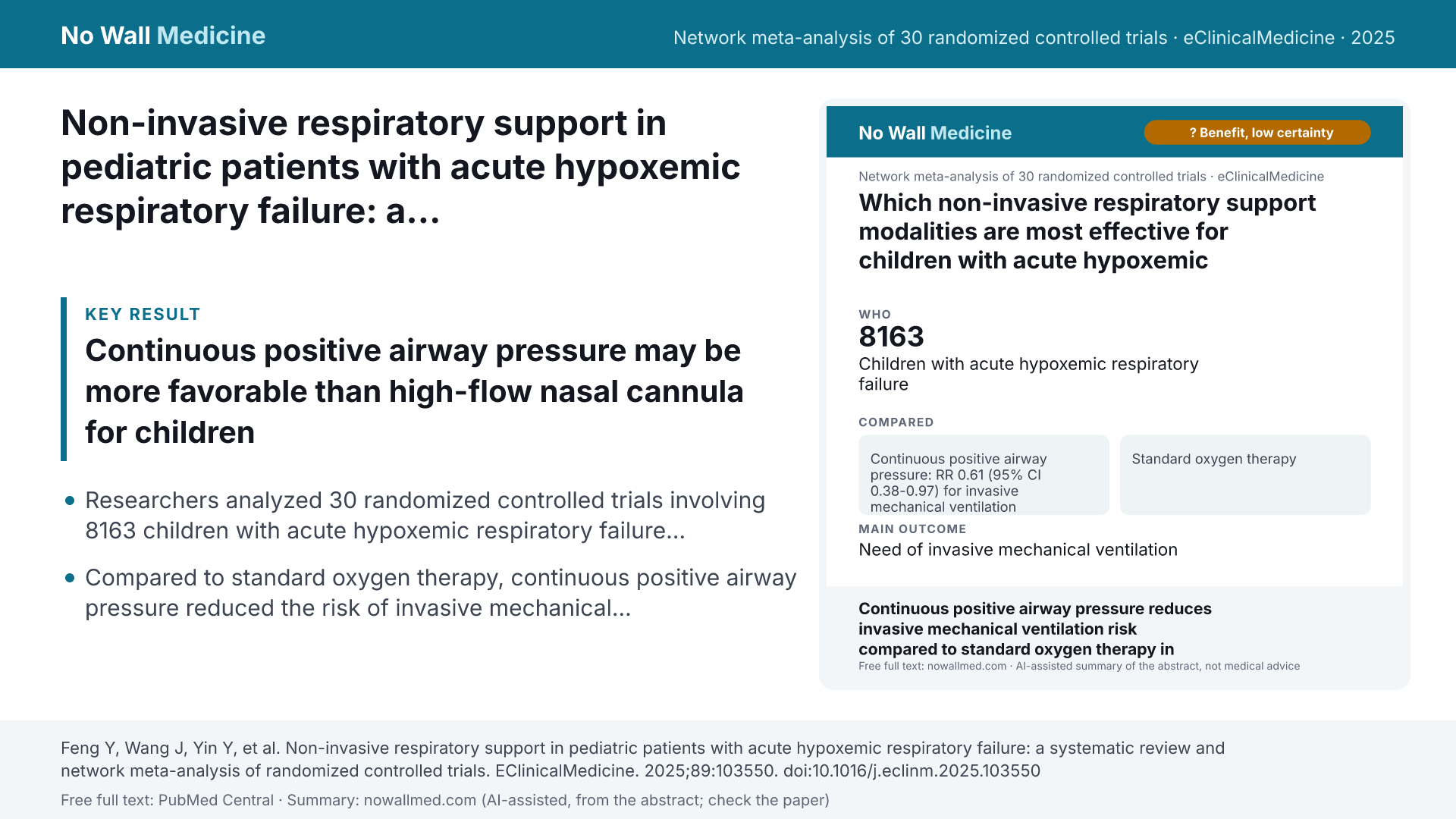
Continuous positive airway pressure may be more favorable than high-flow nasal cannula for children
Non-invasive respiratory support in pediatric patients with acute hypoxemic respiratory failure: a systematic review and network meta-analysis of randomized controlled trials
Network meta-analysis of 30 randomized controlled trialsBenefit found
Which non-invasive respiratory support modalities are most effective for children with acute hypoxemic respiratory failure?
Who
8163
Children with acute hypoxemic respiratory failure
Compared
Continuous positive airway pressure: RR 0.61 (95% CI 0.38-0.97) for invasive mechanical ventilation
Standard oxygen therapy
Main outcome
Need of invasive mechanical ventilation
Result: risk ratio 0.61 (95% CI 0.38 to 0.97)
Bottom line: Continuous positive airway pressure reduces invasive mechanical ventilation risk compared to standard oxygen therapy in children.
Limitation: The certainty of evidence for non-invasive ventilation was very low.
Funded by: Foundation of the First Hospital of Lanzhou University and others
eClinicalMedicine · 2025-10-09Download image
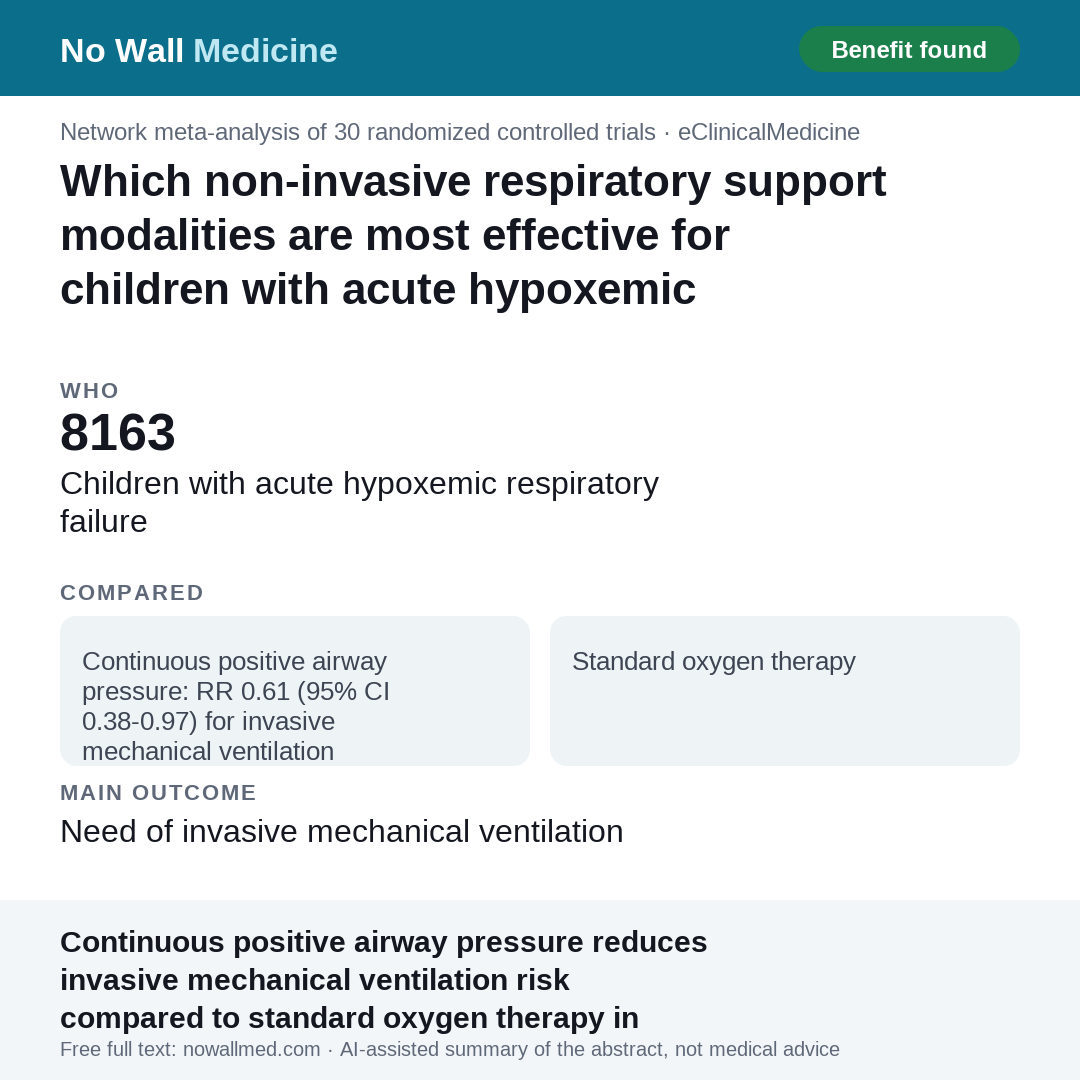
Clinical question: Which non-invasive respiratory support modalities are most effective for children with acute hypoxemic respiratory failure?
Why it matters: There is no clear evidence regarding which non-invasive respiratory support modalities are most effective for children with acute hypoxemic respiratory failure.
Key points
- Researchers analyzed 30 randomized controlled trials involving 8163 children with acute hypoxemic respiratory failure to compare different non-invasive respiratory support methods.
- Compared to standard oxygen therapy, continuous positive airway pressure reduced the risk of invasive mechanical ventilation (RR, 0.61; 95% CI, 0.38-0.97) and treatment failure (RR, 0.52; 95% CI, 0.28-0.99).
- High-flow nasal cannula also reduced treatment failure compared to standard oxygen therapy (RR, 0.52; 95% CI, 0.33-0.80) but was associated with increased intolerance and higher risk of intensive care unit admission.
Limitation the authors note: The authors state that more randomized controlled trials are needed to confirm these conclusions, especially for non-invasive ventilation.
Headline and key points written with AI from the paper’s abstract, with every number checked against it. Read the paper before relying on them.
Was this summary helpful?
Cite this article
Feng Y, Wang J, Yin Y, et al. Non-invasive respiratory support in pediatric patients with acute hypoxemic respiratory failure: a systematic review and network meta-analysis of randomized controlled trials. eClinicalMedicine. 2025. doi:10.1016/j.eclinm.2025.103550
Spotted a mistake? Suggest a correction