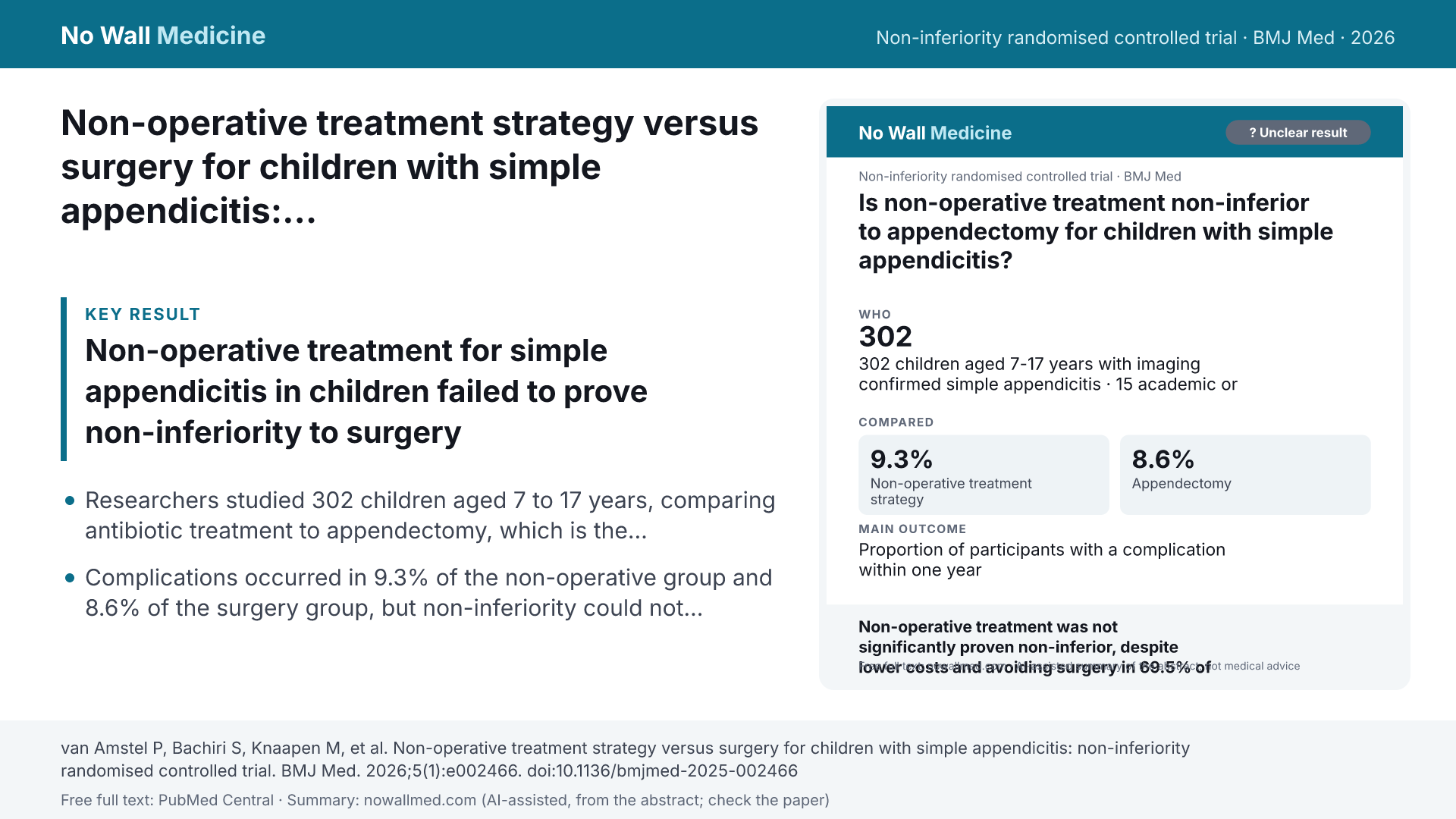
Non-operative treatment for simple appendicitis in children failed to prove non-inferiority to surgery
Non-operative treatment strategy versus surgery for children with simple appendicitis: non-inferiority randomised controlled trial
Non-inferiority randomised controlled trialUnclear result
Is non-operative treatment non-inferior to appendectomy for children with simple appendicitis?
Who
302
302 children aged 7-17 years with imaging confirmed simple appendicitis · 15 academic or general teaching hospitals, Netherlands
Compared
9.3%Non-operative treatment strategy
8.6%Appendectomy
Main outcome
Proportion of participants with a complication within one year
Result: absolute risk difference 0.7%, upper limit of 95% confidence interval 7.1%
Bottom line: Non-operative treatment was not significantly proven non-inferior, despite lower costs and avoiding surgery in 69.5% of cases.
BMJ Med · 2026-05-13Download image
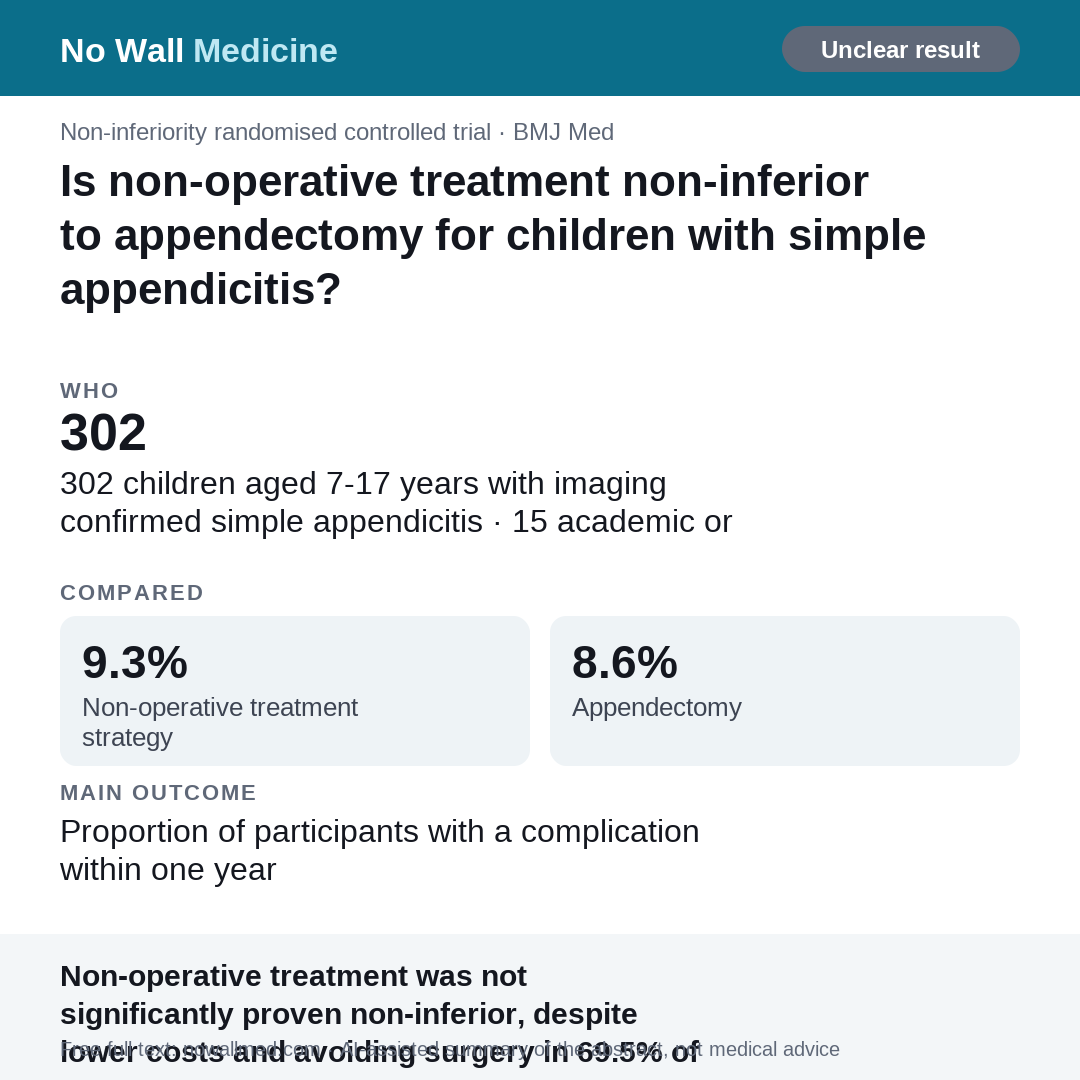
Clinical question: Is non-operative treatment non-inferior to appendectomy for children with simple appendicitis?
Key points
- Researchers studied 302 children aged 7 to 17 years, comparing antibiotic treatment to appendectomy, which is the surgical removal of the appendix.
- Complications occurred in 9.3% of the non-operative group and 8.6% of the surgery group, but non-inferiority could not be significantly proven.
- The non-operative group avoided surgery in 69.5% of cases and had lower costs, but experienced longer hospital stays and lower patient satisfaction.
Headline and key points written with AI from the paper’s abstract, with every number checked against it. Read the paper before relying on them.
Was this summary helpful?
Abstract
Objective
To compare a non-operative treatment strategy with appendectomy for children with simple appendicitis, in terms of complications, avoidance of appendectomy, health related quality of life, and costs, after one year of follow-up. Design
Non-inferiority randomised controlled trial. Setting
15 academic or general teaching hospitals, Netherlands, 1 January 2017 to 19 October 2023. Participants
302 children, aged 7-17 years with imaging confirmed simple appendicitis, excluding those with a faecolith. Interventions
Participants were randomised to the non-operative treatment strategy group (n=151) or the appendectomy group (n=151). The non-operative treatment strategy group received 48 hours of intravenous amoxicillin-clavulanic acid and gentamicin, followed by five days of oral amoxicillin-clavulanic acid. Main outcome measures
The primary outcome was the proportion of participants with a complication within one year (non-inferiority margin of 5%). Secondary outcomes were the number of participants not requiring appendectomy, health related quality of life, and costs. Results
In the intention-to-treat population, 14/151 (9.3%) participants in the non-operative treatment strategy group versus 13/151 (8.6%) in the appendectomy group had a complication during the one year follow-up period (absolute risk difference 0.7%, upper limit of 95% confidence interval (CI) 7.1%). Appendectomy was avoided in 105/151 (69.5%) participants in the non-operative treatment strategy group. No difference was found in health related quality of life between the treatment groups. Costs (both direct and societal) were lower in the non-operative treatment strategy group (mean difference €767 (£668; US$902), 95% CI 320 to 1214 for direct costs and €874, 118 to 1631 for societal costs). In the non-operative treatment strategy group, length of hospital stay was significantly longer (3.3±2.4 v 1.9±1.2 days, mean difference 1.5, 95% CI 1.1 to 1.9) and more unscheduled healthcare visits occurred. Patient satisfaction measured by the Net Promoter Score was significantly lower in the non-operative treatment strategy group (18.9±4.6% v 48.0±5.8%, mean difference -29.1, 95% CI-30.8 to -27.4) at the one year follow-up. Conclusions
Non-inferiority of a non-operative treatment strategy for acute simple appendicitis in children could not be proven significantly. Most of the 95% CI was within the 5% non-inferiority margin, however, with a probability of 90.7% that a non-operative treatment strategy resulted in an increase in complications of ≤5%. Absolute risk difference in the proportion of participants with complications was marginal. Surgery was avoided in about 70% of participants in the non-operative treatment strategy group. Health related quality of life was comparable between the treatment strategies. A non-operative treatment strategy was associated with lower costs, but longer time in hospital, more unscheduled healthcare visits, and lower patient satisfaction at the one year follow-up, measured by the Net Promoter Score. Trial registration
NCT02848820; NTR5977.
Abstract reproduced under the article’s CC BY licence.
Cite this article
van Amstel P, Bachiri S, Knaapen M, et al. Non-operative treatment strategy versus surgery for children with simple appendicitis: non-inferiority randomised controlled trial. BMJ Med. 2026;5(1):e002466. doi:10.1136/bmjmed-2025-002466
Spotted a mistake? Suggest a correction