Non-pharmaceutical primary care interventions to improve mental health in deprived populations: a systematic review
Systematic review of quantitative primary studiesMixed results
Do non-pharmaceutical primary care interventions improve mental health in deprived populations?
Who
People from socioeconomically disadvantaged backgrounds · High-income countries
Compared
Non-pharmaceutical primary care interventions
Control
Main outcome
Common mental health disorders and associated socioeconomic inequalities
Bottom line: Non-pharmaceutical interventions may reduce mental health inequalities, but results for anxiety and depression were inconsistent.
Limitation: Overall study quality was weak and only tentative conclusions can be drawn.
Br J Gen Pract · 2023-03-30Download image
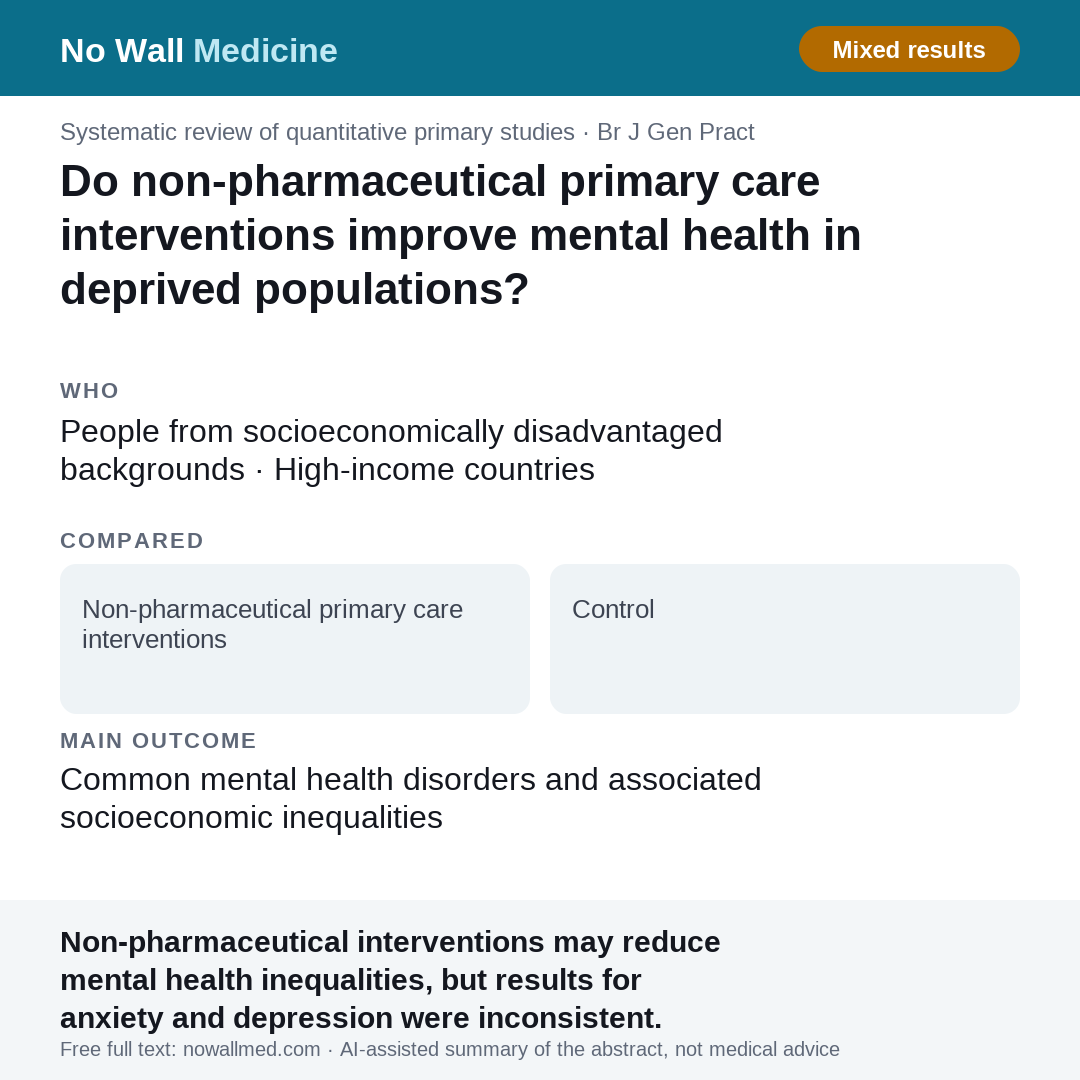
Clinical question: Do non-pharmaceutical primary care interventions improve mental health in deprived populations?
Abstract
Background
Common mental health disorders are especially prevalent among people from socioeconomically disadvantaged backgrounds. Non-pharmaceutical primary care interventions, such as social prescribing and collaborative care, provide alternatives to pharmaceutical treatments for common mental health disorders, but little is known about the impact of these interventions for patients who are socioeconomically disadvantaged. Aim
To synthesise evidence for the effects of non-pharmaceutical primary care interventions on common mental health disorders and associated socioeconomic inequalities. Design and setting
Systematic review of quantitative primary studies published in English and undertaken in high-income countries. Method
Six bibliographic databases were searched and additional grey literature sources screened. Data were extracted onto a standardised proforma and quality assessed using the Effective Public Health Practice Project tool. Data were synthesised narratively and effect direction plots were produced for each outcome. Results
Thirteen studies were included. Social-prescribing interventions were evaluated in 10 studies, collaborative care in two studies, and a new model of care in one study. Positive results (based on effect direction) were reported for the impact of the interventions on wellbeing in groups that were socioeconomically deprived. Inconsistent (mainly positive) results were reported for anxiety and depression. One study reported that people from the group with least deprivation, compared with the group with greatest deprivation, benefitted most from these interventions. Overall, study quality was weak. Conclusion
Targeting non-pharmaceutical primary care interventions at areas of socioeconomic deprivation may help to reduce inequalities in mental health outcomes. However, only tentative conclusions can be drawn from the evidence in this review and more-robust research is required.
Subject terms
Cite this article
Tanner LM, Wildman JM, Stoniute A, Still M, Bernard K, Green R. Non-pharmaceutical primary care interventions to improve mental health in deprived populations: a systematic review. Br J Gen Pract. 2023. doi:10.3399/BJGP.2022.0343
Spotted a mistake? Suggest a correction
Top studies every Monday
The week’s key trials and guidelines in your specialties, plus any topics you follow. By email, free.
Get the weekly digest