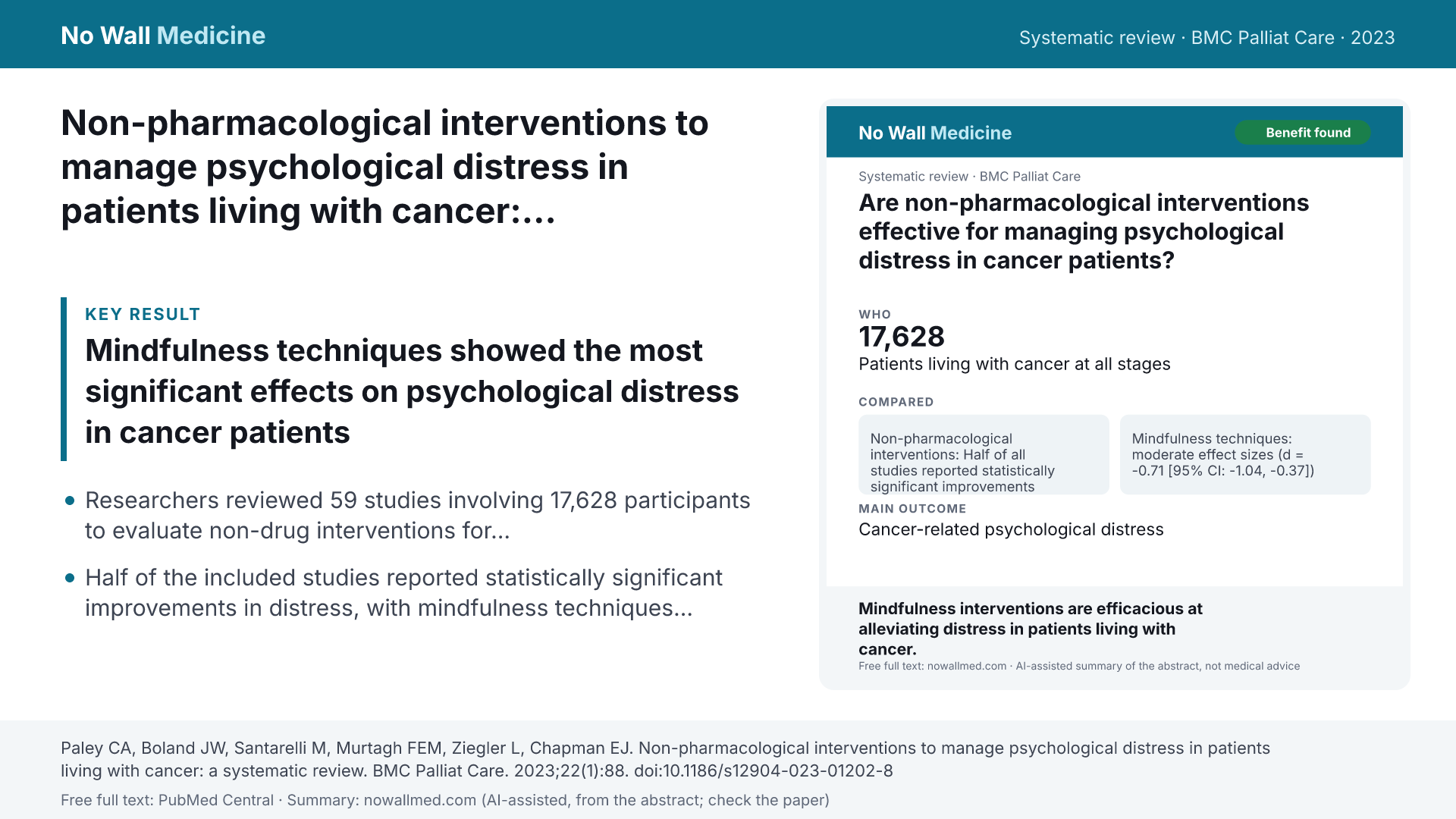
Non-pharmacological interventions to manage psychological distress in patients living with cancer: a systematic review
Key result: Mindfulness techniques showed the most significant effects on psychological distress in cancer patients
Key points
- Researchers reviewed 59 studies involving 17,628 participants to evaluate non-drug interventions for cancer-related psychological distress.
- Half of the included studies reported statistically significant improvements in distress, with mindfulness techniques showing the most prevalent effects.
- Four mindfulness studies showed moderate effect sizes ranging from d = -0.60 to d = -0.77, and one showed a large effect size of d = -1.03.
Why it matters: The effectiveness of various non-drug interventions for managing psychological distress across all stages of cancer was not fully synthesized.
Limitation the authors note: The quality of the included studies was variable and some had a high risk of bias.
Discussion prompts
- Would these patients look like yours? Who was left out?
- Is the main outcome one that matters to patients?
- Is the difference large enough to change what you do?
Cite: Paley CA, Boland JW, Santarelli M, Murtagh FEM, Ziegler L, Chapman EJ. Non-pharmacological interventions to manage psychological distress in patients living with cancer: a systematic review. BMC Palliat Care. 2023;22(1):88. doi:10.1186/s12904-023-01202-8
Free full text: PubMed Central · Summary and visual abstract: nowallmed.com/a/non-pharmacological-interventions-to-manage-psychological-distress-in-tpabj1/ (AI-assisted from the abstract; check the paper before relying on it).