Non-surgical casting was not proven inferior to surgery for children with severe wrist fractures
Non-surgical casting versus surgical reduction for children with severely displaced distal radial fractures (the CRAFFT Study): a multicentre, randomised, controlled non-inferiority trial and economic evaluation
Multicentre, randomised, non-inferiority trialMixed results
Is non-surgical casting non-inferior to surgical reduction for children with severely displaced distal radial fractures?
Who
750
Children aged 4-10 years with severely displaced distal radial fractures · 49 hospitals in the UK
Compared
44.9Non-surgical casting (SD 8.7)
46.6Surgical reduction (8.8)
Main outcome
Patient Report Outcomes Measurement System Upper Extremity Score for Children
Result: adjusted mean difference -1.64 (95% CI -2.84 to -0.44)
Bottom line: Non-surgical casting was not non-inferior to surgical reduction for the main population, though it was non-inferior for off-ended fractures.
Limitation: The confidence interval extended beyond the prespecified non-inferiority margin of -2.5 points.
Lancet · 2026-04-08Download image
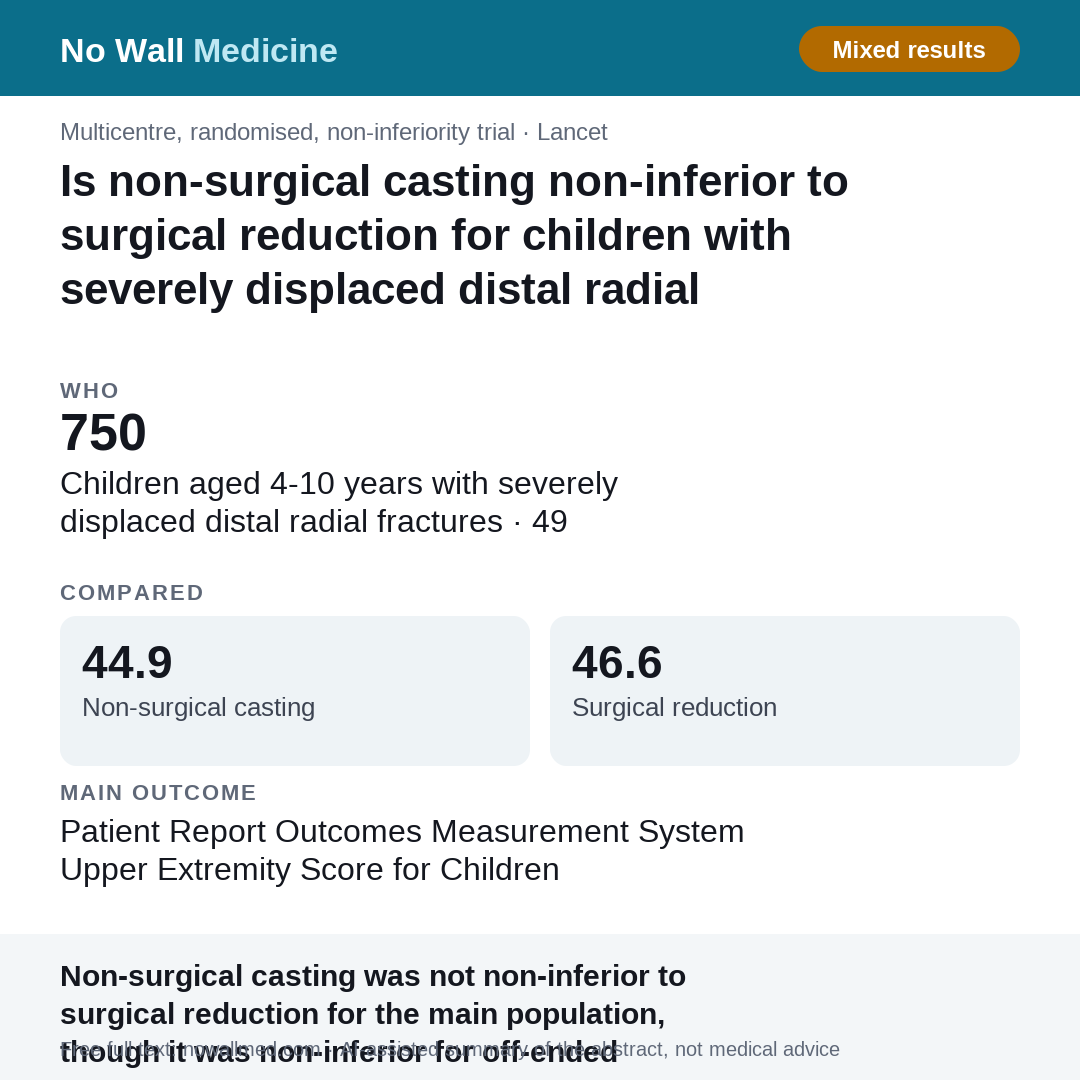
Clinical question: Is non-surgical casting non-inferior to surgical reduction for children with severely displaced distal radial fractures?
Why it matters: Doctors often perform surgery to fix severely displaced wrist fractures in children because the bone displacement looks alarming on X-rays.
Key points
- Researchers studied 750 children aged 4 to 10 years with severely displaced distal radial fractures, comparing non-surgical casting to surgical reduction.
- At 3 months, the mean upper limb function score was 44.9 in the casting group and 46.6 in the surgical group, with a difference of -1.64.
- The confidence interval for the difference between groups extended beyond the pre-specified non-inferiority margin of -2.5 points.
Headline and key points written with AI from the paper’s abstract, with every number checked against it. Read the paper before relying on them.
Abstract
Background
Severely displaced distal radial fractures are among the most common and controversial injuries in children. Despite observational evidence of reliable remodelling with growth in younger children, their alarming radiographic appearance-particularly when completely displaced (off-ended)-has driven routine surgical reduction and fixation. The Children's Radius Acute Fracture Fixation Trial (CRAFFT) aimed to evaluate the clinical and cost-effectiveness of surgical reduction compared with non-surgical casting. Methods
This pragmatic, multicentre, randomised, non-inferiority trial included participants (aged 4-10 years) with a severely displaced distal radial fracture from 49 hospitals in the UK. Recruiting centres were secondary or tertiary care hospitals providing acute paediatric trauma care. Participants were randomly assigned to either non-surgical casting or surgical reduction, using a minimisation algorithm with a random element and stratification factors were centre, age group, fracture location, and displacement severity. Participants and their parents and carers could not be masked to treatment. Surgical reduction was performed under general anaesthesia or conscious sedation, to restore anatomical alignment, with fixation permitted at the discretion of the surgeon. Non-surgical care involved immobilisation of the fracture in a plaster cast without general anaesthesia or sedation, and without purposeful manipulation of the fracture position. Immobilisation of the fracture beyond 6 weeks post-randomisation was not recommended. The primary outcome was upper limb function at 3 months, measured using the Patient Report Outcomes Measurement System (PROMIS) Upper Extremity Score for Children in the intention-to-treat population, which included all participants in the groups to which they were randomly assigned, irrespective of treatment received. The non-inferiority margin was conservatively set at -2·5 points for the main trial population. A prespecified subgroup analysis was powered to assess whether non-surgical casting could exclude a larger more clinically relevant margin of -5 points among children with completely off-ended fractures. Complications and serious adverse events were summarised in a safety (as-treated) population defined by treatment received. A within-trial economic evaluation was undertaken from the perspective of the UK National Health Service (NHS) and Personal Social Services over a 12-month time period. The trial was registered with the ISRCTN registry, ISRCTN10931294, recruitment is complete and extended follow-up to 3-years post-randomisation is ongoing. Findings
Between Aug 11, 2020, and May 30, 2024, 1227 children were screened for eligibility across 49 UK hospitals. 477 children were excluded (54 met exclusion criteria and 423 did not enter the study, the majority for lack of clinical or parental equipoise). 750 participants were randomly assigned, 375 to the non-surgical casting group and 375 to the surgical reduction group. 456 (61%) participants were male, 294 (39%) were female, and the median age of participants was 7·9 years (IQR 6·5-9·5). 329 (44%) of the 750 participants had completely off-ended fractures. Primary outcome data were collected from 640 (85%) participants. At 3 months post-randomisation, the mean PROMIS Upper Extremity score was 44·9 (SD 8·7) in the non-surgical casting group and 46·6 (8·8) in the surgical reduction group (adjusted mean difference -1·64 [95% CI -2·84 to -0·44]), with the confidence interval favouring surgical reduction but extending beyond the prespecified non-inferiority margin of -2·5 points. In children with completely off-ended fractures, findings were consistent with non-inferiority against the wider, prespecified margin for this group. Most complications within 8 weeks occurred in the surgical reduction group, including pressure damage (n=2), wound infections (n=6), scarring (n=5), and nerve irritation (n=1). During the 12-months of follow-up, refracture occurred in 13 participants (nine after non-surgical casting and four after surgical reduction). From an NHS and Personal Social Services perspective, non-surgical casting was associated with a significant reduction in mean cost per patient of £1665 (95% CI 1487 to 1843) and a marginal incremental reduction in quality-adjusted life-years (QALYs; -0·023 [95% CI -0·037 to -0·009]). The probability of non-surgical casting being cost-effective at the £20 000 and £30 000 per QALY threshold was 100%, indicating that the small short-term functional advantage of surgical reduction was not cost-effective. Interpretation
The CRAFFT trial did not demonstrate non-inferiority of non-surgical casting at 3 months against a conservative margin; however, the observed difference in favour of surgical reduction was small, below thresholds that families considered meaningful, and did not persist beyond early recovery. Surgical reduction was associated with higher costs, early procedural complications, and only a modest improvement in cosmetic appearance, supporting consideration of a cast-first strategy for most children. Funding
National Institute for Health and Care Research (NIHR) Health Technology Assessment programme (17/22/02) and the NIHR Oxford Biomedical Research Centre.
Abstract reproduced under the article’s CC BY licence.
Topics
Cite this article
Perry DC, Zimmermann A, Achten J, Nicolaou N, Metcalfe D, Kounali D. Non-surgical casting versus surgical reduction for children with severely displaced distal radial fractures (the CRAFFT Study): a multicentre, randomised, controlled non-inferiority trial and economic evaluation. Lancet. 2026. doi:10.1016/S0140-6736(26)00409-5
Spotted a mistake? Suggest a correction