Diagnostic strategies using D-dimer tests and clinical rules can safely rule out pulmonary embolism in pregnancy
Noninvasive diagnostic work-up for suspected acute pulmonary embolism during pregnancy: a systematic review and meta-analysis of individual patient data
Systematic review and individual patient data meta-analysisBenefit found
How safe and efficient are noninvasive diagnostic strategies for suspected pulmonary embolism in pregnancy?
Who
893
Pregnant women with suspected acute pulmonary embolism
Compared
Wells rule and YEARS algorithm: failure rate 0·37%-1·4%
Bilateral compression ultrasonography: 2·3% efficiency
Main outcome
Safety (failure rate) and efficiency (avoiding chest imaging)
Bottom line: Pretest probability-adapted D-dimer thresholds are efficient and safe for ruling out pulmonary embolism in pregnancy.
Limitation: Only 2 relevant studies were identified for the meta-analysis.
J Thromb Haemost · 2022-12-22Download image
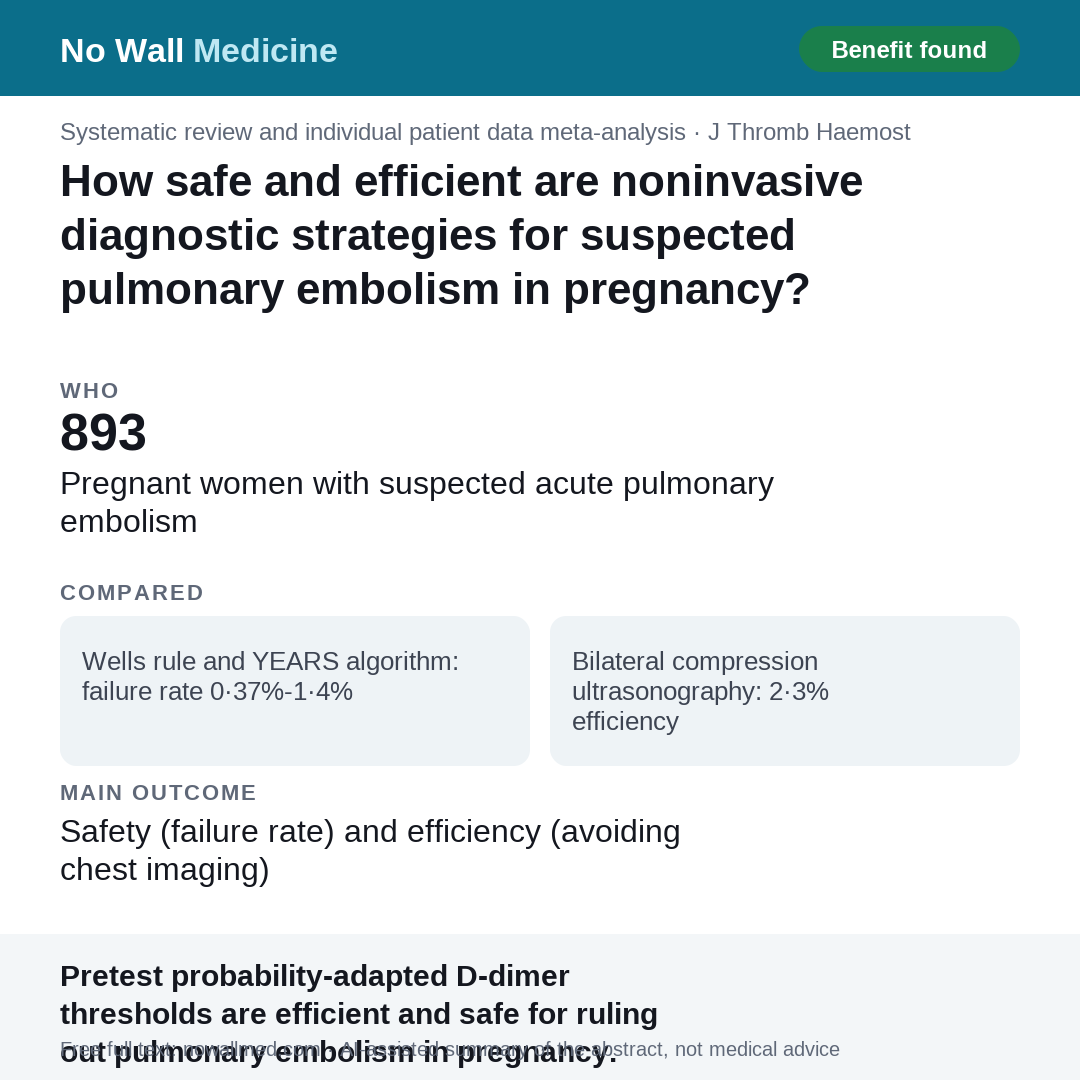
Clinical question: How safe and efficient are noninvasive diagnostic strategies for suspected pulmonary embolism in pregnancy?
Why it matters: The performance of noninvasive diagnostic strategies for suspected acute pulmonary embolism in pregnant women was not well established due to few existing studies.
Key points
- Researchers analyzed individual patient data from 893 pregnant women to evaluate the safety and efficiency of different diagnostic strategies for suspected pulmonary embolism.
- The Wells rule and YEARS algorithm were safe with failure rates between 0.37% and 1.4%, though efficiency was higher using pretest probability-adapted D-dimer thresholds.
- Bilateral compression ultrasonography, an ultrasound of the leg veins, had limited efficiency at 2.3% overall and 0.79% in patients without deep-vein thrombosis symptoms.
Headline and key points written with AI from the paper’s abstract, with every number checked against it. Read the paper before relying on them.
Was this summary helpful?
Subject terms
Cite this article
Stals MAM, Moumneh T, Ainle FN, Aujesky D, van Bemmel T, Bertoletti L. Noninvasive diagnostic work-up for suspected acute pulmonary embolism during pregnancy: a systematic review and meta-analysis of individual patient data. J Thromb Haemost. 2022. doi:10.1016/j.jtha.2022.11.025
Spotted a mistake? Suggest a correction
Top studies every Monday
The week’s key trials and guidelines in your specialties, plus any topics you follow. By email, free.
Get the weekly digest