Surgery or nonoperative care for wrist fractures in older adults shows similar wrist function results
Nonoperative treatment versus volar locking plating for distal radius fracture in patients aged 65 years or older (DRIFT trial): A randomized controlled trial
Randomized controlled trialMixed results
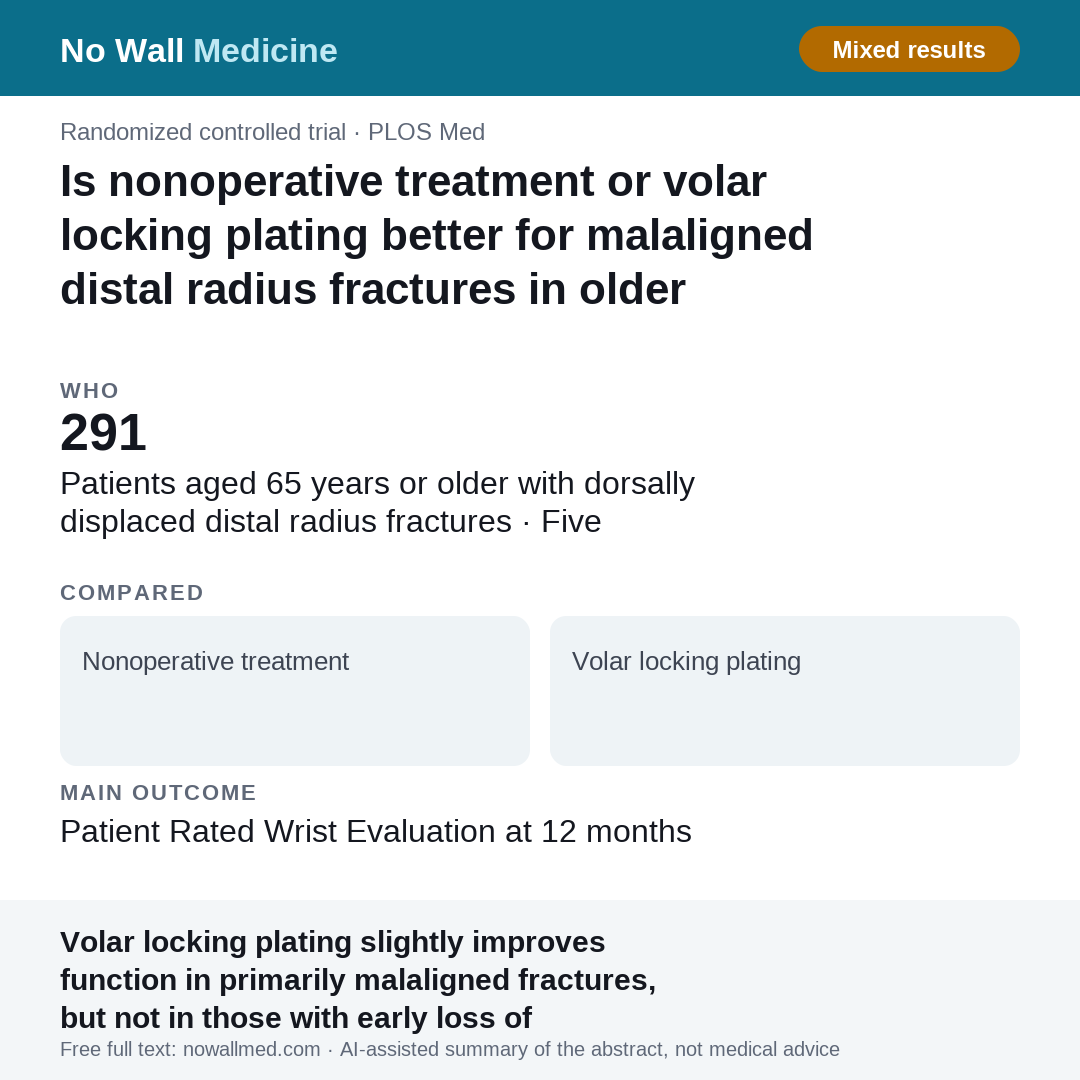
Is nonoperative treatment or volar locking plating better for malaligned distal radius fractures in older patients?
Who
291
Patients aged 65 years or older with dorsally displaced distal radius fractures · Five trauma centers in Finland, Sweden, and Denmark
Compared
Nonoperative treatment
Volar locking plating
Main outcome
Patient Rated Wrist Evaluation at 12 months
Result: primarily malaligned: -9.6 points (95% CI -17.4 to -1.7); early malaligned: -6.2 points (95% CI -15.4 to 3.0)
Bottom line: Volar locking plating slightly improves function in primarily malaligned fractures, but not in those with early loss of alignment.
Limitation: Decreased inclusion rate required ceasing recruitment of early malaligned patients before reaching predefined targets.
PLOS Med · 2025-09-05Download image
Clinical question: Is nonoperative treatment or volar locking plating better for malaligned distal radius fractures in older patients?
Why it matters: It is unclear how to manage distal radius fractures in older patients when the bone alignment is poor initially or lost shortly after a manual reduction.
Key points
- Researchers studied 291 patients aged 65 years or older with distal radius fractures, comparing nonoperative treatment to volar locking plating, which is a surgical metal plate fixation.
- In fractures that were initially misaligned, surgery showed a mean difference of -9.6 points on the Patient Rated Wrist Evaluation scale, which was smaller than the 11 point clinically important difference.
- For fractures that lost alignment during the first 5-10 days, surgery did not show a significant difference in wrist function at 12 months with a mean effect of -6.2 points.
Limitation the authors note: The researchers had to stop recruiting patients with early loss of alignment before reaching the planned 57 patients per group due to a decreased inclusion rate.
Headline and key points written with AI from the paper’s abstract, with every number checked against it. Read the paper before relying on them.
Topics
Cite this article
Hevonkorpi TP, Launonen AP, Reito A, Schandorff Skjærbæk M, Li Y, Luokkala T. Nonoperative treatment versus volar locking plating for distal radius fracture in patients aged 65 years or older (DRIFT trial): A randomized controlled trial. PLOS Med. 2025. doi:10.1371/journal.pmed.1004728
Spotted a mistake? Suggest a correction