5-alpha reductase inhibitors were associated with longer progression-free survival in prostate cancer patients
Nonsurgical Interventions to Prevent Disease Progression in Prostate Cancer Patients on Active Surveillance: A Systematic Review and Meta-analysis
Systematic review and meta-analysisBenefit found
Which nonsurgical interventions prevent prostate cancer progression during active surveillance?
Who
Patients with low-risk and selected intermediate-risk prostate cancer
Compared
5-alpha reductase inhibitors: improved progression-free survival
Other interventions
Main outcome
prostate cancer progression
Result: hazard ratio 0.59 (95% confidence interval 0.48-0.72)
Bottom line: 5-alpha reductase inhibitors are associated with longer progression-free survival in prostate cancer patients on active surveillance.
Limitation: weak available evidence for other interventions
Eur Urol Oncol · 2023-10-28Download image
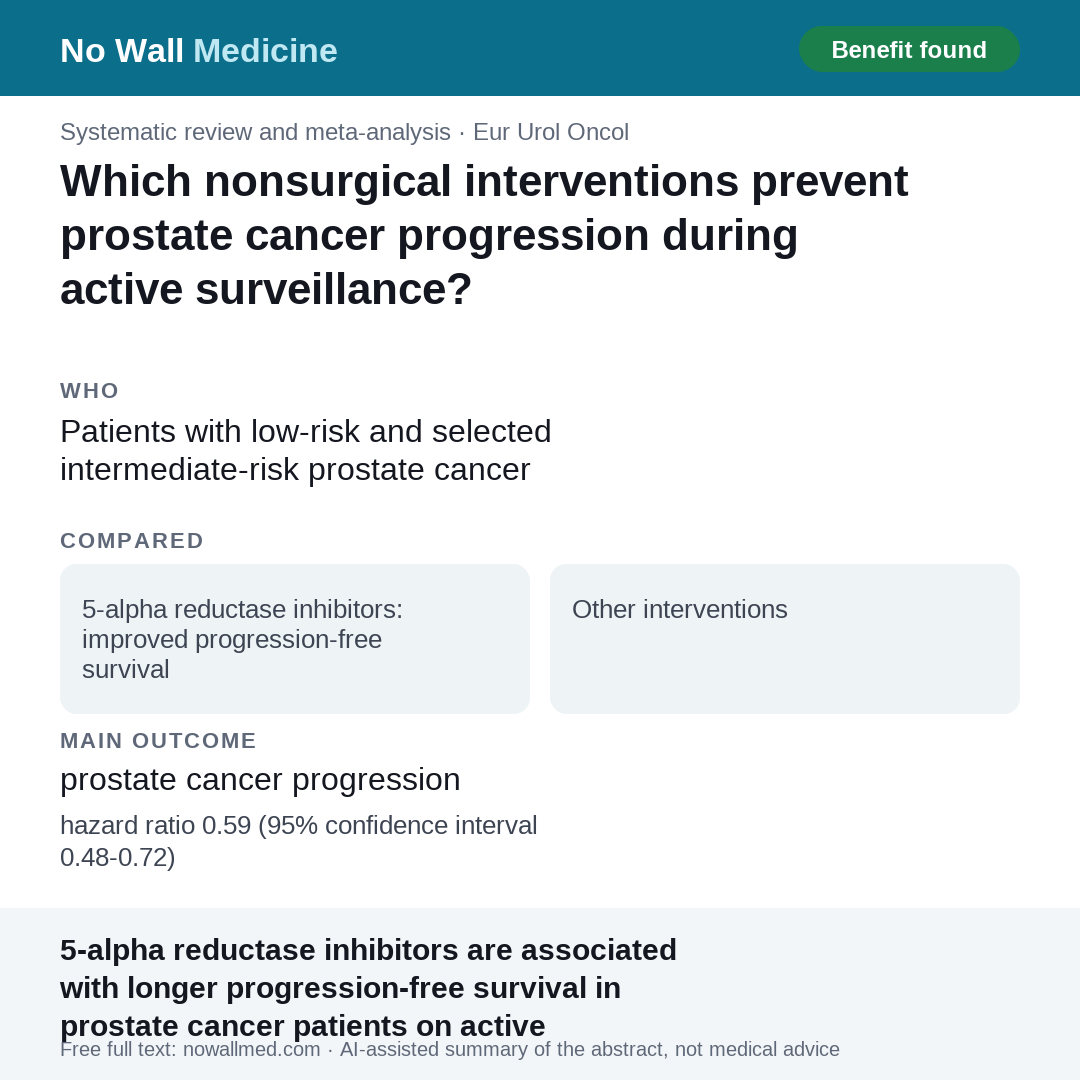
Clinical question: Which nonsurgical interventions prevent prostate cancer progression during active surveillance?
Why it matters: It is unknown which nonsurgical interventions effectively impact the disease trajectory for patients undergoing active surveillance for prostate cancer.
Key points
- Researchers analyzed 22 studies, including six randomized controlled trials and 16 observational studies, looking at various interventions for prostate cancer patients on active surveillance.
- The use of 5-alpha reductase inhibitors was associated with a hazard ratio of 0.59 for progression-free survival and showed no increased toxicity signals.
- Other therapies like vitamin D3, chlormadinone, fexapotide triflutate, and enzalutamide were associated with treatment-related adverse events in up to 88% of patients.
Limitation the authors note: The available evidence for most interventions was weak, making it difficult to draw clear conclusions.
Headline and key points written with AI from the paper’s abstract, with every number checked against it. Read the paper before relying on them.
Abstract
Context
Active surveillance (AS) is a standard of care for patients with low-risk and selected intermediate-risk prostate cancer (PCa). Nevertheless, there is a lack of summary evidence on how to impact disease trajectory during AS.Objective
To assess which interventions prevent PCa progression effectively during AS.Evidence acquisition
We queried PubMed, Scopus, and Web of Science databases to identify studies examining the impact of interventions aimed at slowing disease progression during AS. The primary endpoint was PCa progression, the definition of which must have included pathological upgrading. The secondary endpoint included treatment toxicities.Evidence synthesis
We identified 22 studies, six randomized controlled trials and 16 observational studies, which analyzed the association between different interventions and PCa progression during AS. The interventions considered in the studies included 5-alpha reductase inhibitors (5-ARIs), statins, diet, exercise, chlormadinone, fexapotide triflutate (FT), enzalutamide, coffee, vitamin D3, and PROSTVAC. We found that administration of 5-ARIs was associated with improved progression-free survival (PFS; hazard ratio: 0.59; 95% confidence interval 0.48-0.72), with no increased toxicity signals. Therapies such as vitamin D3, chlormadinone, FT, and enzalutamide have shown some efficacy. However, these anticancer drugs have been associated with treatment-related adverse events in up to 88% of patients.Conclusions
The use of 5-ARIs in PCa patients on AS is associated with longer PFS. However, for the other interventions, it is difficult to draw clear conclusions based on the weak available evidence.Patient summary
Patients with prostate cancer managed with active surveillance (AS) who are treated with 5-alpha reductase inhibitors have a lower risk of disease progression, with minimal adverse events. Other interventions require more studies to determine their efficacy and safety profile in men on AS.
Abstract reproduced under the article’s CC BY licence.
Topics
Cite this article
Matsukawa A, Yanagisawa T, Bekku K, Parizi MK, Laukhtina E, Klemm J. Nonsurgical Interventions to Prevent Disease Progression in Prostate Cancer Patients on Active Surveillance: A Systematic Review and Meta-analysis. Eur Urol Oncol. 2023. doi:10.1016/j.euo.2023.10.010
Spotted a mistake? Suggest a correction
Top studies every Monday
The week’s key trials and guidelines in your specialties, plus any topics you follow. By email, free.
Get the weekly digest