Trial protocol outlines study of saline treatments for children hospitalized with bronchiolitis
Normal saline for children with bronchiolitis: study protocol for a randomised controlled non-inferiority trial
Randomised, controlled non-inferiority trialUnclear result
Is nebulised normal saline or nasal irrigation non-inferior to no saline therapy?
Who
300
Children aged 0-12 months admitted to hospital with bronchiolitis · Six paediatric departments in eastern Denmark
Compared
nebulised normal saline
nasal irrigation with normal saline
no saline therapy
Main outcome
duration of hospitalisation
Bottom line: This study protocol describes a trial to compare nebulised saline, nasal irrigation, and no saline in bronchiolitis.
BMJ Paediatr Open · 2024-01-17Download image
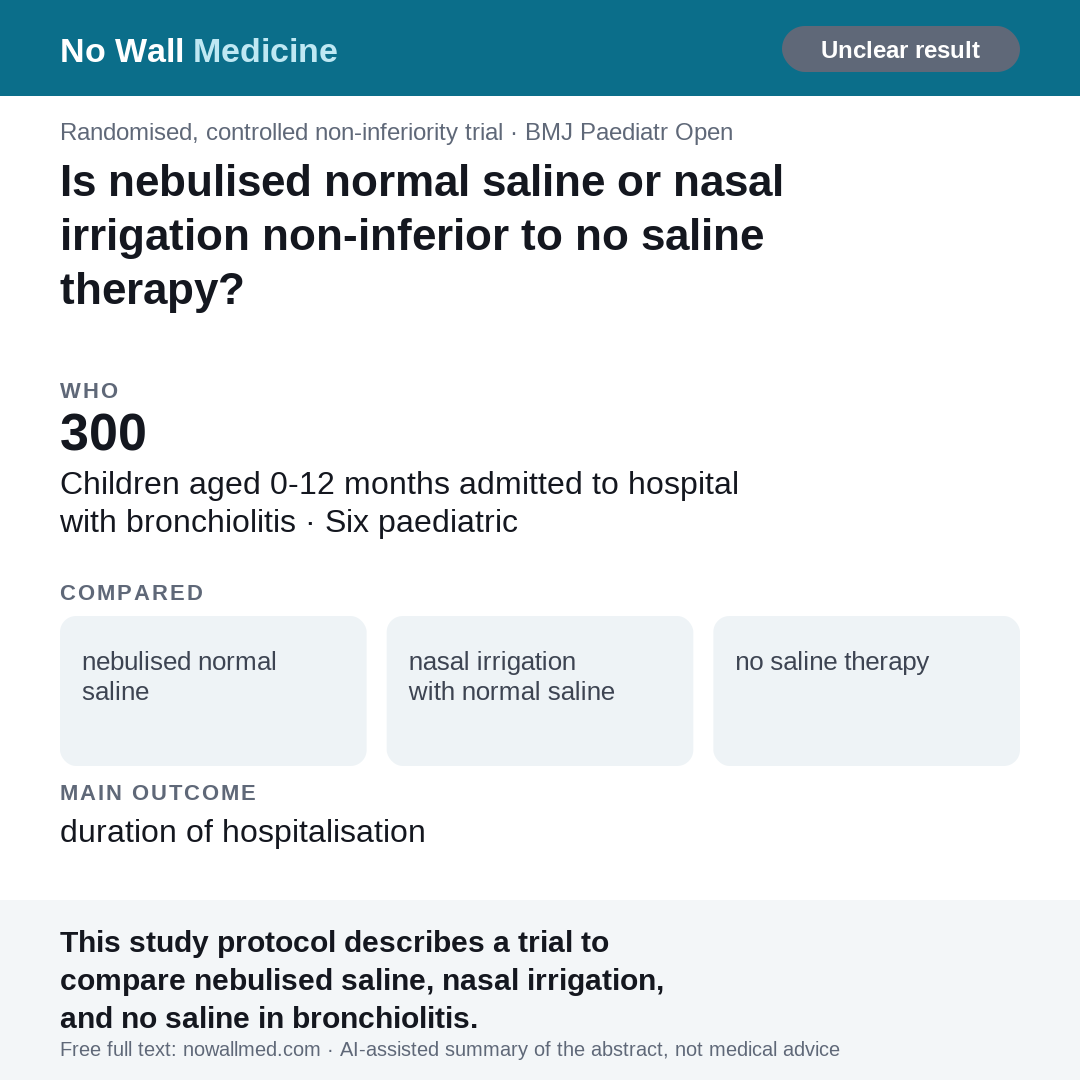
Clinical question: Is nebulised normal saline or nasal irrigation non-inferior to no saline therapy?
Why it matters: It is unknown whether nebulized or nasal irrigation with normal saline is effective for treating mucus clearance in children with bronchiolitis.
Key points
- Researchers plan to enroll 300 children aged 0-12 months to compare nebulized normal saline, nasal irrigation with normal saline, and no saline therapy.
- The primary goal is to determine if saline treatments are non-inferior to no treatment regarding the duration of hospital stays.
- Secondary measures include the need for high-flow oxygen therapy, nasal continuous positive airway pressure, or supplemental fluids.
Headline and key points written with AI from the paper’s abstract, with every number checked against it. Read the paper before relying on them.
Abstract
Introduction
Bronchiolitis is one of the most common reasons for hospital admissions in early childhood. As supportive treatment, some treatment guidelines suggest using nasal irrigation with normal saline (NS) to facilitate clearance of mucus from the airways. In addition, most paediatric departments in Denmark use nebulised NS for the same purpose, which can mainly be administered as inpatient care. However, no studies have ever directly tested the effect of saline in children with bronchiolitis. Methods and analysis
The study is an investigator-initiated, multicentre, open-label, randomised, controlled non-inferiority trial and will be performed at six paediatric departments in eastern Denmark. We plan to include 300 children aged 0-12 months admitted to hospital with bronchiolitis. Participating children are randomised 1:1:1 to nebulised NS, nasal irrigation with NS or no saline therapy. All other treatment will be given according to standard guidelines.The primary outcome is duration of hospitalisation, analysed according to intention-to-treat analysis using linear regression and Cox regression analysis. By including at least 249 children, we can prove non-inferiority with a limit of 12 hours admission, alpha 2.5% and a power of 80%. Secondary outcomes are need for respiratory support with nasal continuous positive airway pressure or high-flow oxygen therapy and requirement of fluid supplements (either by nasogastric tube or intravenous). Ethics and dissemination
This study may inform current practice for supportive treatment of children with bronchiolitis. First, if NS is found to be helpful, it may be implemented into global guidelines. If no effect of NS is found, we can stop spending resources on an ineffective treatment. Second, if NS is effective, but nasal irrigation is non-inferior to nebulisation, it may reduce the workload of nurses, and possible duration of hospitalisation because the treatment can be delivered by the parents at home. Trial registration number
NCT05902702.
Abstract reproduced under the article’s CC BY NC licence.
Topics
Cite this article
Schmidt MN, Daugberg R, Nygaard U, Nielsen XC, Chawes B, Rytter MH. Normal saline for children with bronchiolitis: study protocol for a randomised controlled non-inferiority trial. BMJ Paediatr Open. 2024. doi:10.1136/bmjpo-2023-002273
Spotted a mistake? Suggest a correction
Top studies every Monday
The week’s key trials and guidelines in your specialties, plus any topics you follow. By email, free.
Get the weekly digest