One hour of warm kidney perfusion did not reduce delayed graft function in transplants
Normothermic machine perfusion versus static cold storage in donation after circulatory death kidney transplantation: a randomized controlled trial
Randomized controlled trialNo clear difference
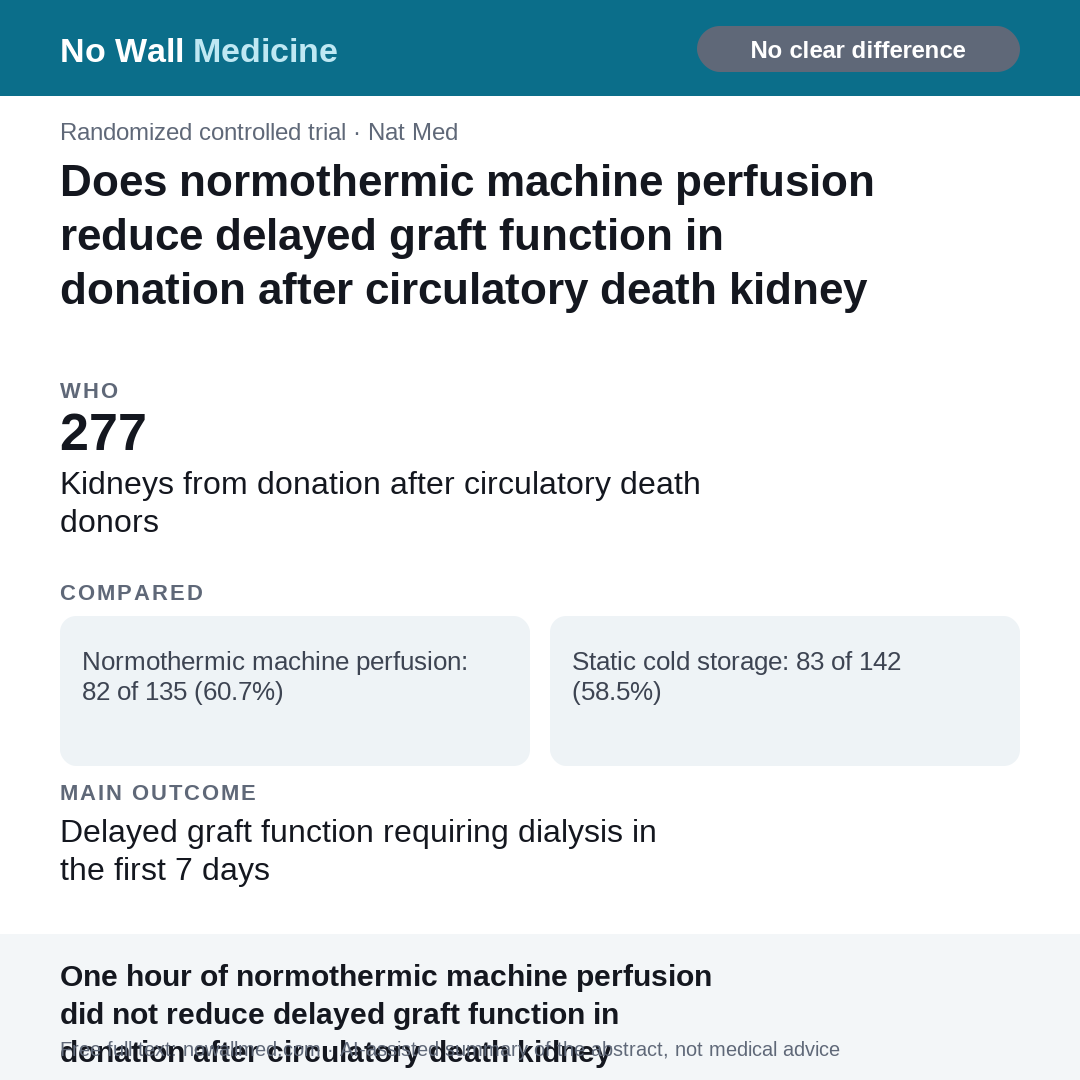
Does normothermic machine perfusion reduce delayed graft function in donation after circulatory death kidney transplantation?
Who
277
Kidneys from donation after circulatory death donors
Compared
Normothermic machine perfusion: 82 of 135 (60.7%)
Static cold storage: 83 of 142 (58.5%)
Main outcome
Delayed graft function requiring dialysis in the first 7 days
Result: adjusted odds ratio 1.13 (95% confidence interval 0.69-1.84)
Bottom line: One hour of normothermic machine perfusion did not reduce delayed graft function in donation after circulatory death kidney transplants.
Nat Med · 2023-05-25Download image
Clinical question: Does normothermic machine perfusion reduce delayed graft function in donation after circulatory death kidney transplantation?
Why it matters: Kidneys from donation after circulatory death are susceptible to injury during storage, which can lead to high rates of delayed graft function.
Key points
- Researchers conducted a randomized trial of 277 kidneys from donation after circulatory death donors, comparing static cold storage to static cold storage plus 1-h normothermic machine perfusion.
- The rate of delayed graft function, requiring dialysis within 7 days, was 60.7% in the normothermic machine perfusion group versus 58.5% in the static cold storage group.
- Normothermic machine perfusion was not associated with an increase in transplant thrombosis, infectious complications, or other adverse events.
Headline and key points written with AI from the paper’s abstract, with every number checked against it. Read the paper before relying on them.
Topics
Cite this article
Hosgood SA, Callaghan CJ, Wilson CH, Smith L, Mullings J, Mehew J. Normothermic machine perfusion versus static cold storage in donation after circulatory death kidney transplantation: a randomized controlled trial. Nat Med. 2023. doi:10.1038/s41591-023-02376-7
Spotted a mistake? Suggest a correction