Patient-facing mobile health alerts for heart failure were feasible and reduced alert incidence
NOTIFY-HF: A Randomized Pilot Trial of Patient-Facing Alerts for Worsening Heart Failure Using Multiparameter Monitoring
Single-center, pragmatic, randomized pilot trialBenefit found
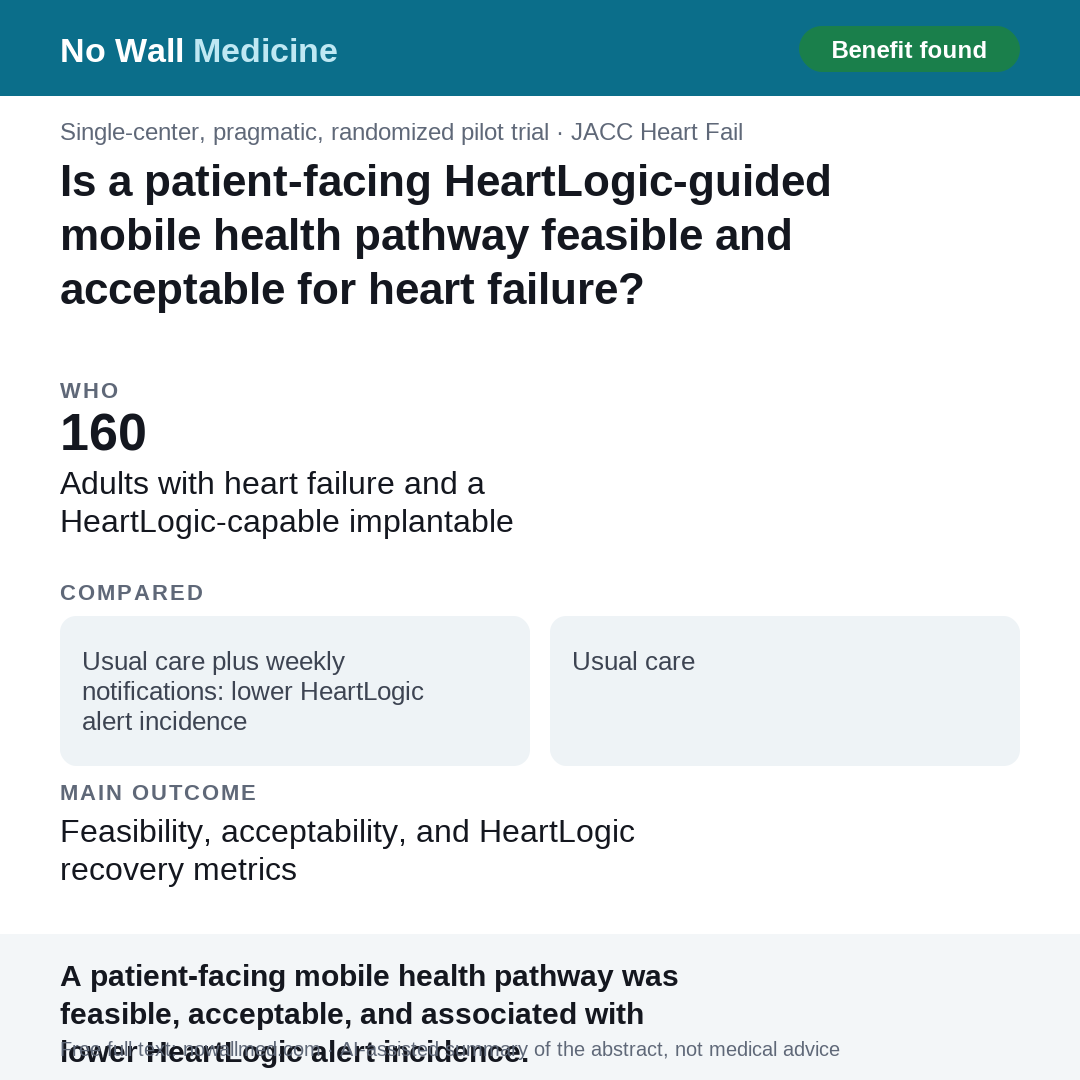
Is a patient-facing HeartLogic-guided mobile health pathway feasible and acceptable for heart failure?
Who
160
Adults with heart failure and a HeartLogic-capable implantable cardioverter-defibrillator · Single-center
Compared
Usual care plus weekly notifications: lower HeartLogic alert incidence
Usual care
Main outcome
Feasibility, acceptability, and HeartLogic recovery metrics
Result: IRR: 0.78 (95% CI: 0.62-0.99)
Bottom line: A patient-facing mobile health pathway was feasible, acceptable, and associated with lower HeartLogic alert incidence.
JACC Heart Fail · 2026-07-10Download image
Clinical question: Is a patient-facing HeartLogic-guided mobile health pathway feasible and acceptable for heart failure?
Why it matters: Remote-monitoring alerts are often designed for clinicians rather than patients, which may prevent timely action when heart failure begins to worsen.
Key points
- Researchers studied 160 adults with heart failure and implantable cardioverter-defibrillators, comparing usual care to usual care plus weekly mobile health notifications.
- The intervention group had a lower incidence of HeartLogic alerts (IRR: 0.78 [95% CI: 0.62-0.99]) and 13% more monitored days outside an alert state.
- The study found high engagement with 80% symptom-screen completion during alerts and high acceptability based on usability questionnaire scores.
Limitation the authors note: The study was a single-center pilot trial and was not powered to evaluate exploratory clinical outcomes.
Headline and key points written with AI from the paper’s abstract, with every number checked against it. Read the paper before relying on them.
Topics
Cite this article
Assad J, Briggs NE, Lo S, Rajaratnam R, Femia G, Leung D. NOTIFY-HF: A Randomized Pilot Trial of Patient-Facing Alerts for Worsening Heart Failure Using Multiparameter Monitoring. JACC Heart Fail. 2026. doi:10.1016/j.jchf.2026.103184
Spotted a mistake? Suggest a correction