Algorithm helps diagnose and treat bile leakage after liver surgery
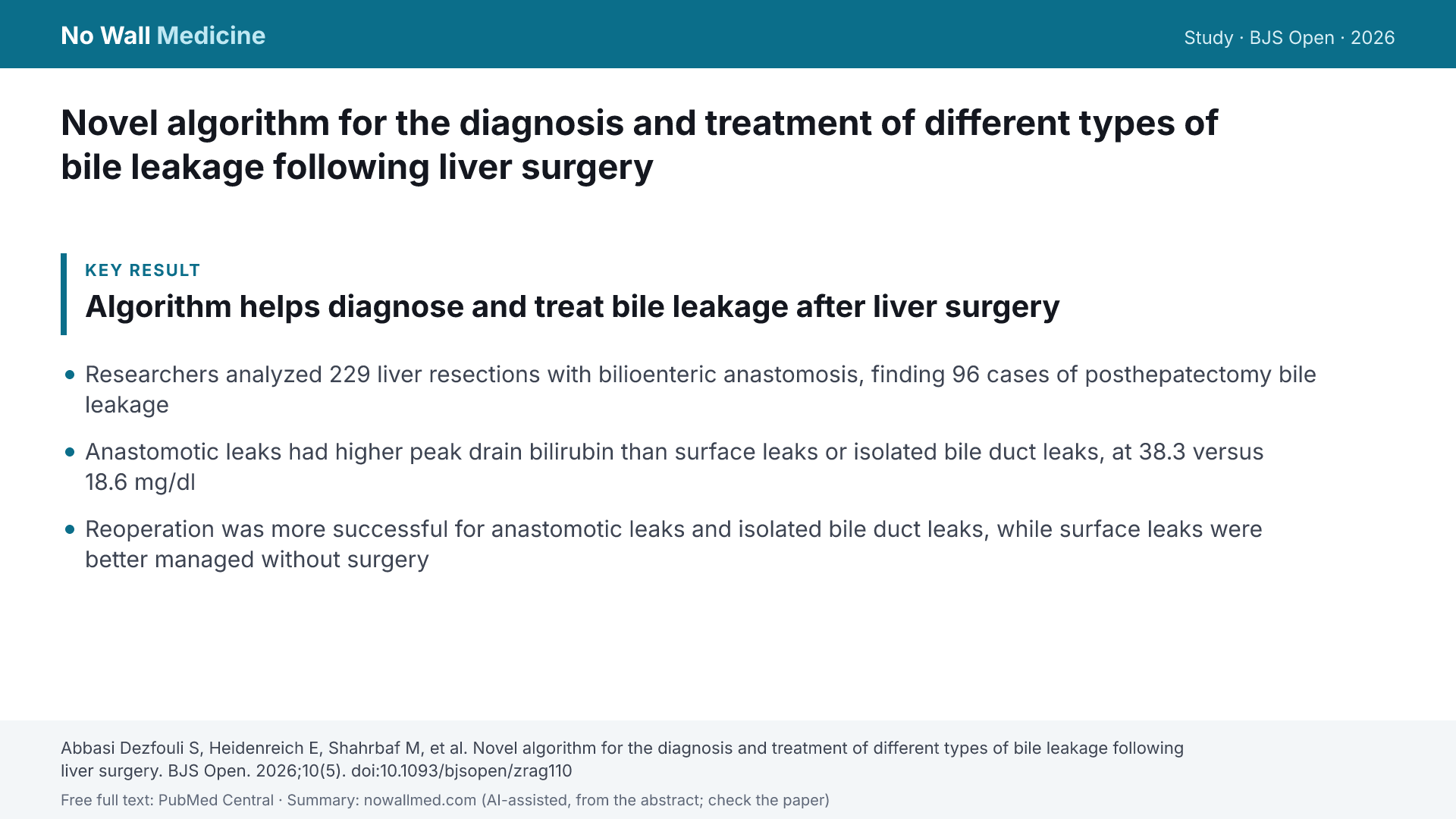
Novel algorithm for the diagnosis and treatment of different types of bile leakage following liver surgery
Why it matters: Doctors lack standardized guidelines for managing posthepatectomy bile leakage after liver surgery
Key points
- Researchers analyzed 229 liver resections with bilioenteric anastomosis, finding 96 cases of posthepatectomy bile leakage.
- Anastomotic leaks had higher peak drain bilirubin than surface leaks or isolated bile duct leaks, at 38.3 versus 18.6 mg/dl.
- Reoperation was more successful for anastomotic leaks and isolated bile duct leaks, while surface leaks were better managed without surgery.
Headline and key points written with AI from the paper’s abstract, with every number checked against it. Read the paper before relying on them.
Was this summary helpful?
Subject terms
Headline, design, result, key points, caveat and citation as plain text.
Cite this article
Abbasi Dezfouli S, Heidenreich E, Shahrbaf M, et al. Novel algorithm for the diagnosis and treatment of different types of bile leakage following liver surgery. BJS Open. 2026;10(5). doi:10.1093/bjsopen/zrag110
Spotted a mistake? Suggest a correction