Digital pelvic floor muscle training shows comparable effectiveness to traditional care for urinary incontinence
Novel Telerehabilitation Interventions for Stress Urinary Incontinence: A Systematic Review of Randomized Controlled Trials
Systematic review of 13 randomized controlled trialsBenefit found
Is telerehabilitation-delivered pelvic floor muscle training effective for women with stress urinary incontinence?
Who
Women aged 18 years or older with stress urinary incontinence
Compared
Digital interventions: significant subjective reductions in symptoms and improved quality of life
Passive management or no-treatment controls
Active conventional care: comparable efficacy
Main outcome
stress urinary incontinence symptoms and quality of life
Bottom line: Telerehabilitation-delivered pelvic floor muscle training is a safe, effective, and scalable alternative for managing stress urinary incontinence.
Limitation: Substantial methodological and clinical heterogeneity
Arch Phys Med Rehabil · 2026-09-08Download image
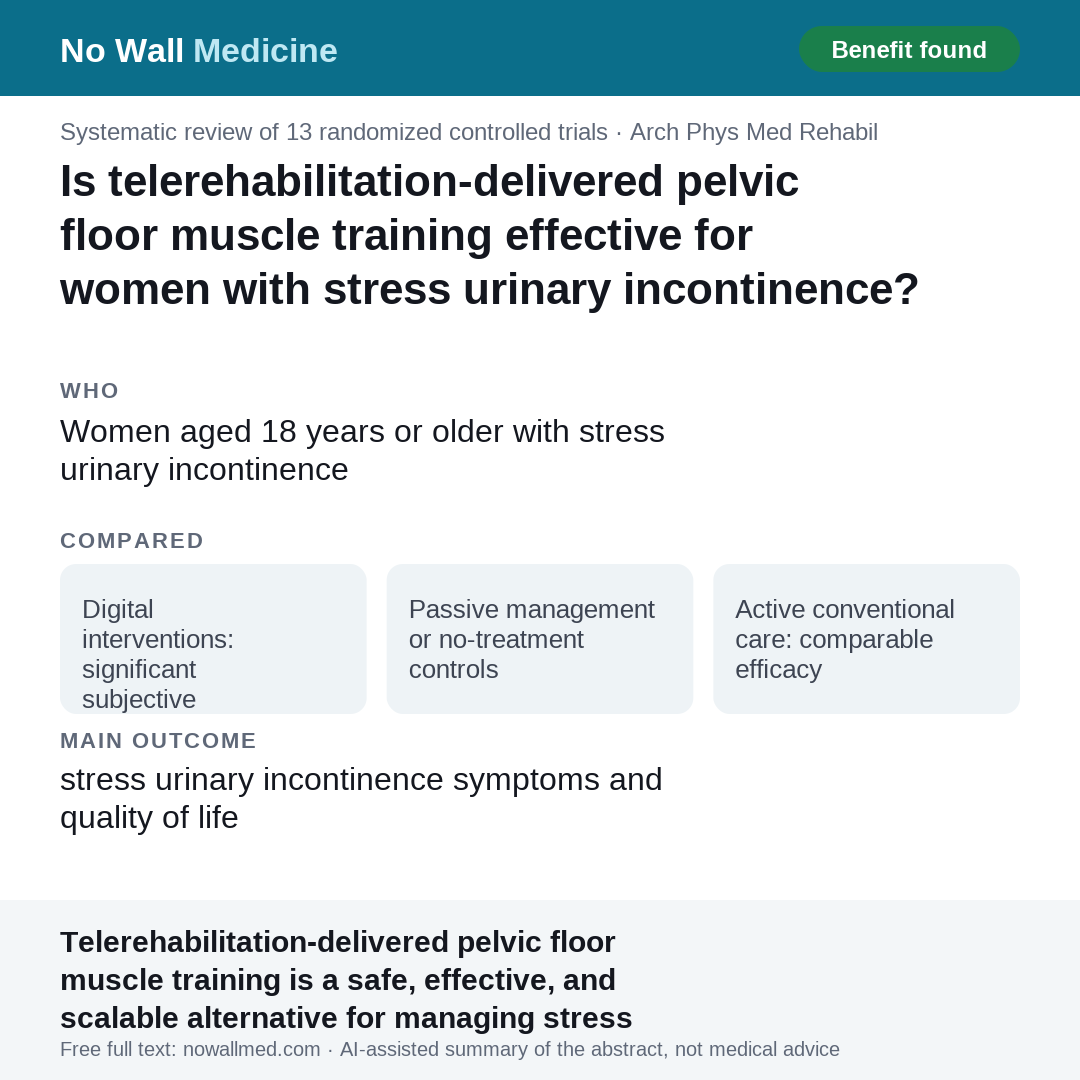
Clinical question: Is telerehabilitation-delivered pelvic floor muscle training effective for women with stress urinary incontinence?
Why it matters: Doctors need to know if virtual pelvic floor muscle training is an effective and accessible alternative to traditional in-person physiotherapy for managing urinary leakage.
Key points
- Researchers reviewed 13 randomized controlled trials involving women with stress urinary incontinence using virtual platforms like mobile applications or video conferencing.
- Digital interventions produced significant subjective reductions in symptoms and improved quality of life compared to no-treatment or passive management controls.
- Digital tools showed comparable efficacy to active conventional care, such as face-to-face physiotherapy or paper booklets, rather than superior efficacy.
Limitation the authors note: The findings were synthesized narratively because of substantial methodological and clinical heterogeneity among the included studies.
Headline and key points written with AI from the paper’s abstract, with every number checked against it. Read the paper before relying on them.
Cite this article
Martin N, Venkataramadas K, Singh A, Osuji E, Schulz J, Nadon E. Novel Telerehabilitation Interventions for Stress Urinary Incontinence: A Systematic Review of Randomized Controlled Trials. Arch Phys Med Rehabil. 2026. doi:10.1016/j.apmr.2026.08.020
Spotted a mistake? Suggest a correction