NRG Oncology/RTOG1205: A Randomized Phase II Trial of Concurrent Bevacizumab and Reirradiation Versus Bevacizumab Alone as Treatment for Recurrent Glioblastoma
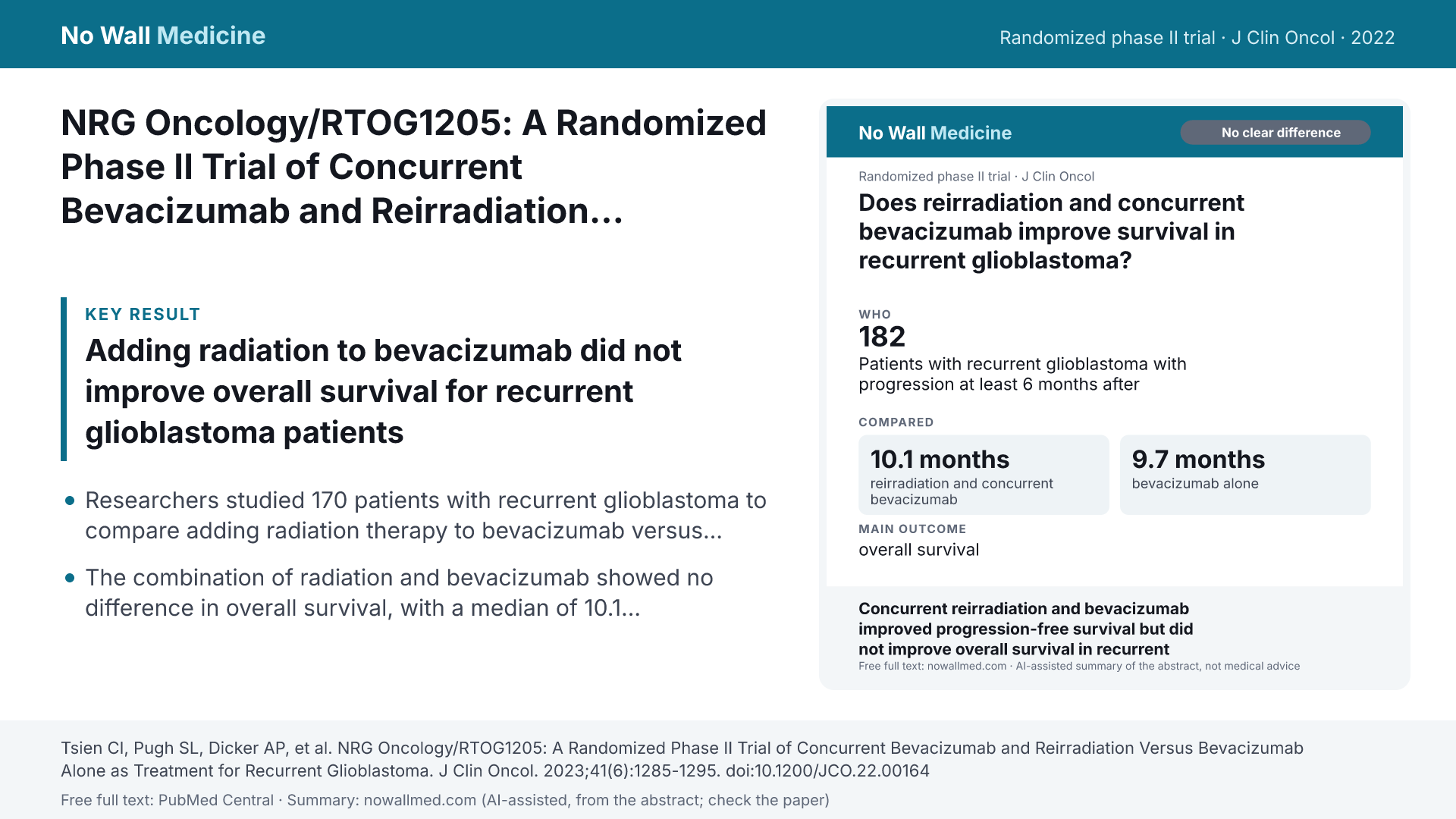
Key result: Adding radiation to bevacizumab did not improve overall survival for recurrent glioblastoma patients
Randomized phase II trialNo clear difference
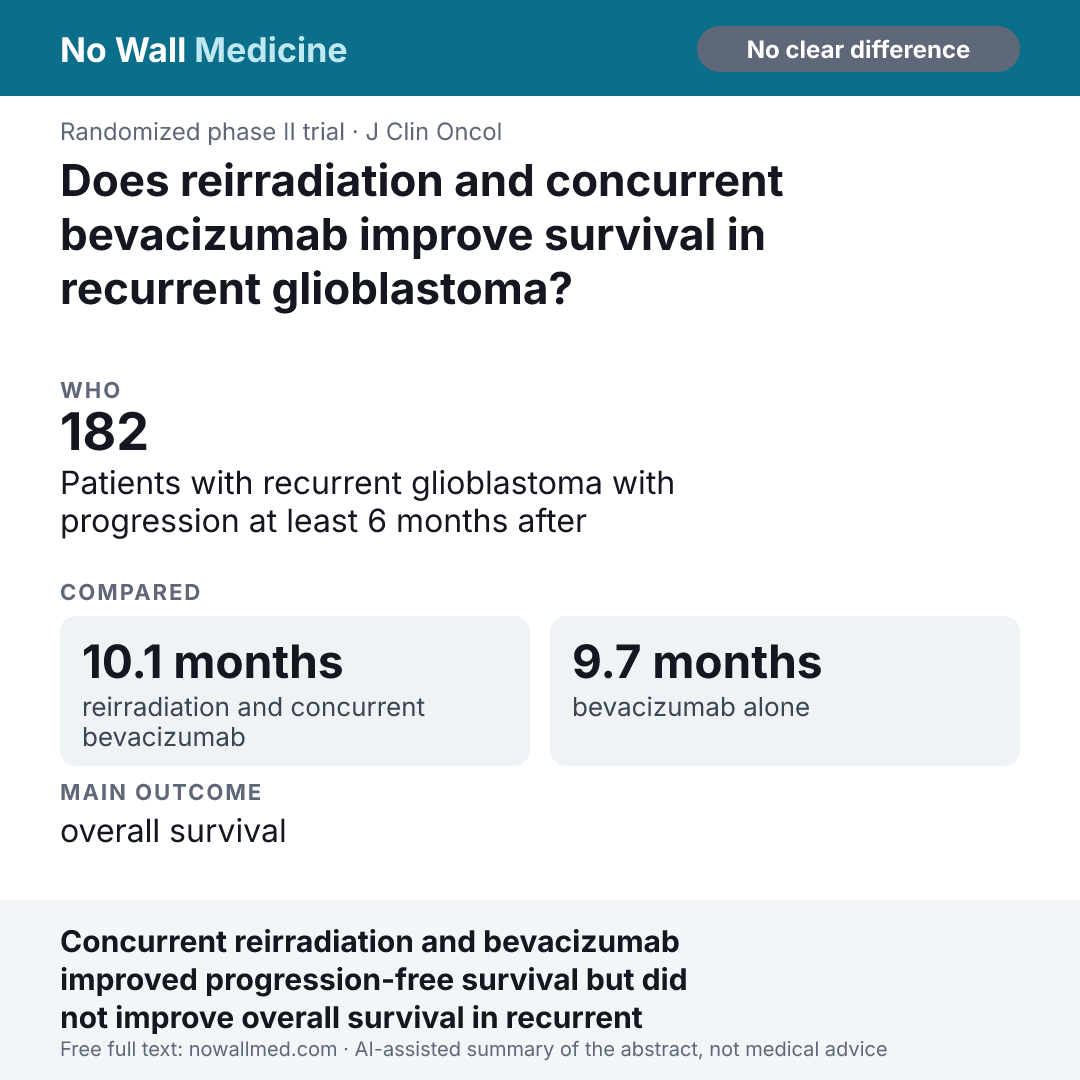
Does reirradiation and concurrent bevacizumab improve survival in recurrent glioblastoma?
Who
182
Patients with recurrent glioblastoma with progression at least 6 months after chemo-radiotherapy · multi-institutional
Compared
10.1 monthsreirradiation and concurrent bevacizumab
9.7 monthsbevacizumab alone
Main outcome
overall survival
Result: hazard ratio 0.98; 80% CI, 0.79 to 1.23
Bottom line: Concurrent reirradiation and bevacizumab improved progression-free survival but did not improve overall survival in recurrent glioblastoma.
J Clin Oncol · 2022-10-19 · Save PNG
Key points
- Researchers studied 170 patients with recurrent glioblastoma to compare adding radiation therapy to bevacizumab versus using bevacizumab alone.
- The combination of radiation and bevacizumab showed no difference in overall survival, with a median of 10.1 months versus 9.7 months.
- The 6-month progression-free survival rate was 54.3% for the combination group compared to 29.1% for bevacizumab alone.
Discussion prompts
- Would these patients look like yours? Who was left out?
- Is the main outcome one that matters to patients?
- Is the difference large enough to change what you do?
Cite: Tsien CI, Pugh SL, Dicker AP, et al. NRG Oncology/RTOG1205: A Randomized Phase II Trial of Concurrent Bevacizumab and Reirradiation Versus Bevacizumab Alone as Treatment for Recurrent Glioblastoma. J Clin Oncol. 2023;41(6):1285-1295. doi:10.1200/JCO.22.00164
Free full text: PubMed Central · Summary and visual abstract: nowallmed.com/a/nrg-oncology-rtog1205-a-randomized-phase-ii-trial-of-concurrent-1ssgt0v/ (AI-assisted from the abstract; check the paper before relying on it).