Nudge-based behavioral interventions increased tablet use among older adults in a Japanese retirement community
Nudge-Based Interventions on Health Promotion Activity Among Very Old People: A Pragmatic, 2-Arm, Participant-Blinded Randomized Controlled Trial
Two-arm, participant-blinded randomized controlled trialBenefit found
Do nudge-based behavioral interventions increase health-promoting tablet activity among very old people?
Who
99
Japanese continuing care retirement community residents · Japan
Compared
Intervention group: significantly higher rate ratios in the second and third periods
Control group
Main outcome
mean daily tablet activity every 4 weeks
Bottom line: Nudge-based interventions can effectively promote health-promoting activities for older adults, especially older men.
J Am Med Dir Assoc · 2022-12-15Download image
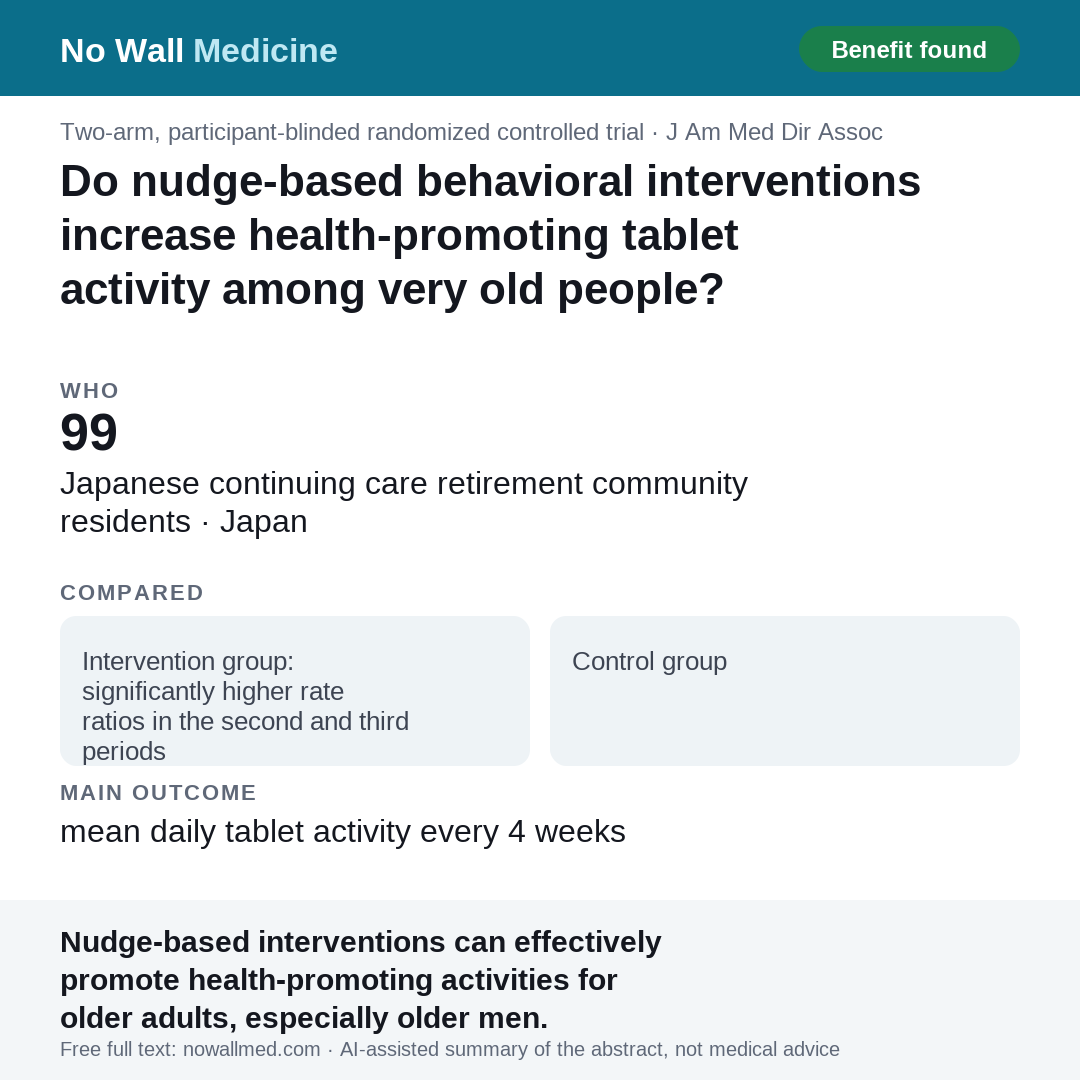
Clinical question: Do nudge-based behavioral interventions increase health-promoting tablet activity among very old people?
Why it matters: It was unknown if nudge-based behavioral interventions could effectively promote health-promoting activities among very old people during periods of social distancing.
Key points
- The study randomized 99 residents of a continuing care retirement community in Japan, with a median age of 82 years and 73% women.
- The intervention group, which received a loss-emphasized nudge and follow-up questions, showed significantly higher rate ratios for tablet use during the second and third 4-week periods.
- Subgroup analysis indicated that the observed effects were largely attributable to men.
Headline and key points written with AI from the paper’s abstract, with every number checked against it. Read the paper before relying on them.
Was this summary helpful?
Subject terms
Cite this article
Yamada Y, Uchida T, Sasaki S, Taguri M, Shiose T, Ikenoue T. Nudge-Based Interventions on Health Promotion Activity Among Very Old People: A Pragmatic, 2-Arm, Participant-Blinded Randomized Controlled Trial. J Am Med Dir Assoc. 2022. doi:10.1016/j.jamda.2022.11.009
Spotted a mistake? Suggest a correction
Top studies every Monday
The week’s key trials and guidelines in your specialties, plus any topics you follow. By email, free.
Get the weekly digest