Homestead food production programme reduced odds of depressive symptoms among women in rural Bangladesh
Nutrition-sensitive agriculture programme impacts women's mental health via food security in rural Bangladesh
Cluster-randomised trialBenefit found
Does a homestead food production programme impact women's mental health in rural Bangladesh?
Who
2513
2513 women in northeastern Bangladesh settlements · Northeastern Bangladesh
Compared
32%Homestead food production programme (EPDS≥12)
38%Control (EPDS≥12)
Main outcome
Depressive symptoms assessed using Edinburgh Postpartum Depression Scale
Result: odds ratio 0.77 (p=0.03)
Bottom line: A homestead food production programme reduced the odds of depressive symptoms in women, partially mediated by food security.
BMJ Glob Health · 2026-05-05Download image
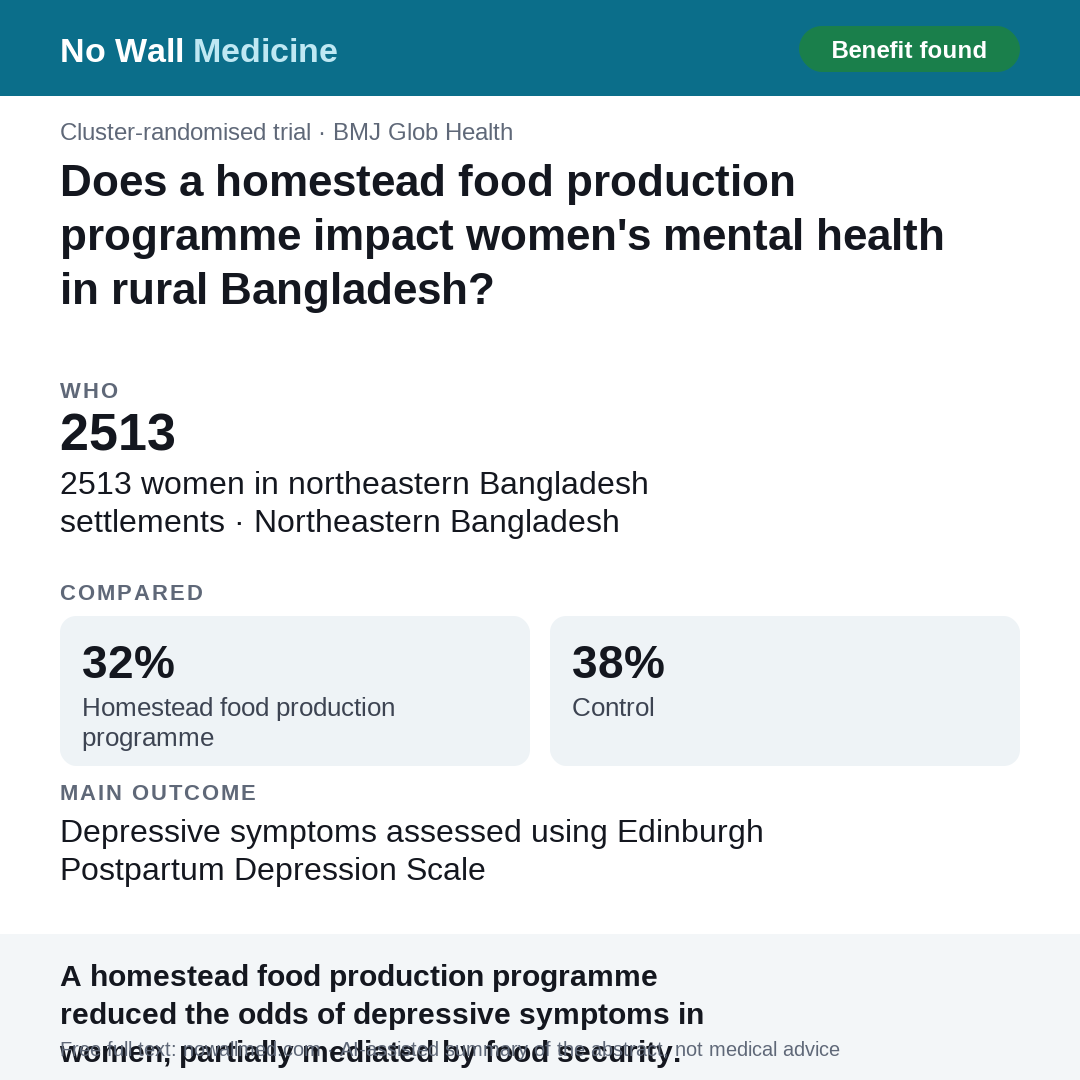
Clinical question: Does a homestead food production programme impact women's mental health in rural Bangladesh?
Why it matters: Food insecurity, malnutrition, and poor mental health can reinforce each other and are often compounded by gender inequity.
In absolute numbers
Homestead food production programme: 32% · Control: 38% → a difference of 6 percentage points, so about 17 people would need the treatment for 1 more to benefit (number needed to treat) over the trial’s follow-up.
Worked out by us from the two group results above, not reported by the authors. Check the paper for the exact outcome and timing.
Key points
- Researchers conducted a cluster-randomised trial involving 2513 women in northeastern Bangladesh to compare a homestead food production programme against a control group.
- The intervention reduced the odds of depressive symptoms by 23% (OR 0.77, p=0.03) compared to the control group at endline.
- Food security accounted for one-third of the total effect on depression (OR 0.92, p=0.01), though the combined pathway was not statistically significant (OR 0.95, p=0.24).
Headline and key points written with AI from the paper’s abstract, with every number checked against it. Read the paper before relying on them.
Abstract
Introduction
Food insecurity and malnutrition, as well as poor mental health, negatively impact millions of people worldwide and can reinforce each other, compounded by gender inequity. Nutrition-sensitive agriculture interventions have the potential to improve these simultaneously. We analysed the impact of a homestead food production (HFP) programme on women's mental health, including pathways through food insecurity, women's empowerment and dietary diversity. Methods
The Food and Agricultural Approaches to Malnutrition cluster-randomised trial allocated 96 settlements in northeastern Bangladesh 1:1 to a HFP programme, implemented 2015-2018, and control. Data were collected at baseline in 2015, at endline in 2019/20 and continuously through a surveillance system. Depressive symptoms were assessed using the Edinburgh Postpartum Depression Scale (EPDS). We quantified the intervention's impact on depressive symptoms at endline, analysing data from 2513 women using multilevel regression. We also examined whether that effect was mediated by household food security, women's empowerment and women's dietary diversity, using sequential mediation analysis with cluster-bootstrapped standard errors, adjusting for baseline covariates. Results
At baseline, 39% of households were severely food insecure and 69% of women did not have minimally diverse diets. At endline, 38% of women in the control and 32% in the intervention arm screened positive for depressive symptoms (EPDS≥12). The intervention reduced the odds of depressive symptoms by 23% (OR 0.77, p=0.03). There was no evidence that the combined pathway reduced depression (OR 0.95, p=0.24). When decomposed, food security was responsible for one-third of the total effect (OR 0.92, p=0.01). Most of the intervention effect on depression was through other pathways (OR 0.81, p=0.08). Conclusions
On average, intervention participants had better mental health 1 year after the programme ended, with some of the effect mediated by increased food security. There are likely other pathways through which nutrition-sensitive agriculture can improve mental health, such as social protection and income, which may act synergistically. Trial registration number
NCT02505711.
Abstract reproduced under the article’s CC BY licence.
Topics
Cite this article
Sparling TM, Cornejo C, Offner C, Mayer A, Waid JL, Kadiyala S. Nutrition-sensitive agriculture programme impacts women's mental health via food security in rural Bangladesh. BMJ Glob Health. 2026. doi:10.1136/bmjgh-2025-020509
Spotted a mistake? Suggest a correction