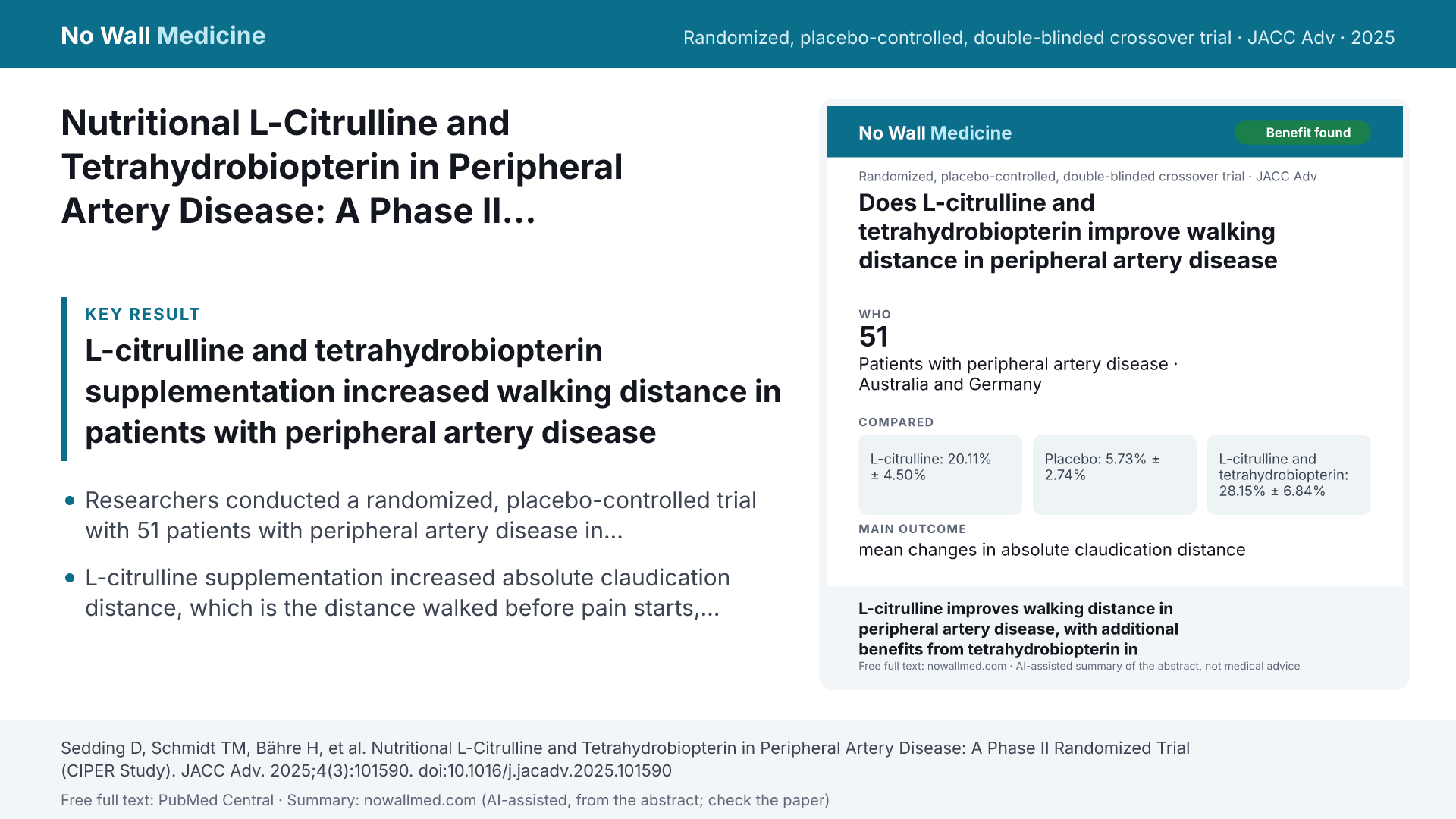
L-citrulline and tetrahydrobiopterin supplementation increased walking distance in patients with peripheral artery disease
Nutritional L-Citrulline and Tetrahydrobiopterin in Peripheral Artery Disease: A Phase II Randomized Trial (CIPER Study)
Randomized, placebo-controlled, double-blinded crossover trialBenefit found
Does L-citrulline and tetrahydrobiopterin improve walking distance in peripheral artery disease patients?
Who
51
Patients with peripheral artery disease · Australia and Germany
Compared
L-citrulline: 20.11% ± 4.50%
Placebo: 5.73% ± 2.74%
L-citrulline and tetrahydrobiopterin: 28.15% ± 6.84%
Main outcome
mean changes in absolute claudication distance
Bottom line: L-citrulline improves walking distance in peripheral artery disease, with additional benefits from tetrahydrobiopterin in patients with pathological ADMA levels.
Limitation: warranting further confirmatory trials
JACC Adv · 2025-02-21 · Save PNG
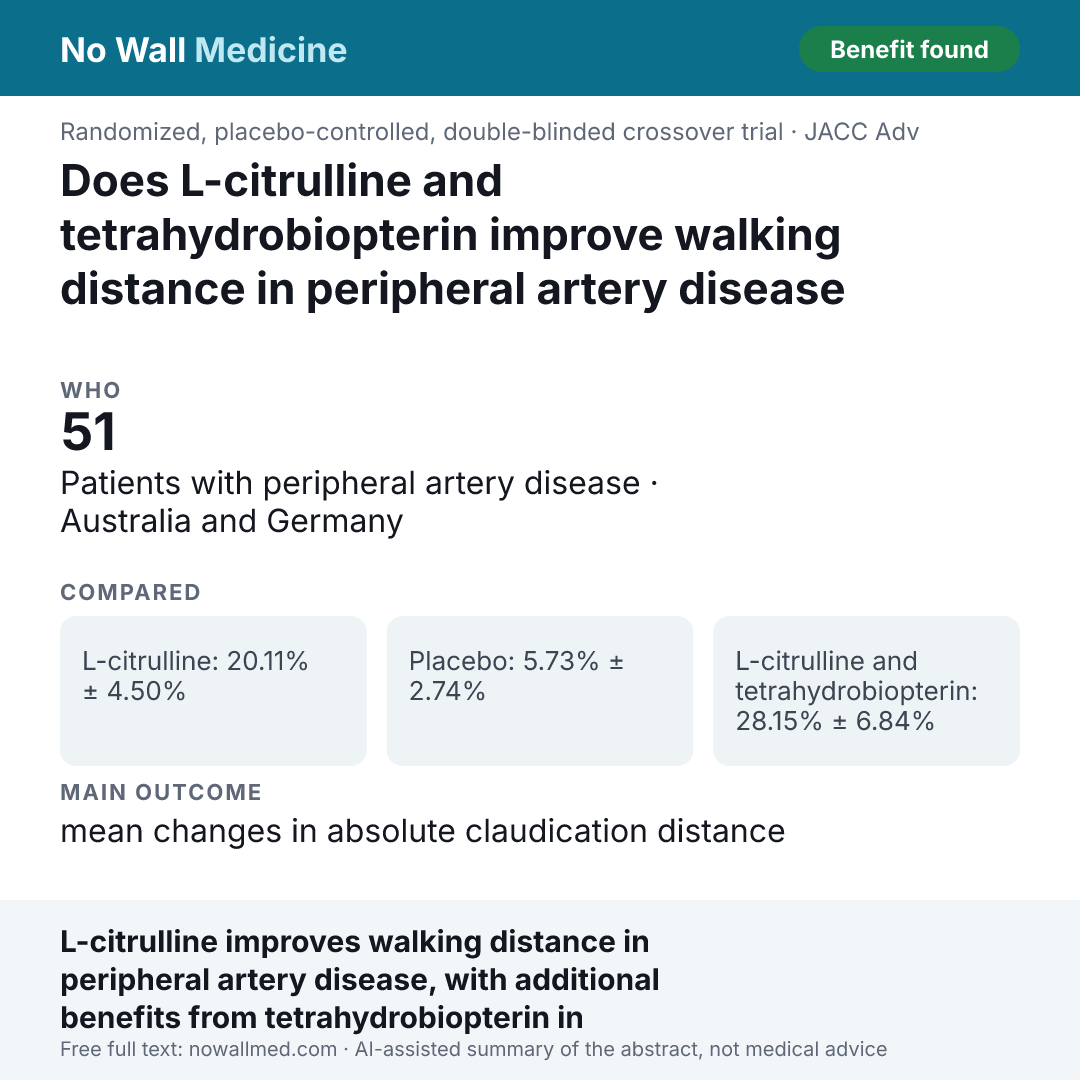
Clinical question: Does L-citrulline and tetrahydrobiopterin improve walking distance in peripheral artery disease patients?
Why it matters: Pharmacological interventions for peripheral artery disease are limited, and the effect of L-citrulline and tetrahydrobiopterin on walking distance remains to be determined.
Key points
- Researchers conducted a randomized, placebo-controlled trial with 51 patients with peripheral artery disease in Australia and Germany.
- L-citrulline supplementation increased absolute claudication distance, which is the distance walked before pain starts, by 20.11% ± 4.50% compared to 5.73% ± 2.74% for placebo.
- Adding tetrahydrobiopterin increased the mean percentage distance to 28.15% ± 6.84% specifically in patients with pathological levels of asymmetric dimethyl L-arginine.
Headline and key points written with AI from the paper’s abstract, with every number checked against it. Read the paper before relying on them.
Was this summary helpful?
Headline, design, result, key points, caveat and citation as plain text.
Cite this article
Sedding D, Schmidt TM, Bähre H, et al. Nutritional L-Citrulline and Tetrahydrobiopterin in Peripheral Artery Disease: A Phase II Randomized Trial (CIPER Study). JACC Adv. 2025;4(3):101590. doi:10.1016/j.jacadv.2025.101590
Spotted a mistake? Suggest a correction