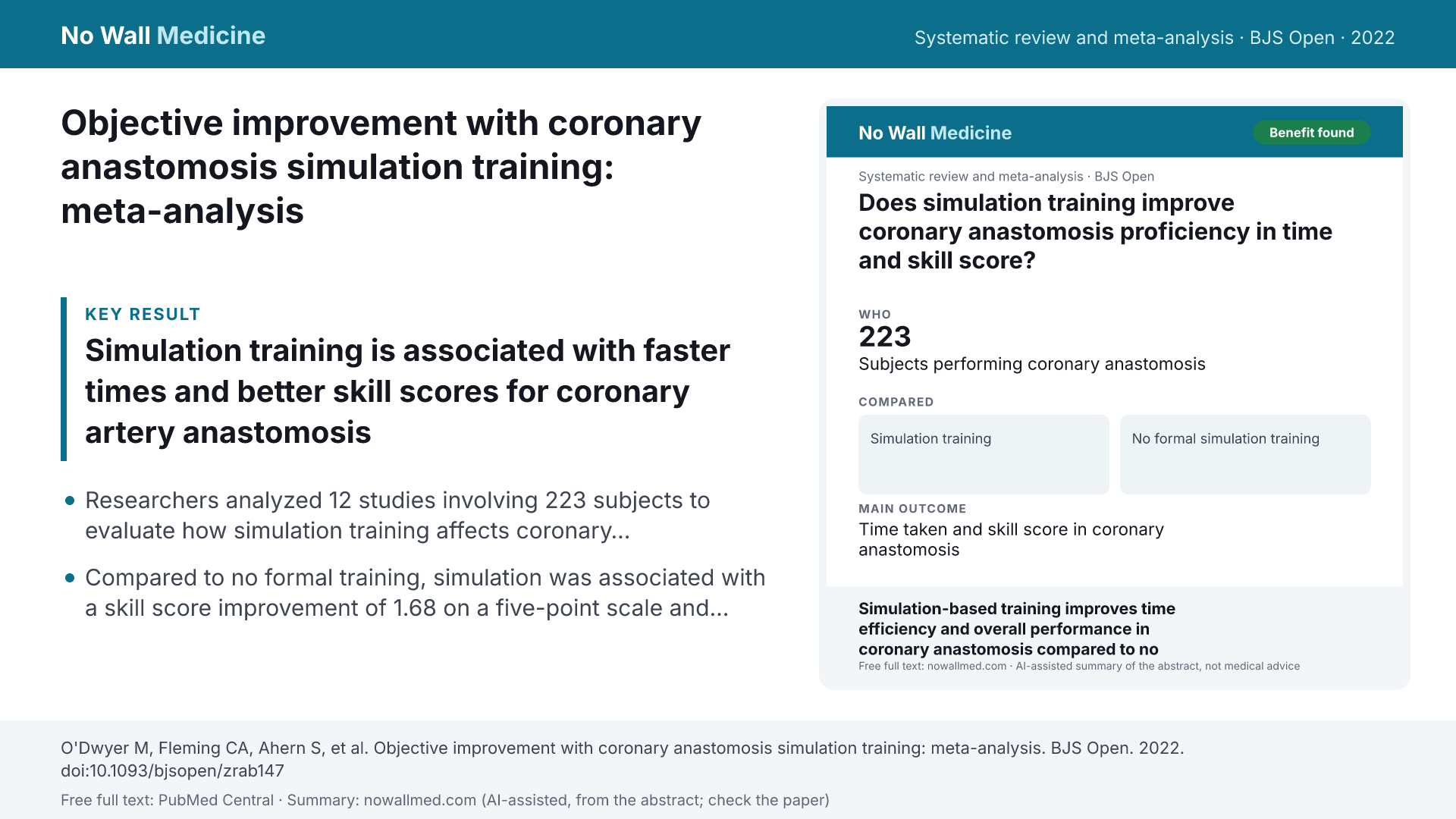
Simulation training is associated with faster times and better skill scores for coronary artery anastomosis
Objective improvement with coronary anastomosis simulation training: meta-analysis
Systematic review and meta-analysisBenefit found
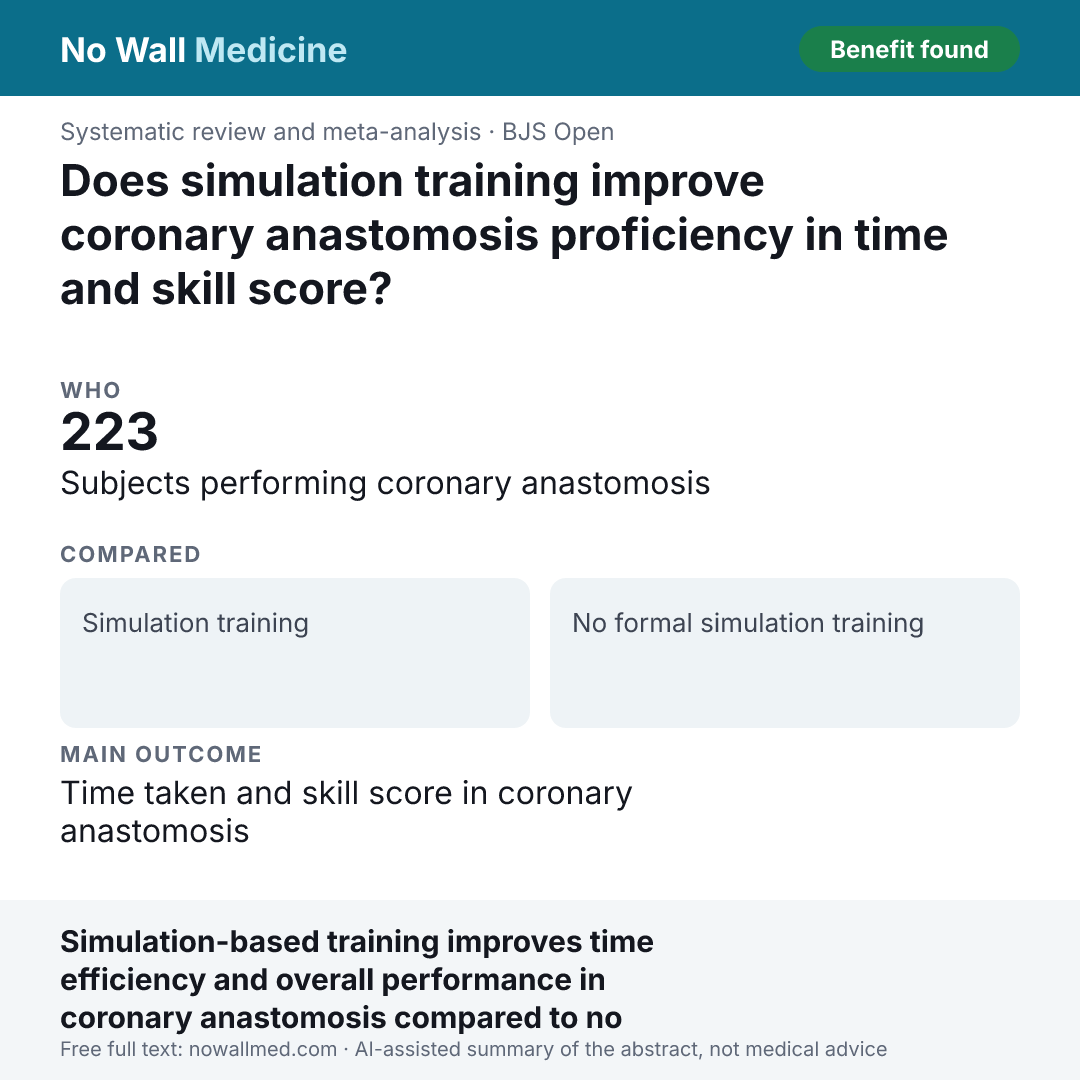
Does simulation training improve coronary anastomosis proficiency in time and skill score?
Who
223
Subjects performing coronary anastomosis
Compared
Simulation training
No formal simulation training
Main outcome
Time taken and skill score in coronary anastomosis
Result: standardized mean difference 1.68 (95 per cent c.i. 1.23 to 2.13); mean difference 205.9 s (95 per cent c.i. 133.62 to 278.18)
Bottom line: Simulation-based training improves time efficiency and overall performance in coronary anastomosis compared to no intervention.
BJS Open · 2022-02-10 · Save PNG
Clinical question: Does simulation training improve coronary anastomosis proficiency in time and skill score?
Key points
- Researchers analyzed 12 studies involving 223 subjects to evaluate how simulation training affects coronary artery anastomosis, which is the surgical connection of two blood vessels.
- Compared to no formal training, simulation was associated with a skill score improvement of 1.68 on a five-point scale and a time difference of 205.9 s.
- Novice cardiothoracic surgeons showed a 293 s improvement in time, while senior cardiothoracic surgeons showed a 120 s improvement.
Headline and key points written with AI from the paper’s abstract, with every number checked against it. Read the paper before relying on them.
Was this summary helpful?
Subject terms
Headline, design, result, key points, caveat and citation as plain text.
Cite this article
O'Dwyer M, Fleming CA, Ahern S, et al. Objective improvement with coronary anastomosis simulation training: meta-analysis. BJS Open. 2022. doi:10.1093/bjsopen/zrab147
Spotted a mistake? Suggest a correction